mbeva
mbeva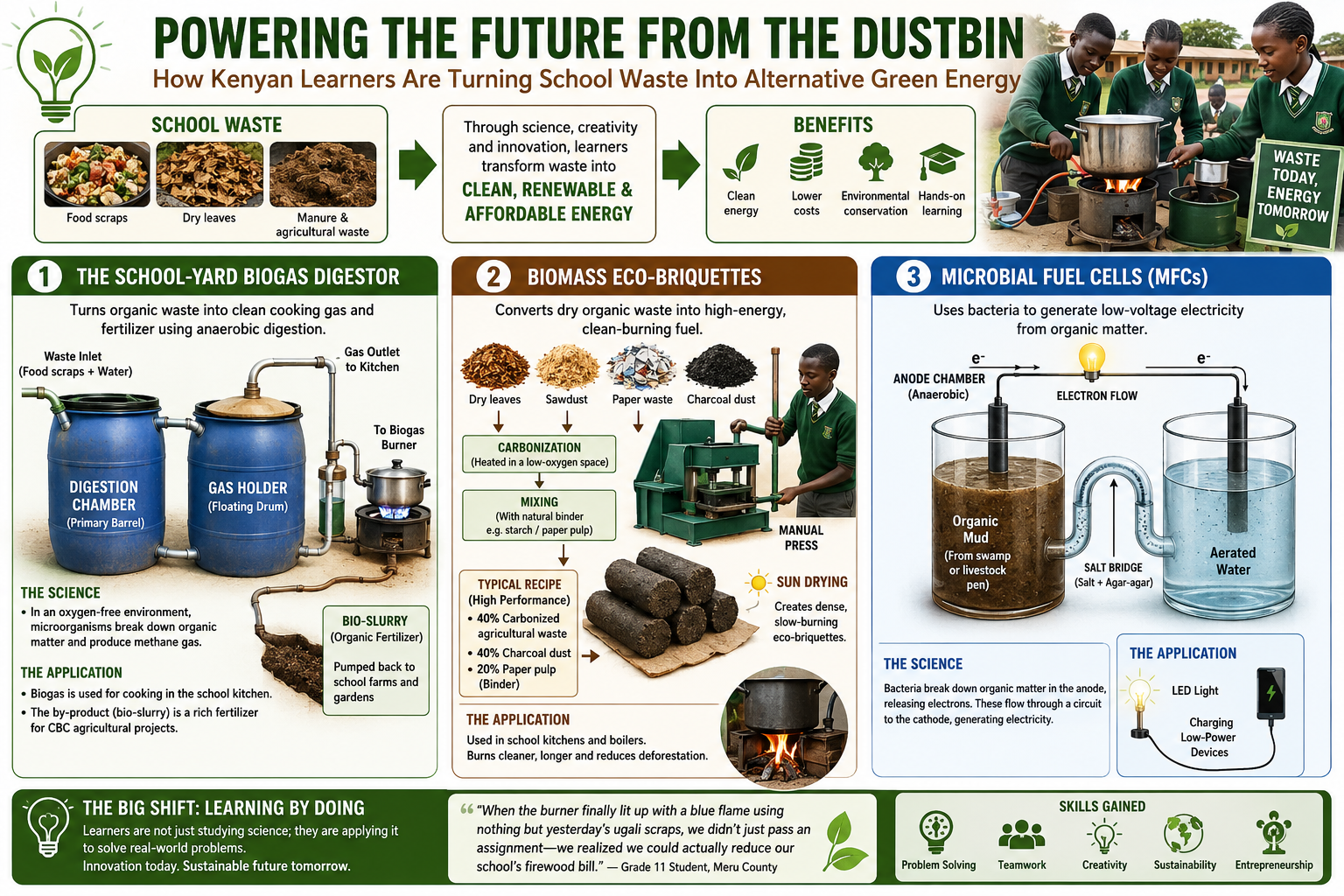
Powering the Future from the Dustbin
Walk behind the kitchen or near the agricultural plots of a modern Kenyan school, and you will likely encounter a strange sight: large plastic barrels connected by intricate PVC piping, or meticulously layered compost pits managed entirely by students.
Under Kenya’s Competency-Based Curriculum (CBC) and Competency-Based Education (CBE) frameworks, the traditional concept of “school waste” is being completely turned on its head. What used to be thrown away—food scraps from the dining hall, dry leaves from the school yard, and manure from agricultural projects—is now being viewed as a goldmine for scientific innovation.
Across the country, Junior and Senior School learners are engineering Alternative Green Energy Systems. By applying practical physics, chemistry, and biology, these students are proving that school waste can be harvested to generate clean power, reducing both environmental footprints and institutional running costs.
The Waste Crisis vs. The Energy Demand
Managing waste and keeping up with energy costs are two massive hurdles for schools across Kenya. Large boarding institutions produce hundreds of kilograms of organic waste daily from kitchens and agricultural patches, which usually ends up in overloaded compost pits or local dumps. At the same time, schools face high recurring expenses for firewood, cooking gas (LPG), and grid electricity.
Faced with these overlapping challenges, STEM pathway students have stepped up. They are designing circular-economy solutions that transform daily school waste into reliable, renewable, and incredibly affordable green energy.
The Three Core Green Energy Innovations Trending in Schools
Through collaboration and creative design, learners are focusing on three main alternative energy systems that can be built using cheap, locally sourced materials:
1. The School-Yard Biogas Digestor
The most popular innovation on school grounds is the low-cost, portable biogas digestor. Students use large, airtight plastic drums or underground tanks to create an anaerobic (oxygen-free) environment.
- The Science: Kitchen food waste and agricultural runoff are mixed with water and fed into the digestor. Microorganisms break down this organic matter, releasing methane gas.
- The Custom Framework: In school configurations, a dual-barrel system is often deployed. The first barrel serves as the primary digestion chamber where acidification and methanogenesis occur. The second barrel acts as a floating-drum gas holder that rises and falls to provide a visual indicator of gas pressure.
- The Application: The methane is captured through flexible PVC pipes, routed through simple water-trap filters to remove moisture, and channeled directly into the school kitchen to power specialized gas burners. The byproduct left behind in the tank is a nutrient-rich bio-slurry, which the students pump back into their CBC agricultural plots as premium organic fertilizer.
2. Biomass Eco-Briquettes
To combat the heavy reliance on firewood and charcoal—which contributes to regional deforestation—learners are mastering the art of biomass compaction.
- The Science: Students collect dry leaves, paper waste from classrooms, sawdust, and charcoal dust from kitchen hearths. They carbonize the dry organic material, mix it with a natural binder like starch or wet paper pulp, and feed it into student-fabricated manual wooden presses.
- The Material Matrix: Students experiment with different ratios to find the optimal burn rate. A typical high-performance student recipe blends 40% carbonized agricultural waste, 40% charcoal dust, and 20% shredded paper pulp acting as the binding agent.
- The Application: The compressed blocks are sun-dried to create dense, slow-burning eco-briquettes. These briquettes burn cleaner and longer than traditional charcoal, giving schools a completely free fuel source for heavy kitchen boilers.
3. Microbial Fuel Cells (MFCs)
In advanced Senior School STEM tracks, students are bridging chemistry and electricity by experimenting with biological batteries known as Microbial Fuel Cells.
- The Science: Students construct dual-chamber cells using plastic bottles, mud rich in anaerobic bacteria from school swamps or livestock pens, and simple carbon electrodes. The naturally occurring bacteria break down organic nutrients in the mud, freeing up electrons in the process.
- The Circuit Architecture: The anode chamber is packed with organic mud and sealed to remain anaerobic, while the cathode chamber contains aerated water. Students bridge the two using a homemade salt bridge (constructed from salt and agar-agar in a plastic tube) to allow proton transfer.
- The Application: By routing these electrons through a basic circuit, students generate low-voltage electricity. While it isn’t enough to power a whole building yet, these student-built mud batteries are successfully powering small LED classroom lights and charging low-consumption digital devices.
The Big Shift: Redefining Academic Success
This green energy boom perfectly mirrors the fundamental shift in Kenya’s educational philosophy. In the past, a student would memorize the definition of “anaerobic respiration” or “chemical potential energy” purely to pass a national examination, rarely seeing how those concepts applied to real life.
“Our first biogas prototype leaked, and the gas pressure was too low to light a flame. We had to study gas laws and seal every pipe joint with local resins. When the burner finally lit up with a blue flame using nothing but yesterday’s ugali scraps, we didn’t just pass an assignment—we realized we could actually reduce our school’s firewood bill.” — Grade 11 Senior School Student, Meru County
Under CBE, the focus has moved entirely away from rote learning to practical problem-solving, teamwork, resourcefulness, and ecological intelligence. Students are graded on how well they troubleshoot system failures, calculate energy outputs, and safely handle biological materials.
Moving from the Lab to the Community
What makes these green energy systems so profound is their scalability. The technologies being built in school backyards are directly translatable to rural homesteads and local markets. By demonstrating that agricultural waste and food scraps can replace expensive fuels, these students are acting as grassroots ambassadors for climate-smart technologies.
Kenya’s classrooms are proving that innovation doesn’t require a massive corporate budget. With a few plastic barrels, discarded pipes, and a solid understanding of science, the next generation is successfully fueling a cleaner, greener tomorrow.