mbeva
mbeva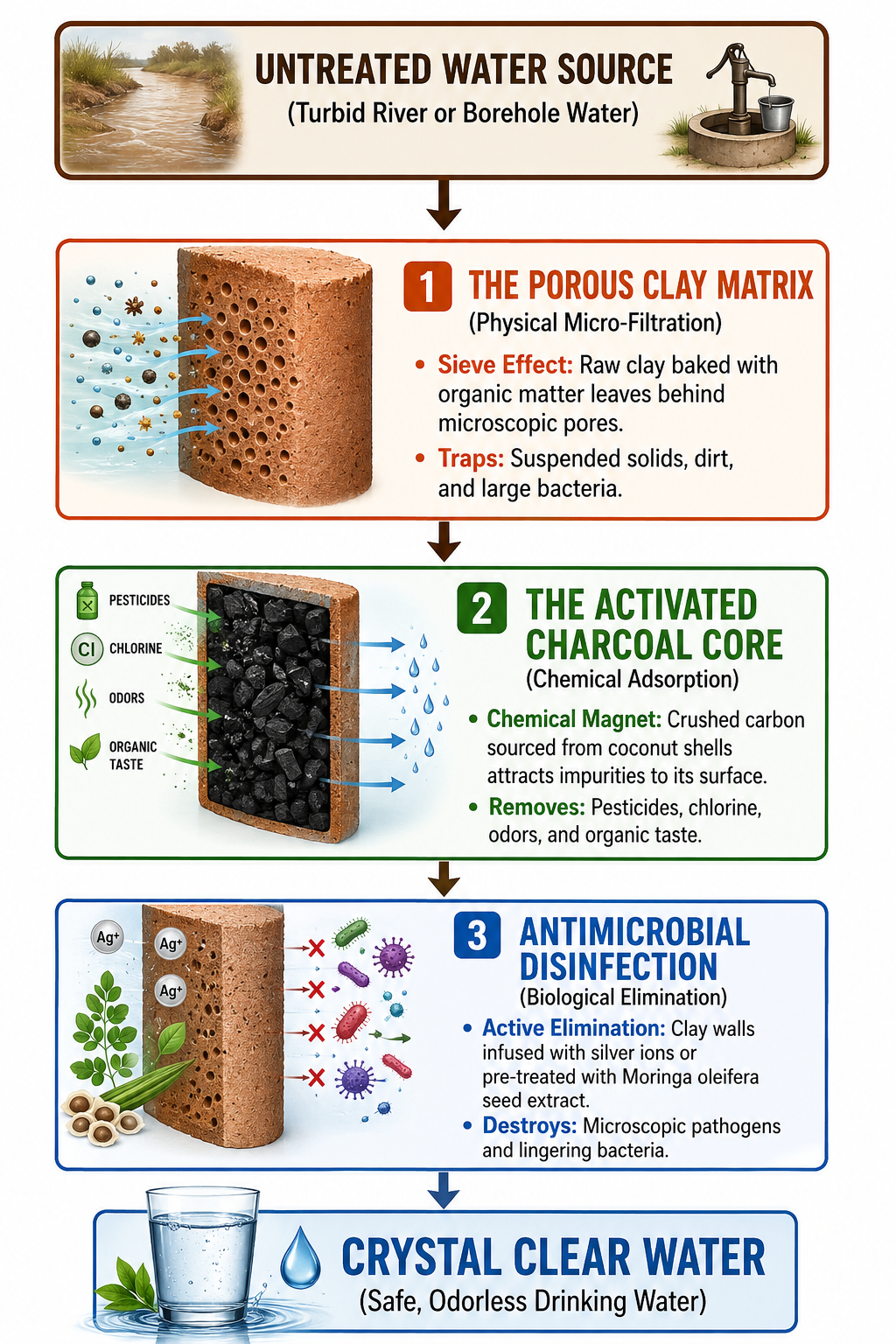
Clean Water Innovation.
The traditional science laboratory in a Kenyan school is undergoing a radical transformation. For decades, the subject was defined by rows of expensive, imported glass beakers, strict warnings not to touch delicate equipment, and abstract formulas scribbled on a chalkboard to be memorized for a terminal exam.
Today, under the nationwide rollout of the Competency-Based Curriculum (CBC) and Competency-Based Education (CBE) frameworks, the classroom has expanded far beyond four walls. The community itself has become the ultimate laboratory.
Nowhere is this shift more evident than in the wave of student-led science projects tackling deep-rooted societal challenges. A standout innovation gripping the attention of educators, environmentalists, and public health officials alike is a brilliant, low-cost solution coming straight from Junior and Senior School learners: Affordable Clay-Based Water Purification Filters.
By blending readily available traditional materials with core scientific principles, these young innovators are proving that a school does not need a multi-million-shilling facility to produce impactful, life-saving technology.
The Core Challenge: Meeting a Critical Grassroots Need
Access to clean, safe drinking water remains a pressing challenge in many rural, arid, and peri-urban communities across Kenya. Waterborne diseases such as cholera, typhoid, and amoebiasis routinely disrupt learning and strain family resources. While commercial ceramic filters, reverse-osmosis systems, and chemical treatments exist in the retail market, their high costs, reliance on electricity, and irregular distribution chains make them entirely impractical for low-income households.
Faced with this reality during their integrated science, environmental, and chemistry strands, Kenyan learners across various counties asked a fundamental, practical question: How can we use locally available, affordable materials to make contaminated river and borehole water safe for human consumption?
The answer lay right beneath their feet—ordinary, indigenous clay.
The Science Inside the Clay Filter Innovation
The brilliance of the student-designed clay filter lies in its sophisticated integration of biology, physics, and chemistry. Learners are not simply molding pottery; they are manipulating materials at a structural level to engineer a multi-stage filtration system.
Through collaboration with local potters and the use of basic school workshops, students have standardized a meticulous production process:
1. The Porous Clay Matrix (Physical Micro-Filtration)
Students harvest raw clay from local riverbeds and combine it with finely sifted organic combustibles, such as sawdust, spent coffee husks, or discarded rice hulls. The mixture is thoroughly kneaded, molded into a pot or disk shape, and allowed to dry.
When the molded filter is fired in a traditional kiln or localized furnace at precise temperatures, the embedded organic matter burns away completely. This leaves behind a microscopic network of tortuous pores within the ceramic walls. These micro-pores act as a physical sieve, effectively trapping suspended solids, turbidity, cysts, and large bacterial pathogens.
2. The Activated Charcoal Core (Chemical Adsorption)
To address chemical impurities that a physical sieve cannot catch, learners manufacture their own activated carbon by burning coconut shells or wood scraps in a low-oxygen environment, followed by chemical or thermal activation.
This crushed charcoal is packed tightly as an internal layer or mixed directly into the core matrix. Through the process of chemical adsorption, the highly porous charcoal acts like a chemical magnet, drawing in and trapping dissolved organic pollutants, pesticides, chlorine residues, and unpleasant volatile organic compounds, which instantly improves the water’s taste and odor.
3. Natural Antimicrobial Enhancements (Biological Disinfection)
In more advanced Senior School STEM pathway projects, students are pushing the boundaries of traditional pottery by experimenting with natural disinfection. Recognizing that some microscopic bacteria can still slip through clay pores, learners are infusing their filters with minute, non-toxic amounts of colloidal silver.
Alternatively, some student groups are utilizing extracts from the seeds of Moringa oleifera (a locally abundant tree known for its natural coagulant and antimicrobial properties) to treat the water before or during the filtration process, neutralizing harmful micro-organisms on contact.
The Big Shift: From Memorizing Facts to Solving Problems
This clay filter movement perfectly encapsulates the profound psychological and pedagogical shift occurring in Kenya’s education sector. Under the old 8-4-4 system, a student might have simply memorized the textbook definitions of “sedimentation,” “filtration,” and “adsorption” to score a straight ‘A’ on a written paper, only to forget the concepts immediately after graduation.
“When we were testing our first filter prototype with dirty water from the local stream, the water came out cloudy. We realized our clay-to-sawdust ratio was completely wrong. We had to go back to our chemistry and physics notes, recalculate the volumes, and try firing the clay again. Seeing the water finally turn crystal clear because we solved the problem ourselves made me realize that science isn’t a book—it’s a tool to change lives.” — Grade 10 STEM Pathway Student, Kisumu County
Under the Competency-Based Education model, the metrics of academic success have been completely rewritten. Students are evaluated on core competencies: critical thinking, problem-solving, collaboration, peer leadership, and the ability to iterate on a failed design. They learn resourcefulness by sourcing clay locally, negotiation by engaging local artisans to understand kiln temperatures, and data literacy by using basic water testing kits to measure pH and bacterial levels before and after filtration.
Scaling the Innovation: Classroom to Community
What started as a graded practical assessment is rapidly showing potential for broader socio-economic impact. In several sub-counties, forward-thinking schools are organizing community exhibition days where students showcase their working prototypes and distribute these affordable filters to local families.
Because these clay-based systems require absolutely zero electricity, utilize 100% locally sourced materials, and can be produced for a fraction of the cost of commercial alternatives, they represent a highly scalable and sustainable model for grassroots public health.
The message echoing out of Kenya’s classrooms is clear: the next generation of African innovators, engineers, and scientists is not waiting for university degrees or corporate funding to start transforming the continent. They are starting right now, in their school yards, one clay filter at a time.