mbeva
mbeva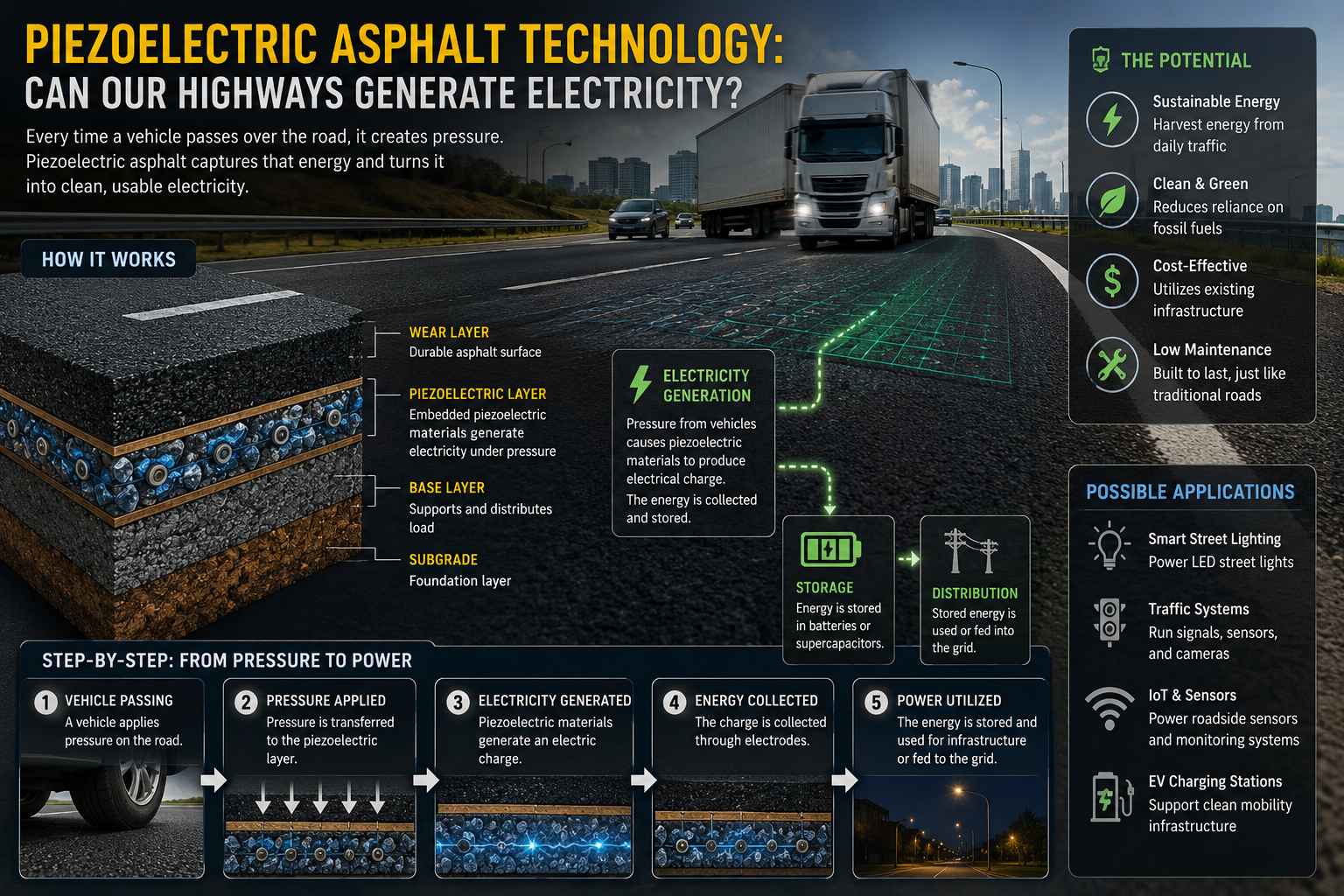
Piezoelectric Asphalt Technology
Imagine driving down a highway where every car, truck, and motorcycle passing over the road helps power the streetlights overhead, the traffic signals ahead, and the nearby smart grid. As cities seek sustainable, decentralized green energy solutions, traffic-dominated roadways are being viewed as massive, untapped goldmines of kinetic energy.
This is the promise of piezoelectric asphalt technology—an emerging smart infrastructure innovation that embeds energy-harvesting materials directly into our road surfaces.
But how does it actually work? How can tiny crystals survive the crushing weight of a 40-ton semi-truck without shattering, and can these roads really generate enough electricity to be viable? Let’s dive into the material science, structural engineering, and real-world feasibility of kinetic highways.
The Science Behind the Surface: What is the Piezoelectric Effect?
To understand kinetic roads, we have to start at the molecular level. The word “piezo” comes from the Greek word for pressure. In material science, the piezoelectric effect describes the ability of certain materials to generate an electric charge when subjected to mechanical stress or vibration.
When a vehicle drives over a road, its weight applies a massive downward mechanical force. In a standard road, this energy is wasted as heat and structural vibration.
However, when piezoelectric materials are embedded in the road matrix:
- The physical weight of the vehicle deforms the internal crystal lattice of the material.
- This shifting distortion causes positive and negative ions within the material to move closer together or farther apart, creating an electrical dipole moment.
- This displacement creates a voltage difference across the material, generating a clean electrical current that can be captured, stored, and redirected.
Once the tire passes, the material relaxes, returning to its original shape and generating a secondary electrical pulse in the opposite direction.
Material Selection: Crystals vs. Ceramics in Road Design
Engineers cannot simply throw any smart material into an asphalt mixer. Highways are brutal environments subject to extreme temperature fluctuations, chemical spills, moisture infiltration, and millions of cycles of crushing weight.
To withstand these conditions, researchers categorize piezoelectric road elements into two primary material types:
1. Piezoelectric Ceramics (Lead Zirconate Titanate – PZT)
PZT is the absolute gold standard for energy output. These synthetic ceramics possess an incredibly high piezoelectric coefficient, meaning they convert a very high percentage of mechanical stress into electrical energy.
- The Challenge: Ceramics are inherently brittle. If you place a raw ceramic disc directly under asphalt, the shear stress from heavy traffic will crack it within days.
2. Piezoelectric Polymers (PVDF)
Polyvinylidene Fluoride (PVDF) is a flexible, synthetic plastic material with piezoelectric properties. Because it is highly flexible, it easily integrates into flexible asphalt pavements without cracking.
- The Challenge: While durable, polymers have a significantly lower energy harvesting efficiency compared to rigid ceramics.
The Solution: Piezoelectric Composite Modules
To balance power output with long-term survival, modern smart infrastructure developers use composites. Tiny, high-efficiency ceramic PZT rods or particles are embedded inside a protective, high-strength epoxy or polymer matrix.
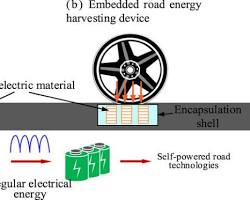
These components are housed inside rugged, waterproof, and pressure-resistant packaging capsules or “modules” that look like heavy-duty pucks or blocks.
Integrating Smart Modules into the Asphalt Matrix
One of the biggest hurdles facing piezoelectric asphalt technology is structural road safety. Civil engineers design roads to last 15 to 20 years. If adding energy harvesters creates weak spots, causes premature potholes, or accelerates asphalt cracking, the tech becomes a liability.
To prevent this, modules are integrated using two distinct installation methods:
Method A: The Layered Additive Approach (In-Situ Installation)
During new road construction or major resurfacing projects, the roadbed is built in layers:
- A base sub-grade layer is laid down.
- A grid array of packaged piezoelectric modules is anchored into place.
- The modules are wired together in a parallel-series electrical circuit configuration.
- The top wearing course of standard or modified asphalt concrete is poured and compacted directly over the grid.
Method B: Retrofitted Keyhole Installation
For existing highways, engineers core-drill precise holes into the top layers of the asphalt pavement, drop the encapsulated modules into place, route the wiring through narrow, sealed sub-surface channels to the shoulder, and fill the top with a high-strength binding grout.
Maintaining Roadway Integrity
To ensure the road behaves naturally, the protective casings of the piezo-modules must match the elastic modulus (stiffness) of the surrounding asphalt.
If the modules are too rigid, the surrounding asphalt will deform around them over time, causing bumps and localized structural failures. If they are too soft, they will absorb the impact without transferring enough stress to the inner crystals to generate maximum electricity.
Real-World Feasibility: Reality vs. Hype
Can our highways genuinely power our cities? The answer depends entirely on traffic density and vehicle weight.
A lightweight compact car passing over a single module generates a modest amount of milliwatts ($mW$). However, energy harvesting is a numbers game. When you scale this up to a multi-lane highway experiencing a high volume of heavy freight trucks traveling at 80-100 km/h, the numbers shift drastically.
| Metric | Estimated Performance Value |
| Energy Generation Per Vehicle | Approx. $1 \text{ to } 5 \text{ Joules}$ per module pass |
| Estimated Multi-Lane Highway Output | $100 \text{ to } 200 \text{ MWh}$ per kilometer annually (High Traffic) |
| Primary Power Applications | LED street lighting, traffic sensors, smart signs, EV charging stations |
While piezoelectric roads are unlikely to replace traditional renewable energy sources like commercial solar farms or wind turbines, they offer a massive advantage: space efficiency. They generate decentralized green energy directly inside existing urban infrastructure footprints without requiring extra land clearing.
The Road Ahead: Overcoming Key Challenges
While pilot projects have successfully rolled out across countries like Israel, California, Italy, and Japan, a few key roadblocks prevent widespread global adoption:
- High Initial Capital Cost: Manufacturing and wiring ruggedized smart road modules is significantly more expensive upfront than pouring standard gravel and asphalt.
- Wiring Complexities: Connecting thousands of sub-surface modules into a durable, moisture-sealed grid requires specialized civil engineering and electrical expertise.
- Energy Transmission Efficiency: Alternating current (AC) generated by traffic must be converted to direct current (DC) via sub-surface bridge rectifiers, smoothed out with large capacitors, and stepped up to higher voltages without experiencing major transmission losses along the roadside.
The Bottom Line
Piezoelectric asphalt technology proves that the future of renewable energy isn’t just above us in the sun and wind—it’s right beneath our feet. As material science creates tougher, more efficient piezo-composites and the cost of smart grid integration decreases, our highway networks may soon transition from passive transit routes into active, self-sustaining power plants.