mbeva
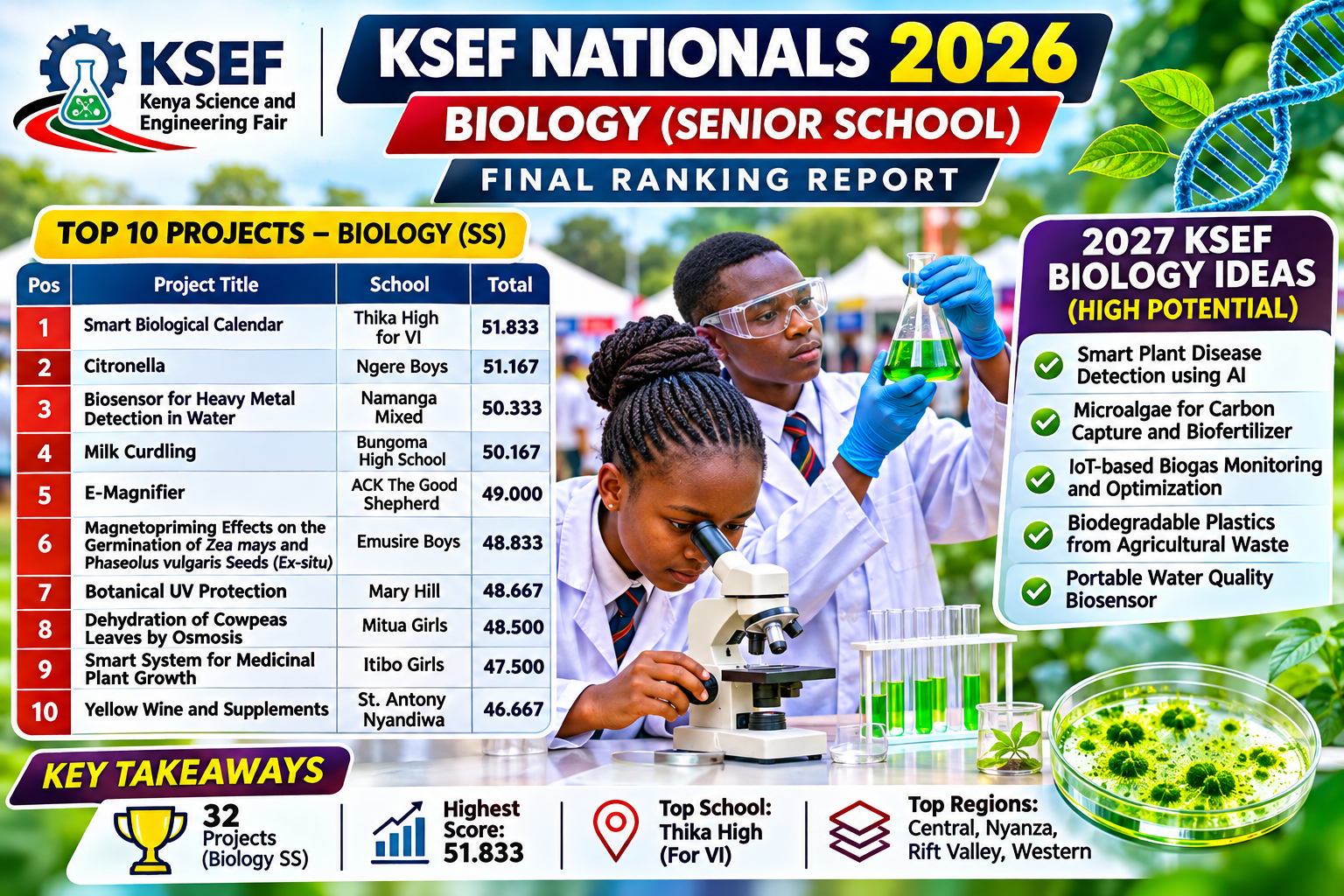
The 2026 Kenya Science and Engineering Fair (KSEF) Nationals Biology Senior School competition has showcased outstanding scientific creativity, with students presenting innovative projects addressing agriculture, healthcare, environmental conservation, biotechnology and biological research.
According to the official final ranking report, Thika High School for VI emerged as the national winner in Biology (Senior School) with its project titled Smart Biological Calendar, scoring 51.833 points.
Ngere Boys secured second position with Citronella, while Namanga Mixed took third place with an innovative biosensor designed for detecting heavy metals in water.
The competition featured 32 projects, demonstrating the growing contribution of Kenyan Senior School learners to scientific innovation and practical problem-solving.
For students and teachers preparing for KSEF Nationals 2027, the 2026 results provide important insights into the types of biological innovations that can attract attention at national level.
KSEF 2026 Biology Top 10 Projects and Schools
The following table presents the leading ten projects according to the official KSEF Nationals 2026 Biology Senior School final ranking report.
| Position | Project | School | Score |
|---|---|---|---|
| 1 | Smart Biological Calendar | Thika High for VI | 51.833 |
| 2 | Citronella | Ngere Boys | 51.167 |
| 3 | Biosensor for Heavy Metal Detection in Water | Namanga Mixed | 50.333 |
| 4 | Milk Curdling | Bungoma High School | 50.167 |
| 5 | E-Magnifier | ACK The Good Shepherd | 49.000 |
| 6 | Magnetopriming Effects on the Germination of Zea mays and Phaseolus vulgaris Seeds (Ex-situ) | Emusire Boys | 48.833 |
| 7 | Botanical UV Protection | Mary Hill | 48.667 |
| 8 | Dehydration of Cowpeas Leaves by Osmosis | Mitua Girls | 48.500 |
| 9 | Smart System for Medicinal Plant Growth | Itibo Girls | 47.500 |
| 10 | Yellow Wine and Supplements | St. Antony Nyandiwa | 46.667 |
Source: KSEF Nationals 2026 Biology (SS) Project Ranking Report – Final Totals Only.
Detailed Analysis of the Top 10 Biology Projects
1. Smart Biological Calendar – Thika High for VI
Thika High for VI claimed first position nationally with 51.833 points through its Smart Biological Calendar project.
The project demonstrates the potential of integrating biological knowledge with practical calendar-based applications.
Its national victory highlights the importance of developing projects that connect biological concepts with useful applications.
2. Citronella – Ngere Boys
Ngere Boys secured second position with 51.167 points through its Citronella project.
Citronella is associated with naturally occurring aromatic compounds and has applications in insect-repellent products.
The project provides an interesting example of how students can explore plant-based solutions to everyday challenges.
3. Biosensor for Heavy Metal Detection in Water – Namanga Mixed
Namanga Mixed secured third position with 50.333 points.
The project focused on developing a biosensor for detecting heavy metals in water.
Water contamination remains an important environmental and public health concern. Developing accessible detection technologies could contribute to safer water monitoring.
This project demonstrates the potential of combining biology, environmental science and sensor technology.
4. Milk Curdling – Bungoma High School
Bungoma High School achieved fourth position with 50.167 points.
Milk curdling is an important biological and food science process involving changes in milk proteins.
Students exploring this area can investigate factors affecting milk coagulation, including temperature, acidity and microbial activity.
5. E-Magnifier – ACK The Good Shepherd
ACK The Good Shepherd secured fifth position with 49.000 points.
The project, E-Magnifier, demonstrates an interesting approach to combining scientific observation and technology.
It also highlights opportunities for developing affordable learning devices that support biological investigations.
6. Magnetopriming Effects on Seed Germination – Emusire Boys
Emusire Boys secured sixth position with 48.833 points.
The project investigated the effects of magnetopriming on the germination of maize (Zea mays) and common bean (Phaseolus vulgaris) seeds under ex-situ conditions.
Seed germination is an important agricultural process, and investigating methods that may improve germination offers opportunities for practical agricultural research.
7. Botanical UV Protection – Mary Hill
Mary Hill achieved seventh position with 48.667 points.
The project explored botanical UV protection, an interesting area connecting plant science and the development of protective formulations.
Students interested in this field can investigate the potential of plant extracts in reducing ultraviolet exposure, while using appropriate experimental controls and validated measurements.
8. Dehydration of Cowpeas Leaves by Osmosis – Mitua Girls
Mitua Girls secured eighth position with 48.500 points.
The project investigated the dehydration of cowpea leaves through osmosis.
This research area has important connections to food preservation, post-harvest management and reducing agricultural losses.
9. Smart System for Medicinal Plant Growth – Itibo Girls
Itibo Girls achieved ninth position with 47.500 points.
The project explored the application of smart systems in medicinal plant cultivation.
This is an emerging area where biological knowledge can be combined with automated monitoring of environmental conditions.
10. Yellow Wine and Supplements – St. Antony Nyandiwa
St. Antony Nyandiwa completed the national Top 10 with 46.667 points.
The project explored yellow wine and supplements, bringing together aspects of biological processes and product development.
It highlights opportunities for student research in fermentation, food biotechnology and value addition.
Complete KSEF Nationals 2026 Biology Rankings: All 32 Projects
The official report contains 32 entries. Below is the complete ranking, including the scores and positions as recorded in the final report.
| No. | Project Title | School | Score | Position |
|---|---|---|---|---|
| 1 | Smart Biological Calendar | Thika High for VI | 51.833 | 1 |
| 2 | Citronella | Ngere Boys | 51.167 | 2 |
| 3 | Biosensor for Heavy Metal Detection in Water | Namanga Mixed | 50.333 | 3 |
| 4 | Milk Curdling | Bungoma High School | 50.167 | 4 |
| 5 | E-Magnifier | ACK The Good Shepherd | 49.000 | 5 |
| 6 | Magnetopriming Effects on Seed Germination | Emusire Boys | 48.833 | 6 |
| 7 | Botanical UV Protection | Mary Hill | 48.667 | 7 |
| 8 | Dehydration of Cowpeas Leaves by Osmosis | Mitua Girls | 48.500 | 8 |
| 9 | Smart System for Medicinal Plant Growth | Itibo Girls | 47.500 | 9 |
| 10 | Yellow Wine and Supplements | St. Antony Nyandiwa | 46.667 | 10 |
| 11 | Nephron Filtration Model | Matuga Girls | 46.167 | 11 |
| 12 | Smart Liquid Medicine Dispenser | Sabaki Secondary | 46.000 | 12 |
| 13 | Cassava Starch: Bioplastic | Dr Aggrey | 45.500 | 13 |
| 14 | Flower Species Identification Using Machine Learning | Galana Boys | 45.333 | 14 |
| 15 | Making Biofabrics from Pineapples | Karura SDA | 45.333 | 14 |
| 16 | MelJud Fingerprint Forensic Analysis | Empakasi | 45.000 | 16 |
| 17 | Automated Biogas Monitoring and Management System | Sinyolo Girls | 43.833 | 17 |
| 18 | Eduscope | OLC Mugoiri | 43.667 | 18 |
| 19 | The Circulatory System | Kapkoros | 42.000 | 19 |
| 20 | Test Colour for Visually Impaired | Njabini Boys | 41.667 | 20 |
| 21 | IV Drip Alarm | Aga Khan High School | 41.333 | 21 |
| 22 | Baby Diaper Monitor | Kibirichia Girls SS | 41.000 | 22 |
| 23 | Smart Cow Cost Portable Ventilator Integrated with Biomedical Sensor for Accessible Health Care | Makueni Boys Senior School | 40.667 | 23 |
| 24 | Axiomblock | Moi Girls Nairobi | 40.667 | 23 |
| 25 | Prototype: Effect of Neem on Mitosis | Highway School | 40.333 | 25 |
| 26 | Biofuel from Water Hyacinth | Ikuu Boys | 40.167 | 26 |
| 27 | Smart Hospital Bed System for a Patient with Paralysis | Kaningo Senior School | 40.000 | 27 |
| 28 | Herbal Mosquito Repellant | Moi Girls | 38.833 | 28 |
| 29 | Extraction and Analysis of DNA from Common Fruits | Hill School | 38.667 | 29 |
| 30 | Heartbeat Analysis MS | Wajir High School | 38.333 | 30 |
| 31 | Harnessing Lactobillus | Rhamu Girls | 36.000 | 31 |
| 32 | Kidney Working Model | NEP Girls | 35.833 | 32 |
What the 2026 Biology Results Reveal About Scientific Innovation
The 2026 Biology rankings demonstrate several important areas of interest for student researchers.
1. Biotechnology and biosensors
The third-place project on heavy metal detection in water demonstrates the potential of biological sensing technologies.
Students can explore affordable methods of detecting environmental contaminants using biological materials and suitable analytical techniques.
2. Agricultural biotechnology
Projects involving seed germination, medicinal plants and food preservation show the importance of agricultural research.
Agriculture remains a promising area for Biology students because it provides opportunities to investigate practical challenges affecting food production.
3. Environmental sustainability
Projects involving cassava starch bioplastics, pineapple biofabrics and water hyacinth biofuel demonstrate how biological resources can be explored for sustainable material and energy production.
4. Healthcare and biomedical innovation
Projects involving medicine dispensers, filtration models, hospital beds and biomedical sensors demonstrate the potential of applying biological knowledge to healthcare challenges.
5. Artificial intelligence and smart systems
The project on flower species identification using machine learning and the smart medicinal plant growth system demonstrate opportunities for integrating Biology with digital technologies.
Top 10 Promising Biology Project Ideas for KSEF 2027
Students preparing for the 2027 Kenya Science and Engineering Fair should consider developing projects that address real community challenges.
The following are suggested research directions, not confirmed KSEF 2027 winning predictions.
| No. | Proposed project | Research opportunity |
|---|---|---|
| 1 | AI-Based Plant Disease Detection System | Early identification of crop diseases using image processing |
| 2 | Microalgae Photobioreactor for Carbon Capture and Biofertilizer Production | Environmental biotechnology and sustainable agriculture |
| 3 | Smart Biosensor for Water Contamination Detection | Affordable environmental monitoring |
| 4 | Automated Medicinal Plant Growth Monitoring System | Smart agriculture and plant physiology |
| 5 | Biodegradable Plastic from Agricultural Waste | Sustainable materials and biotechnology |
| 6 | Smart Soil Microbial Activity Monitoring System | Soil biology and agricultural productivity |
| 7 | Low-Cost DNA Extraction and Analysis System | Molecular biology and biotechnology |
| 8 | IoT-Based Biogas Production Monitoring System | Waste management and renewable energy |
| 9 | Natural Plant-Based Food Preservation Technology | Food biotechnology and post-harvest management |
| 10 | Smart Seed Germination and Growth Prediction System | Plant physiology and agricultural innovation |
How to Prepare a Competitive Biology Project for KSEF 2027
A successful science fair project should go beyond constructing a model or presenting a scientific concept.
Students should demonstrate a clear research problem, a testable hypothesis, a suitable experimental methodology and measurable findings.
The following preparation strategies can help:
1. Identify a real problem
Begin by identifying a challenge affecting your school or community. Examples include crop diseases, unsafe water, food spoilage, poor waste management and declining agricultural productivity.
2. Conduct preliminary research
Read relevant scientific literature and identify what has already been investigated. Establish the knowledge gap your project intends to address.
3. Develop a testable hypothesis
Your hypothesis should predict a measurable outcome.
4. Conduct controlled experiments
Use appropriate experimental groups, control groups, repeated trials and reliable data collection methods.
5. Analyse your findings
Present your findings using tables, graphs, photographs and appropriate statistical analysis.
6. Demonstrate innovation
Explain what makes your project different from existing solutions and how it could benefit the community.
7. Prepare for scientific questioning
Students should understand the biological principles behind their projects, experimental limitations, safety considerations and possible applications.
Why Teachers Should Start Preparing for KSEF 2027 Early
The 2026 results provide useful reference points for teachers, science club patrons and project advisors.
Early preparation allows students to conduct preliminary investigations, improve experimental designs, obtain reliable materials and collect sufficient research data.
Schools should also encourage interdisciplinary collaboration between Biology, Chemistry, Physics, Agriculture, Computer Science and Mathematics.
For example, a smart plant disease detection project could combine plant pathology, image processing and computer programming.
Similarly, a water contamination biosensor could combine microbiology, environmental science, chemistry and electronics.
The objective should be to develop scientifically sound projects that provide practical solutions rather than simply producing attractive exhibition models.
Frequently Asked Questions About KSEF Biology 2026
Which school won Biology at KSEF Nationals 2026?
Thika High for VI emerged first nationally in Biology Senior School with the Smart Biological Calendar project, scoring 51.833 points.
Which school came second in KSEF Biology 2026?
Ngere Boys secured second position with the Citronella project, scoring 51.167 points.
Which project came third in KSEF Biology 2026?
Namanga Mixed secured third position with its Biosensor for Heavy Metal Detection in Water project, scoring 50.333 points.
How many projects were ranked in Biology Senior School?
The official 2026 Biology Senior School final ranking report contains 32 projects.
What are the best Biology project ideas for KSEF 2027?
Promising research directions include AI-based plant disease detection, biosensors, microalgae biotechnology, agricultural waste bioplastics, medicinal plant monitoring and smart seed germination systems.
How can students improve their chances at KSEF Nationals?
Students should focus on originality, scientific accuracy, experimental evidence, measurable results, practical applications and a clear understanding of the biological principles behind their projects.
Conclusion: Building on the 2026 Biology Innovation for 2027
The KSEF Nationals 2026 Biology Senior School results demonstrate the contribution of Kenyan students to scientific research and innovation.
From the Smart Biological Calendar by Thika High for VI to the heavy metal detection biosensor by Namanga Mixed, the leading projects illustrate the value of applying biological knowledge to real-world challenges.
The results should inspire schools, teachers and students to begin preparing for the 2027 competition early.
The next generation of successful Biology projects could emerge from affordable biotechnology, agricultural innovation, environmental monitoring, artificial intelligence and healthcare research.