mbeva
KSEF Nationals 2026 Chemistry Projects Ranking: Discover Kenya’s Top 10 Innovations
The Kenya Science and Engineering Fair (KSEF) Nationals 2026 showcased impressive scientific creativity and innovation among Senior School students across the country. In the Chemistry category, learners presented research projects addressing environmental pollution, renewable energy, water purification, agricultural challenges, material science and chemical analysis.
The final ranking report lists 32 competing projects from different regions of Kenya, highlighting the growing contribution of school-based scientific research to solving real-world problems.
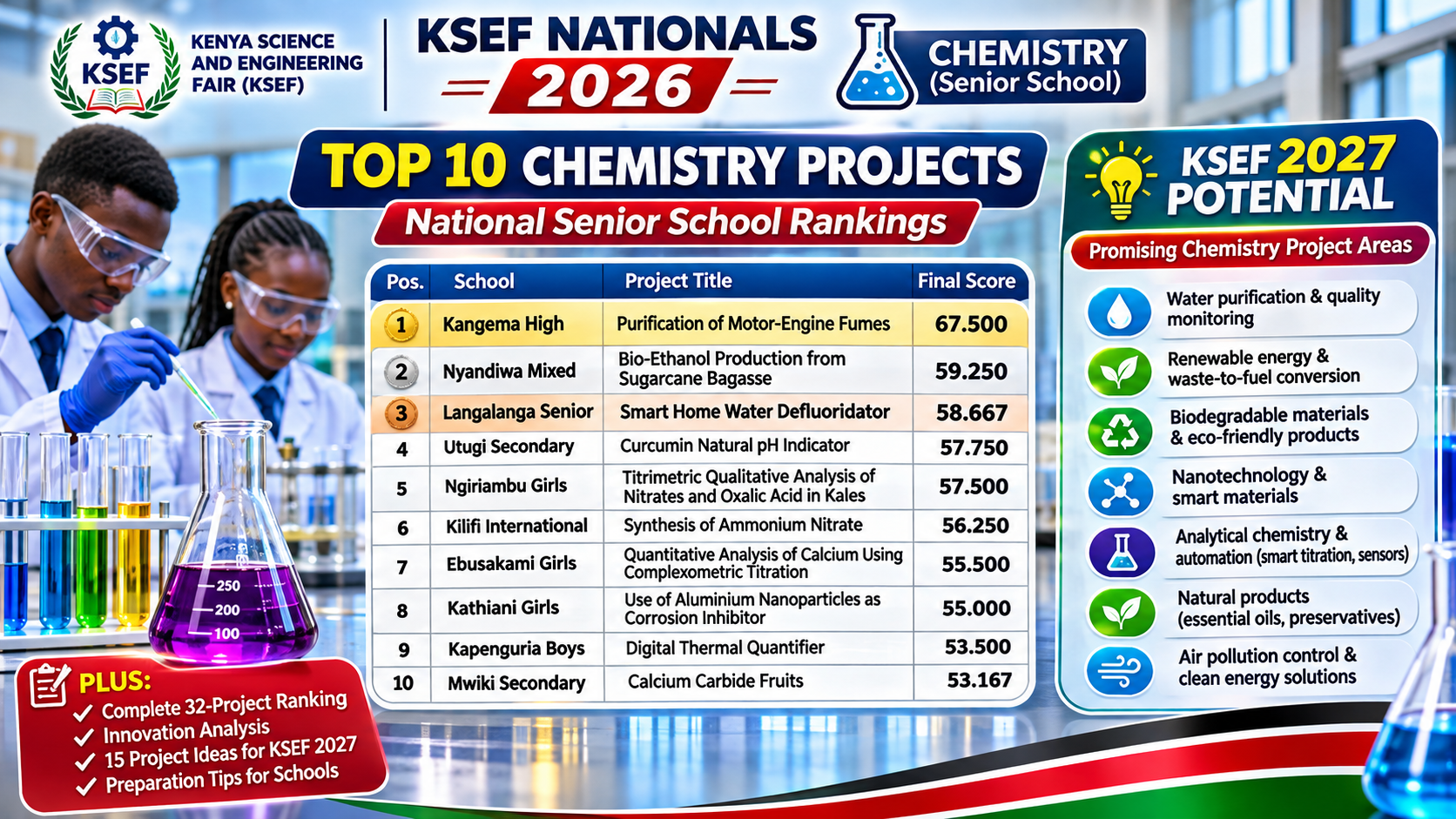
Leading the national Chemistry rankings was Kangema High School, whose project, Purification of Motor-Engine Fumes, achieved an impressive final score of 67.500.
Nyandiwa Mixed secured second position with a bioethanol production project, while Langalanga Senior took third position with an innovative smart home water defluoridator.
This article presents the complete Top 10 rankings, all 32 listed projects, an analysis of outstanding innovations and practical project development ideas for students preparing for KSEF 2027.
KSEF 2026 Chemistry Top 10 National Rankings
The following are the ten highest-ranked Chemistry projects according to the final totals report.
| Position | School | Chemistry Project | Score |
|---|---|---|---|
| 1 | Kangema High | Purification of Motor-Engine Fumes | 67.500 |
| 2 | Nyandiwa Mixed | Bio-Ethanol Production from Sugarcane Bagasse | 59.250 |
| 3 | Langalanga Senior | Smart Home Water Defluoridator | 58.667 |
| 4 | Utugi Secondary | Curcumin Natural pH Indicator | 57.750 |
| 5 | Ngiriambu Girls | Titrimetric Qualitative Analysis of Nitrates and Oxalic Acid in Kales | 57.500 |
| 6 | Kilifi International | Synthesis of Ammonium Nitrate | 56.250 |
| 7 | Ebusakami Girls | Quantitative Analysis of Calcium Using Complexometric Titration | 55.500 |
| 8 | Kathiani Girls | Use of Aluminium Nanoparticles as Corrosion Inhibitor | 55.000 |
| 9 | Kapenguria Boys | Digital Thermal Quantifier | 53.500 |
| 10 | Mwiki Secondary | Calcium Carbide Fruits | 53.167 |
Source: KSEF Nationals 2026 Chemistry (SS) Project Ranking Report – Final Totals.
Analysis of the Top Three Chemistry Projects
1. Purification of Motor-Engine Fumes – Kangema High School
Final Score: 67.500
Kangema High School emerged as the national leader in Senior School Chemistry with its project titled Purification of Motor-Engine Fumes.
The project addresses one of the major environmental challenges associated with modern transportation: air pollution caused by motor vehicles.
Motor-engine emissions may contain harmful gases and particulate matter that contribute to environmental degradation and respiratory health risks.
A project investigating methods of reducing or treating these emissions demonstrates the potential application of chemistry in environmental protection.
Its first-place position makes it an interesting case study for students interested in environmental chemistry, air quality monitoring and pollution control.
2. Bio-Ethanol Production from Sugarcane Bagasse – Nyandiwa Mixed
Final Score: 59.250
Nyandiwa Mixed secured second position with its project on producing bioethanol from sugarcane bagasse.
Sugarcane bagasse is the fibrous material remaining after extracting juice from sugarcane.
The project explores the potential of converting agricultural waste into a useful energy resource.
Bioethanol is an important renewable fuel that can be produced from biomass through suitable processing and fermentation techniques.
This innovation demonstrates how agricultural waste can become a valuable resource instead of being discarded.
The project offers opportunities for further research into renewable energy, waste management and sustainable industrial production.
3. Smart Home Water Defluoridator – Langalanga Senior
Final Score: 58.667
Langalanga Senior secured third position with its Smart Home Water Defluoridator.
The project focuses on water treatment and the removal of excess fluoride from drinking water.
Fluoride is naturally present in some water sources. However, excessive concentrations can pose health risks, making water treatment an important public health concern.
The smart home concept introduces an opportunity to explore how technology and chemistry can be combined to improve household water quality.
Students preparing for KSEF 2027 can draw inspiration from this project by investigating affordable water purification systems, filtration materials and water-quality monitoring technologies.
Complete KSEF 2026 Chemistry Projects Ranking: Positions 1–32
The following table provides the complete national ranking as presented in the uploaded final totals report.
| Position | School | Project Title | Score |
|---|---|---|---|
| 1 | Kangema High | Purification of Motor-Engine Fumes | 67.500 |
| 2 | Nyandiwa Mixed | Bio-Ethanol Production from Sugarcane Bagasse | 59.250 |
| 3 | Langalanga Senior | Smart Home Water Defluoridator | 58.667 |
| 4 | Utugi Secondary | Curcumin Natural pH Indicator | 57.750 |
| 5 | Ngiriambu Girls | Titrimetric Qualitative Analysis of Nitrates and Oxalic Acid in Kales | 57.500 |
| 6 | Kilifi International | Synthesis of Ammonium Nitrate | 56.250 |
| 7 | Ebusakami Girls | Quantitative Analysis of Calcium Using Complexometric Titration | 55.500 |
| 8 | Kathiani Girls | Use of Aluminium Nanoparticles as Corrosion Inhibitor | 55.000 |
| 9 | Kapenguria Boys | Digital Thermal Quantifier | 53.500 |
| 10 | Mwiki Secondary | Calcium Carbide Fruits | 53.167 |
| 11 | Tumutumu Girls | Extraction of Essential Oils | 52.333 |
| 12 | Emanyinya Secondary School | Redox Determination | 52.167 |
| 13 | SA Chebosi Boys | Timely Fire Extinguisher | 50.000 |
| 14 | Radienya High | Starch-Based Adhesive | 48.667 |
| 15 | Orando | Active Laboratory Safety | 47.667 |
| 16 | Meru School SS | Eggshell-Based Fuel | 47.000 |
| 17 | Ribe Girls | Extraction of P. Acid | 46.667 |
| 18 | Igwamiti | Swanfred Smart Airguard | 45.250 |
| 19 | SCSS Academy | Organic Fertilisers | 44.167 |
| 20 | Moi Forces | Nanosynth H.P | 43.000 |
| 21 | Miathene Boys SS | Smart Water Analysis and Distillation System | 42.750 |
| 22 | Ikuu Boys | Biofuel from Waste Vegetable Peels | 42.667 |
| 23 | Itibo Girls | Arduino-Based Thermodynamic System | 42.500 |
| 24 | Budalangi Secondary | NeutraSense | 42.000 |
| 24* | Arnesens’s Senior | Smart pH-Based Automated Titration System | 42.000 |
| 26 | Memon SS | Eco Diapers and Sanitary Pads | 40.250 |
| 27 | Wajir Girls | Acid-Induced Casein Biopolymer | 38.000 |
| 28 | Precious Blood Riruta | Smoke Shift | 34.667 |
| 29 | Sheikh Khalifa | Hydropowa | 34.250 |
| 30 | Sheikh Ali | Making Skin Smoother and Anti-Aging Cream | 23.833 |
| 31 | Rhamu Girls | Alternative Healthy Way of Inflating a Balloon | 23.667 |
| 32 | Rhamu Girls | Balloon Extinguisher | 18.167 |
Important ranking note: The original report assigns position 24 to both Budalangi Secondary and Arnesens’s Senior. The next listed position is 26. The table preserves the positions printed in the source rather than independently changing the official ranking.
Major Chemistry Innovation Trends from KSEF 2026
The 2026 Chemistry projects demonstrate several important areas of scientific research that students and teachers can explore further.
1. Environmental Chemistry and Pollution Control
Environmental protection featured prominently in the competition.
Examples include:
- Purification of Motor-Engine Fumes.
- Smart Home Water Defluoridator.
- Swanfred Smart Airguard.
- Smoke Shift.
- NeutraSense.
These projects demonstrate opportunities for investigating pollution detection, water treatment, air purification and environmental monitoring.
2. Renewable Energy and Waste-to-Energy Technology
Renewable energy was another significant area of innovation.
Projects included:
- Bio-Ethanol Production from Sugarcane Bagasse.
- Eggshell-Based Fuel.
- Biofuel from Waste Vegetable Peels.
- Hydropowa.
These innovations demonstrate how locally available waste materials can be investigated as potential resources for alternative energy production.
3. Analytical and Quantitative Chemistry
Several projects concentrated on chemical analysis and laboratory techniques.
Examples include:
- Quantitative Analysis of Calcium Using Complexometric Titration.
- Titrimetric Qualitative Analysis of Nitrates and Oxalic Acid in Kales.
- Redox Determination.
- Smart pH-Based Automated Titration System.
These projects highlight the importance of accurate measurements, experimental procedures, data collection and quantitative analysis in Chemistry.
4. Nanotechnology and Advanced Materials
The use of advanced materials was represented by projects such as:
- Use of Aluminium Nanoparticles as Corrosion Inhibitor.
- Nanosynth H.P.
- Acid-Induced Casein Biopolymer.
- Starch-Based Adhesive.
These projects provide opportunities for further research into sustainable materials, corrosion protection and alternative industrial products.
5. Digital Technology and Smart Chemistry
The integration of electronics and chemical processes is becoming an interesting area of school-based innovation.
Projects included:
- Digital Thermal Quantifier.
- Arduino-Based Thermodynamic System.
- Smart Water Analysis and Distillation System.
- Smart pH-Based Automated Titration System.
These projects demonstrate the potential of combining Chemistry, electronics, programming and engineering.
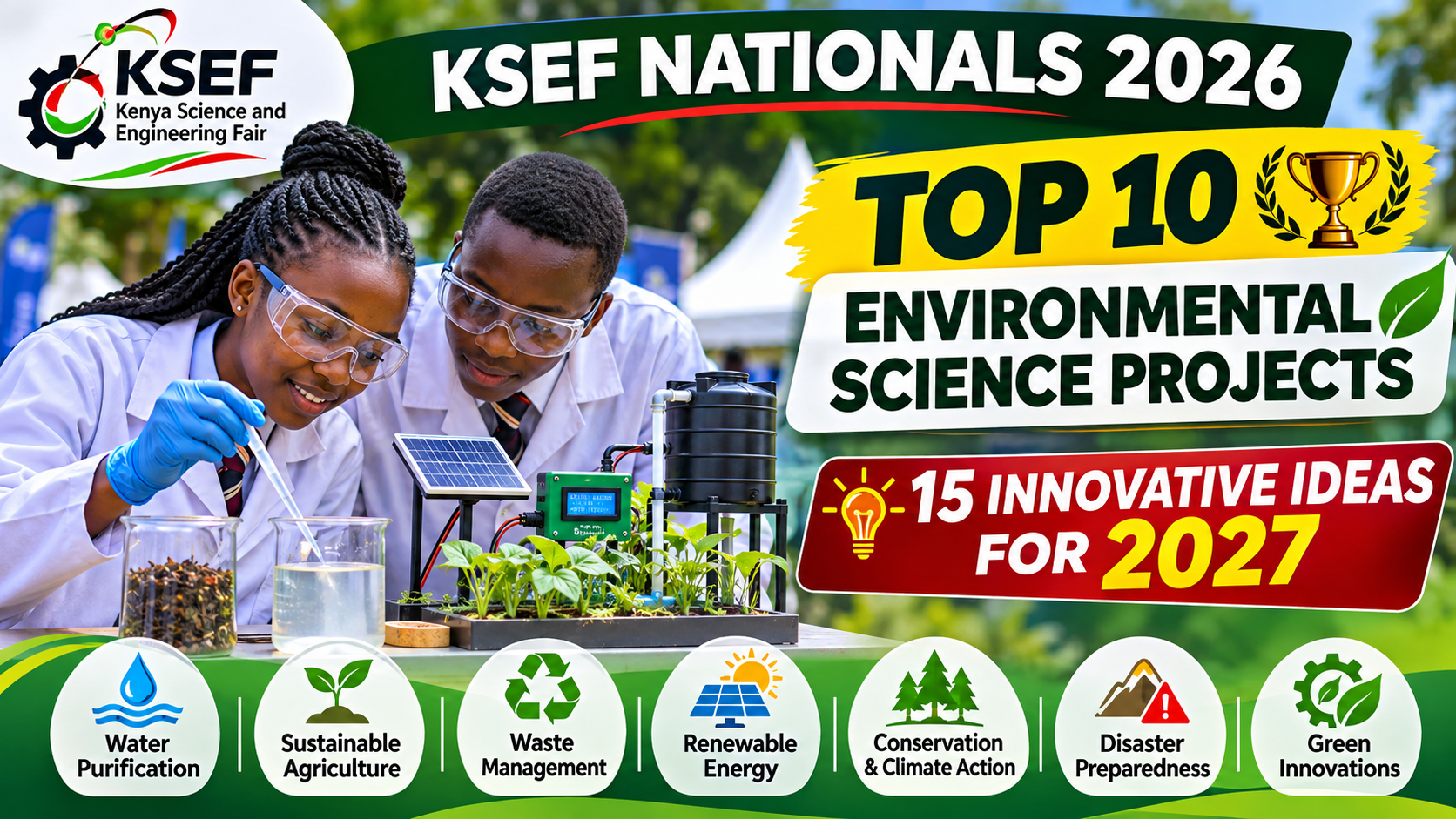
15 Chemistry Project Ideas for KSEF 2027
Students preparing for the next Kenya Science and Engineering Fair can use the 2026 projects as inspiration while developing original investigations.
The following are suggested project concepts, not confirmed KSEF 2027 entries.
| No. | Suggested Project | Research Area |
|---|---|---|
| 1 | Low-Cost Smart Water Fluoride Monitoring System | Water Chemistry |
| 2 | Bioethanol Production from Banana Peels | Renewable Energy |
| 3 | Natural Corrosion Inhibitors from Plant Extracts | Materials Chemistry |
| 4 | Smart Air Pollution Detection and Filtration System | Environmental Chemistry |
| 5 | Development of Biodegradable Packaging from Cassava Starch | Polymer Chemistry |
| 6 | Natural pH Indicators from Indigenous Plants | Analytical Chemistry |
| 7 | Production of Activated Carbon from Agricultural Waste | Water Treatment |
| 8 | Smart Automated Acid-Base Titration System | Analytical Chemistry |
| 9 | Extraction of Essential Oils from Local Medicinal Plants | Organic Chemistry |
| 10 | Development of Natural Food Preservatives | Food Chemistry |
| 11 | Production of Biodegradable Adhesives from Plant Starch | Materials Chemistry |
| 12 | Heavy Metal Removal Using Modified Agricultural Waste | Environmental Chemistry |
| 13 | Solar-Powered Water Distillation System | Physical Chemistry |
| 14 | Development of Eco-Friendly Paint Using Natural Pigments | Industrial Chemistry |
| 15 | Smart Soil Nutrient Monitoring System | Agricultural Chemistry |
How Students Can Prepare Competitive Chemistry Projects for KSEF 2027
The KSEF 2026 results provide useful examples of how students can approach scientific research.
Students and their teachers should consider the following principles when developing their next projects.
1. Identify a real community problem
A strong project should investigate a problem that affects people, the environment, agriculture or industry.
2. Develop a clear research question
Students should establish exactly what they intend to investigate and what scientific question their experiments will answer.
3. Conduct preliminary investigations
Before developing a final prototype, learners should review existing research, investigate available materials and conduct preliminary experiments.
4. Collect measurable experimental data
Scientific projects should include observations, measurements, repeated trials and appropriate data analysis.
5. Demonstrate the working prototype
Where applicable, students should develop a functional model that demonstrates the practical application of their research.
6. Explain the underlying Chemistry
Learners must understand the chemical principles, reactions and processes involved in their innovations.
7. Evaluate the effectiveness of the innovation
Students should compare experimental results against appropriate controls, existing methods or established benchmarks.
Why the KSEF 2026 Chemistry Results Matter for Senior School STEM Education
The Chemistry rankings demonstrate the potential of Senior School learners to investigate scientific challenges using practical research and innovation.
The projects also illustrate how Chemistry can be connected to other STEM disciplines, including environmental science, agriculture, electronics, engineering and materials science.
For teachers, the results provide useful reference points when mentoring learners, identifying research opportunities and preparing school teams for future science competitions.
The increasing interest in smart systems, renewable energy, nanotechnology and environmental solutions also provides opportunities for interdisciplinary project development.
Frequently Asked Questions About KSEF 2026 Chemistry Results
1. Which school emerged position one in KSEF 2026 Chemistry?
Kangema High School emerged first nationally in the Senior School Chemistry category with 67.500 points.
2. Which project won the KSEF 2026 Chemistry category?
Purification of Motor-Engine Fumes, presented by Kangema High School, achieved the highest final score.
3. Which school took second position in Chemistry?
Nyandiwa Mixed secured second position with Bio-Ethanol Production from Sugarcane Bagasse, scoring 59.250.
4. Which school emerged third in Chemistry?
Langalanga Senior took third position with Smart Home Water Defluoridator, scoring 58.667.
5. How many projects were listed in the KSEF 2026 Chemistry ranking report?
The final totals report contains 32 projects.
6. What are some promising Chemistry project areas for KSEF 2027?
Environmental chemistry, water purification, renewable energy, nanotechnology, analytical chemistry, biodegradable materials and smart chemical monitoring systems are promising areas for further investigation.
Conclusion
The KSEF Nationals 2026 Chemistry competition demonstrated the creativity and scientific potential of Kenyan Senior School learners.
From motor-engine fume purification and bioethanol production to smart water defluoridation and nanotechnology, the projects addressed practical challenges with applications in environmental protection, energy, agriculture and industrial development.
Kangema High School led the national rankings, followed by Nyandiwa Mixed and Langalanga Senior.
As schools begin preparing for KSEF 2027, the 2026 results offer valuable inspiration for students, teachers and project mentors seeking to develop innovative, evidence-based scientific solutions.