mbeva
Introduction
Environmental challenges are becoming increasingly complex, creating opportunities for young innovators to develop practical scientific solutions that can transform communities.
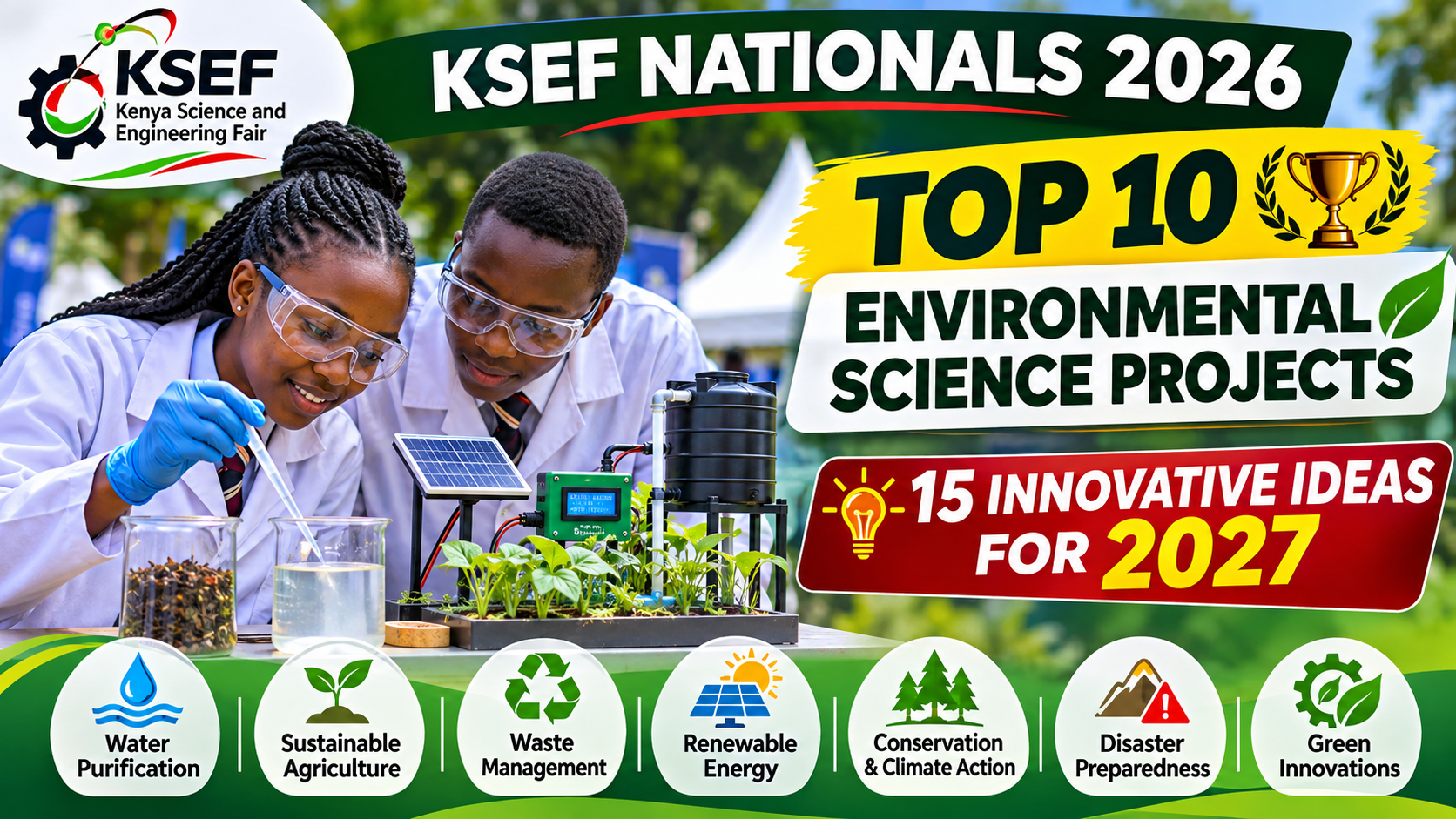
At the Kenya Science and Engineering Fair (KSEF) Nationals 2026, Senior School students demonstrated how science, technology, engineering and environmental management can be combined to address real-world challenges.
The Environmental Science and Management category featured projects focusing on water purification, sustainable agriculture, waste management, renewable energy, climate change, disaster preparedness and environmental conservation.
The official KSEF Nationals 2026 final ranking report lists 33 projects in this category, with students presenting innovations designed to address environmental problems affecting communities across Kenya.
Some of the outstanding innovations included using tea leaves to remove heavy metal ions from water, eco-friendly pest management, biodegradable plastics, smart irrigation systems, forest fire detection and smart flood warning systems.
For students and teachers preparing for KSEF 2027, these projects provide valuable insights into the types of environmental challenges that can inspire innovative scientific investigations.
This article highlights the leading projects from the 2026 competition and presents 15 new project directions that students can explore for the 2027 science fair.
KSEF Nationals 2026: Top Environmental Science Projects
According to the official Environmental Science and Management Senior School ranking report, the leading projects were as follows.
1. Use of Tea Leaves as Adsorbents of Heavy Metal Ions from Water
Position: 1
Final Score: 69.167
Students: Anita Wangui and Nancy Stacy Nguthuko
School: Muruguru Girls
Region: Central
The first position went to an innovative water treatment project investigating the use of tea leaves as adsorbents for removing heavy metal ions from water.
Tea leaves are readily available organic materials that can be investigated for their ability to bind contaminants in water.
This project presents an interesting approach to environmental pollution control by exploring the potential of agricultural and household waste materials in water treatment.
Its relevance extends to communities facing water contamination challenges.
Possible 2027 research extension: Investigate the effectiveness of different locally available agricultural wastes in removing selected heavy metal ions from contaminated water.
2. Eco-Friendly Pest Management
Position: 2
Final Score: 68.667
Students: Joseph Machio and David Maina
School: Senior Chief Gichohi
Region: Central
The second position was awarded to a project focusing on eco-friendly pest management.
Agricultural pests contribute to significant crop losses, while excessive dependence on conventional pesticides can create environmental concerns.
The project explores environmentally conscious approaches to pest control.
For future researchers, opportunities exist in developing botanical pesticides, biological pest management methods and integrated pest management systems.
3. ECOPOLY
Position: 3
Final Score: 66.167
Students: Mwanaidi Ahmed and Rabai Waluchu
School: Bungoma Baptist Girls
Region: Western
ECOPOLY secured third position in the national competition.
The project title suggests an innovation associated with ecological materials and polymer applications.
It is an interesting direction for students interested in sustainable materials, plastic alternatives and environmental protection.
Further research could investigate the production of environmentally friendly polymer materials using locally available resources.
4. IoT-Based Irrigation System
Position: 4
Final Score: 66.000
Students: Munira Swaleh and Hellen Khamala
School: Samitsi Girls
Region: Western
This project demonstrated the relevance of Internet of Things technology in modern agriculture.
IoT-based irrigation systems can combine soil moisture sensors, microcontrollers and water delivery mechanisms to improve irrigation management.
Students preparing for 2027 can explore more advanced systems incorporating:
- Soil moisture monitoring.
- Automatic water pumps.
- Weather data integration.
- Wireless monitoring.
- Water consumption analysis.
The project provides an excellent starting point for innovations in precision agriculture.
4. Gas Leakage Detector
Position: 4 (Joint)
Final Score: 66.000
Students: Jeff Chruphine and Charles Omolo
School: Anjego
Region: Nyanza
Sharing fourth position was a gas leakage detection project.
Gas leakage presents serious safety and environmental challenges, particularly in homes, laboratories and industrial environments.
A gas leakage detection system can use gas sensors, electronic circuits, alarms and automatic safety mechanisms to identify potentially dangerous leaks.
For 2027, students could investigate improved gas monitoring systems with wireless alerts and automatic shut-off mechanisms.
6. Solar Powered Zero Emission Vehicle
Position: 6
Final Score: 62.000
Students: Paulsen Mukori and Griffin Orina
School: Nyamabaria High School
Region: Nyanza
This project explored renewable energy applications in transportation.
Solar-powered vehicles provide an opportunity to investigate clean energy conversion, electric mobility and sustainable transport.
Students can extend this concept by examining solar charging efficiency, battery performance, vehicle energy consumption and lightweight construction materials.
7. Sharnel Smart Landslide Detection System
Position: 7
Final Score: 61.333
Students: Nelly Chelangat and Joshua Wafula
School: Muchorwe Senior
Region: Rift Valley
Landslides are dangerous natural hazards that can destroy homes, roads, farms and infrastructure.
The smart landslide detection system addressed the need for early warning mechanisms in areas vulnerable to ground movement.
Potential research extensions include integrating soil moisture sensors, tilt sensors, vibration detection and wireless communication.
Such a system could help communities receive warnings before potentially dangerous ground movement develops.
8. Forest Fire Alert System
Position: 8
Final Score: 61.000
Students: Timothy Ombogo and Elisha Alloys
School: Iruma Mixed
Region: Nyanza
Forest fires contribute to biodiversity loss, destruction of natural habitats and environmental degradation.
The Forest Fire Alert System focused on detecting potential fire incidents and improving early warning.
Future developments could combine temperature sensors, smoke detection, GPS technology and wireless communication.
Students can also investigate how automated monitoring systems could support forest conservation.
9. Biodegradable Plastics
Position: 9
Final Score: 59.500
Students: Mark Mungai and Derrick Mutuhu
School: Muguru Boys
Region: Central
Plastic pollution remains a major environmental challenge.
This project explored biodegradable plastics as an alternative approach to conventional plastic materials.
Students interested in this field can investigate biodegradable materials made from starch, cellulose, agricultural residues and other locally available resources.
Important research areas include decomposition rates, water resistance, tensile strength and suitability for packaging applications.
10. OTVEL Smart Toilet
Position: 10
Final Score: 59.333
Students: James Otieno and Ian Kipkemboi
School: Kurgung B
Region: Rift Valley
The OTVEL Smart Toilet secured a joint tenth position.
The project introduced an interesting intersection between sanitation and technology.
Smart sanitation innovations can explore improved water efficiency, hygiene monitoring, automatic flushing and waste management.
Such innovations are relevant to schools, public facilities and communities seeking improved sanitation solutions.
10. Flood Alert and Bridge Safety System
Position: 10 (Joint)
Final Score: 59.333
Students: Obadiah Kiprono and Aiden Kimutai
School: Kabarnet High
Region: Rift Valley
Sharing tenth position was a flood alert and bridge safety system.
Flooding can make roads and bridges dangerous, particularly during periods of heavy rainfall.
The project addressed the importance of monitoring water levels and providing early warnings to people approaching potentially unsafe crossings.
Future improvements could include ultrasonic water level sensors, GSM communication, warning lights and automated barriers.
What the KSEF 2026 Environmental Science Rankings Reveal
The 2026 competition demonstrates that successful environmental science innovations can emerge from different scientific disciplines.
Several important themes stand out.
1. Water Treatment and Conservation
Water-related projects featured prominently in the rankings.
Examples included:
- Tea leaves as adsorbents for heavy metal ions.
- IoT-based irrigation.
- Smart water tank monitoring and pump control.
- Smart water conservation systems.
- Smart water controllers.
- Automatic water leakage and tank overflow detection.
These projects demonstrate opportunities for students to investigate water quality, efficient water usage and intelligent water management.
2. Climate Change and Disaster Management
Disaster preparedness was another important theme.
Projects included:
- Smart landslide detection.
- Forest fire alert systems.
- Flood alert and bridge safety systems.
- Smart flood alarms.
- Early drought warning systems.
- Modern weather stations.
These innovations demonstrate how environmental monitoring can support disaster preparedness.
3. Sustainable Materials and Waste Management
Students also explored environmentally friendly materials.
Examples included:
- ECOPOLY.
- Biodegradable plastics.
- Composite tiles.
- Biodegradable banana bags.
- Modified terpene-induced polystyrene solubilization.
- Production of hydrogel using biodegradable agar and citric acid.
These projects offer opportunities to investigate waste reduction, material science and sustainable production.
4. Smart Agriculture and Environmental Technology
The IoT-based irrigation system demonstrated the importance of combining agriculture with digital technology.
Other promising directions include automated irrigation, agricultural pest management, smart weather stations and early drought warning.
The opportunity for 2027 is to develop systems that are affordable, reliable and useful to local farmers.
KSEF 2027: 15 Innovative Environmental Science Project Ideas for Senior School Students
The following ideas are proposed research directions inspired by the environmental challenges and project themes represented in the 2026 rankings. They are not confirmed KSEF 2027 entries or official predictions.
Students should select projects that allow them to investigate a specific problem, develop a working prototype and collect measurable experimental data.
1. AI-Based Water Quality Monitoring and Contamination Detection System
Research area: Water pollution and environmental monitoring.
Develop a system that monitors water quality using sensors and a microcontroller.
Possible components:
- ESP32 development board.
- pH sensor.
- Turbidity sensor.
- Temperature sensor.
- Electrical conductivity sensor.
- LCD display.
The system could monitor changes in water quality and provide alerts when measured parameters exceed predetermined limits.
Research opportunity: Compare sensor readings with appropriate laboratory measurements and evaluate the reliability of the monitoring system.
2. Smart Flood Prediction and Early Warning System Using IoT
Research area: Climate change and disaster management.
Develop an intelligent flood monitoring prototype that measures water levels and rainfall.
Possible components:
- Arduino or ESP32.
- Ultrasonic sensor.
- Rain sensor.
- GSM module.
- Buzzer.
- Warning lights.
The system could send alerts when water levels reach predefined danger thresholds.
Research opportunity: Evaluate the relationship between rainfall intensity, water level changes and warning response time.
3. Production of Biodegradable Packaging from Agricultural Waste
Research area: Sustainable materials and waste management.
Investigate the production of biodegradable packaging materials from locally available agricultural residues.
Potential raw materials include:
- Banana peels.
- Cassava starch.
- Maize residues.
- Sugarcane bagasse.
- Potato starch.
Students can investigate the physical properties of the resulting materials.
Research opportunity: Compare tensile strength, water absorption and decomposition rates under controlled conditions.
4. Solar-Powered Smart Irrigation and Fertigation System
Research area: Sustainable agriculture and renewable energy.
Develop a solar-powered irrigation system that automatically supplies water based on soil moisture levels.
The project could incorporate a fertilizer delivery mechanism to investigate controlled fertigation.
Research opportunity: Compare crop growth, water consumption and irrigation efficiency between automated and conventional irrigation methods.
5. Smart Forest Fire Detection and Monitoring System
Research area: Forest conservation and environmental protection.
Develop a prototype that detects potential forest fire conditions through temperature, smoke and gas sensors.
Possible features include:
- Temperature monitoring.
- Smoke detection.
- Wireless communication.
- GPS-based location reporting.
- Automatic alarm activation.
Research opportunity: Evaluate detection response time under different simulated environmental conditions.
6. Production of Biochar from Agricultural Waste for Soil Improvement
Research area: Soil science and environmental management.
Investigate the production of biochar from suitable agricultural residues and evaluate its influence on selected soil properties.
Possible materials include maize cobs, rice husks and other agricultural residues.
Research opportunity: Compare soil water retention and selected plant growth parameters in amended and untreated soil.
Biochar production should be conducted using appropriate safety precautions and controlled equipment.
7. Smart Air Pollution Monitoring System Using ESP32
Research area: Air quality and environmental health.
Develop a low-cost air monitoring prototype using gas and particulate matter sensors.
The system could record environmental measurements and display changes over time.
Research opportunity: Compare readings at different locations, such as near roads, school compounds and residential areas.
Low-cost sensor measurements should be treated as indicative unless validated against calibrated instruments.
8. Eco-Friendly Pesticide Production from Indigenous Plants
Research area: Sustainable agriculture.
Investigate the potential of selected plant extracts in managing agricultural pests.
Students could compare different formulations and concentrations.
Research opportunity: Measure pest mortality, crop damage and possible effects on beneficial organisms under controlled conditions.
9. Development of Hydrogel for Water Retention in Agriculture
Research area: Agricultural materials and water conservation.
Investigate the production of biodegradable hydrogels using suitable natural polymers.
The project could examine the ability of different formulations to absorb and retain water.
Research opportunity: Compare water absorption, release rates and soil moisture retention.
10. Smart Waste Segregation and Recycling System
Research area: Waste management and environmental technology.
Develop an automated system that identifies and separates selected categories of waste.
Possible technologies include:
- Arduino.
- Infrared sensors.
- Inductive sensors.
- Servo motors.
- Sorting compartments.
Research opportunity: Measure sorting accuracy and the time required to process different waste materials.
11. Automated Water Leakage and Tank Overflow Prevention System
Research area: Water conservation and engineering.
Develop a system that detects water leakage and automatically controls water pumps.
Possible features include:
- Ultrasonic water level sensing.
- Flow rate monitoring.
- Leak detection.
- Automatic pump switching.
- SMS notifications.
Research opportunity: Measure water losses under different leakage conditions and evaluate the effectiveness of the automatic control mechanism.
12. Production of Eco-Friendly Construction Blocks from Recycled Materials
Research area: Sustainable construction and material science.
Investigate the potential of recycled materials in producing construction or decorative blocks.
Potential materials may include suitable recycled plastics, glass or other processed waste materials.
Research opportunity: Compare compressive strength, water absorption and durability against an appropriate control material.
Safety and suitability testing are essential before proposing structural applications.
13. Smart Drought Prediction and Agricultural Advisory System
Research area: Climate resilience and agricultural technology.
Develop a monitoring system that combines rainfall, temperature and soil moisture measurements.
The system could provide information on changing environmental conditions and potential water stress.
Research opportunity: Evaluate how different environmental indicators relate to soil moisture and crop water requirements.
14. Solar-Powered Atmospheric Water Collection System
Research area: Renewable energy and water conservation.
Investigate a prototype that collects moisture from air through condensation or another suitable atmospheric water harvesting method.
Research opportunity: Measure water collection rates under different humidity and temperature conditions and calculate energy requirements.
15. Conversion of Organic Waste into Biogas and Organic Fertilizer
Research area: Renewable energy and waste management.
Investigate the conversion of suitable organic waste into biogas through anaerobic digestion.
The project could also examine the characteristics of the resulting digestate for potential agricultural use.
Research opportunity: Compare gas production from different feedstock mixtures under controlled conditions.
How to Choose a Winning Environmental Science Project for KSEF 2027
Coming up with an impressive project title is not enough. Students must demonstrate that their innovation addresses a real problem and that the proposed solution has been scientifically investigated.
The following considerations can help project teams prepare stronger submissions.
1. Identify a Real Environmental Problem
Start by identifying an environmental challenge affecting the school or surrounding community.
Examples include:
- Water contamination.
- Poor waste disposal.
- Soil erosion.
- Agricultural pests.
- Water wastage.
- Deforestation.
- Flooding.
- Air pollution.
Conduct a preliminary investigation to establish the magnitude of the problem.
2. Develop a Clear Research Question
A strong project should answer a specific research question.
For example:
“How effective are selected locally available agricultural wastes in removing heavy metal ions from contaminated water?”
This is more meaningful than simply stating that the project involves water purification.
3. Build a Functional Prototype
Where applicable, students should develop a working prototype.
For electronic projects, the prototype may incorporate sensors, microcontrollers, displays and communication modules.
For chemistry and materials projects, it may involve producing and testing different formulations.
The prototype should demonstrate the proposed innovation rather than merely display an attractive model.
4. Collect Experimental Data
Data collection is essential in scientific investigations.
Students should consider measuring:
- Efficiency.
- Accuracy.
- Response time.
- Water consumption.
- Material strength.
- Decomposition rate.
- Energy consumption.
- Cost effectiveness.
The results should be presented using tables, graphs and appropriate statistical analysis.
5. Compare the Innovation with an Existing Method
A project becomes more convincing when students demonstrate how their innovation performs compared with an existing approach.
For example, an automated irrigation system can be compared with conventional irrigation using similar crop varieties, growing conditions and observation periods.
6. Demonstrate Practical Application
Students should explain how the project could be used outside the science fair.
A good innovation should have a clear potential application in homes, schools, farms, industries or the wider community.
7. Consider Affordability and Sustainability
Environmental innovations should not only work but also be practical.
Students should calculate:
- Initial development costs.
- Operating costs.
- Maintenance requirements.
- Availability of materials.
- Environmental impact.
- Potential for scaling up.
Frequently Asked Questions About KSEF Environmental Science Projects
1. Which project emerged position one in Environmental Science and Management at KSEF Nationals 2026?
The project titled “Use of Tea Leaves as Adsorbents of Heavy Metal Ions from Water” from Muruguru Girls emerged position one with 69.167 marks.
2. Which school emerged position two?
Senior Chief Gichohi secured second position with the project titled “Eco-Friendly Pest Management”, scoring 68.667 marks.
3. Which project emerged position three?
Bungoma Baptist Girls secured third position with ECOPOLY, scoring 66.167 marks.
4. Which projects shared fourth position?
The IoT-Based Irrigation System from Samitsi Girls and the Gas Leakage Detector from Anjego both scored 66.000 marks and shared fourth position.
5. What are the best environmental science project ideas for KSEF 2027?
Promising research directions include AI-based water quality monitoring, smart irrigation, biodegradable packaging, smart flood detection, biochar production, forest fire detection and automated waste segregation.
6. How can students improve their chances of performing well at KSEF?
Students should identify a real problem, formulate a clear research question, develop a working prototype where appropriate, collect reliable experimental data and demonstrate the effectiveness of their proposed solution.
7. Why is Environmental Science and Management important in STEM education?
The category allows learners to apply scientific knowledge to environmental challenges while developing research, critical thinking, problem-solving, creativity and engineering skills.
Conclusion: Preparing the Next Generation of Environmental Innovators
The KSEF Nationals 2026 Environmental Science and Management competition demonstrated the potential of Senior School learners to develop solutions to environmental challenges.
From using tea leaves in water treatment to designing smart irrigation systems, biodegradable materials, forest fire detection systems and flood warning technologies, the projects demonstrated the value of practical scientific investigation.
For 2027, students and project advisors should focus on developing innovations that combine scientific knowledge, emerging technologies and locally available resources.
The most important consideration is not the complexity of the technology but the quality of the research, the effectiveness of the solution and the evidence supporting the findings.