mbeva
mbeva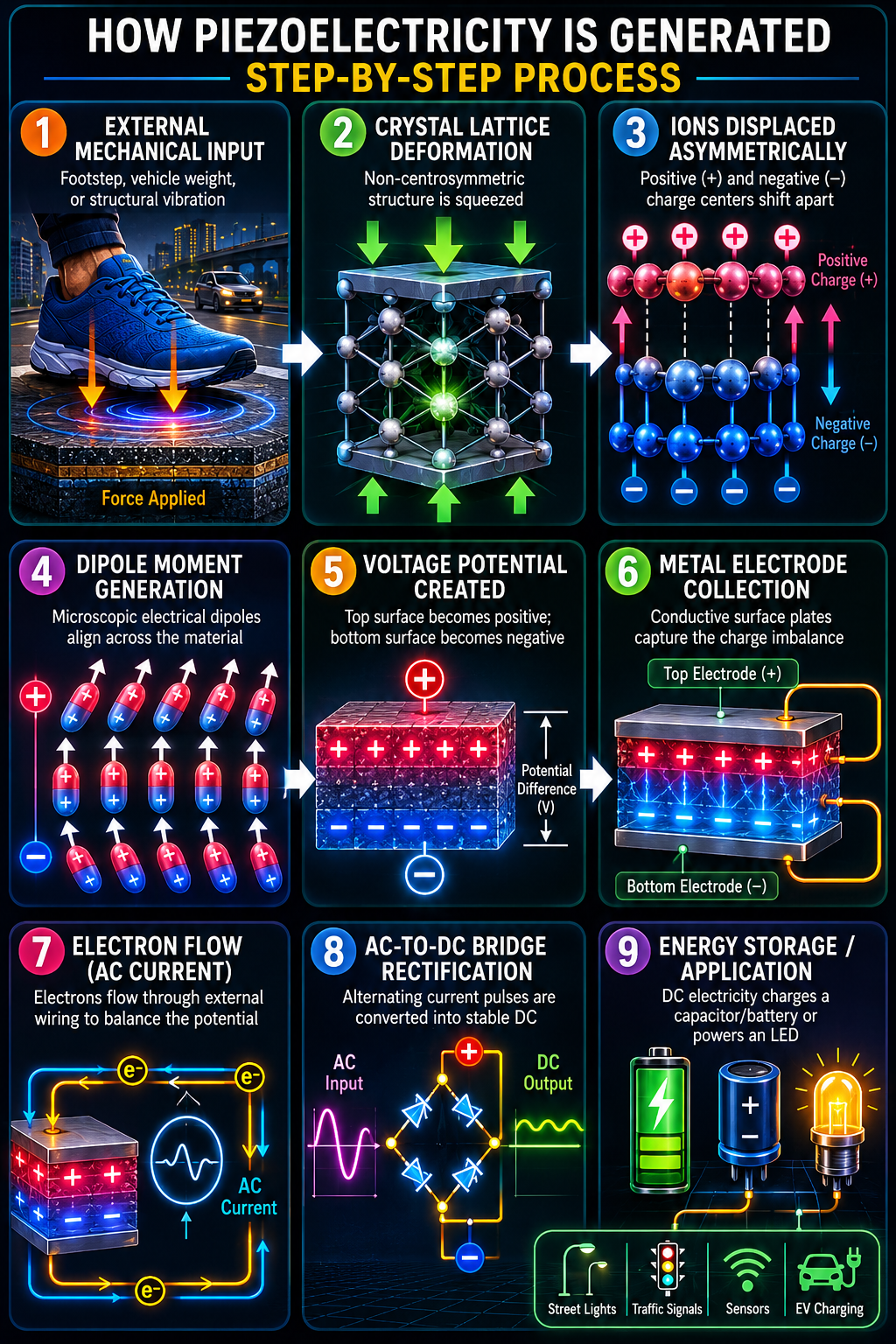
A Simple Engineering Guide
From smart fitness trackers that charge as you run to futuristic highways that harvest power from passing traffic, the demand for decentralized, clean energy is skyrocketing. But while solar and wind power dominate the headlines, a silent green technology revolution is happening right under our feet.
It is called ambient kinetic energy harvesting, and it is entirely powered by a fascinating scientific phenomenon: the piezoelectric effect.
If you’ve ever wondered exactly how piezoelectric materials generate electricity, you are in the right place. In this simple engineering guide, we will strip away the overly dense academic jargon and break down the atomic physics, crystal structures, and practical mechanics behind this incredible smart material technology.
What is the Piezoelectric Effect?
To understand this technology, we have to start with the name itself. The word “piezo” originates from the Greek word piezein, which literally means to squeeze, press, or compress.
In mechanical engineering and material science, the piezoelectric effect describes a unique physical property found in certain solid materials: the ability to convert mechanical stress into an electrical charge.
What makes this phenomenon even more incredible is that it is a completely reversible process. This gives us two distinct types of piezoelectricity depending on your system’s design:
- The Direct Piezoelectric Effect: You apply physical pressure (squeeze, bend, or vibrate the material), and it instantly generates an electric voltage. This is the foundation of energy harvesters, sensors, and microphones.
- The Converse Piezoelectric Effect: You apply an electric voltage to the material, and it physically deforms, expands, or vibrates. This is how microscopic ultrasonic medical equipment, precision industrial actuators, and audio buzzers operate.
The Molecular Science: What Happens at the Atomic Level?
How can squeezing a solid rock or ceramic create electricity? The secret lies deep within the material’s internal crystal lattice structure.
In a standard non-piezoelectric material (like a block of steel, aluminum, or glass), the atoms are arranged in a perfectly symmetrical structure. The positive and negative charges inside the material cancel each other out completely, leaving the object electrically neutral—no matter how hard you compress or hit it.
Piezoelectric materials, however, are non-centrosymmetric. This means their internal atomic structure is naturally asymmetrical.
1. The State of Equilibrium (No Pressure)
Take a common natural piezoelectric crystal like Quartz (SiO2) or a synthetic ceramic like PZT (Lead Zirconate Titanate). In its natural, unstressed resting state, the positive charges (cations) and negative charges (anions) sit in an asymmetrical balance.
Even though the molecular layout itself is skewed, the center of gravity for the positive charges perfectly aligns with the center of gravity for the negative charges. Because these centers match, the net electrical charge on the outside of the crystal remains exactly zero.
2. The Compressed State (Under Mechanical Stress)
When you apply an external mechanical force—such as stepping on a piezo-embedded floor mat or driving a heavy vehicle over a smart highway module—you physically distort that atomic crystal lattice.
This mechanical compression forces the ions to shift positions within the lattice. Suddenly, the center of gravity for the positive charges moves away from the center of gravity for the negative charges. This structural separation of internal electrical charges creates an electrical dipole moment.
Because millions of these microscopic atomic dipoles align in the exact same direction under directional pressure, they combine to form a massive cumulative charge across the entire material matrix. The top surface of the material becomes highly positive, while the opposite bottom surface becomes highly negative. This charge imbalance creates a measurable voltage potential across the material.
Step-by-Step Word Flow: From Mechanical Pressure to Electrical Output
To map out exactly how this atomic compression transforms into usable electricity that can power external devices, engineers trace the energy through a sequential loop.
Here is the complete mechanical-to-electrical word flow diagram of a piezoelectric harvesting system:
[ STEP 1: External Mechanical Input ] │ (Example: Footstep, vehicle weight, or structural vibration) ▼ [ STEP 2: Crystal Lattice Deformation ] │ (The non-centrosymmetric atomic structure is physically squeezed) ▼ [ STEP 3: Ions Displaced Asymmetrically ] │ (Positive and negative charge centers shift away from each other) ▼ [ STEP 4: Dipole Moment Generation ] │ (Microscopic electrical dipoles align across the material matrix) ▼ [ STEP 5: Voltage Potential Created ] │ (Top surface becomes positive; bottom surface becomes negative) ▼ [ STEP 6: Metal Electrode Collection ] │ (Conductive surface plates capture the charge imbalance) ▼ [ STEP 7: Electron Flow (AC Current) ] │ (Electrons flow through external wiring to balance the potential) ▼ [ STEP 8: AC-to-DC Bridge Rectification ] │ (Alternating current pulses are converted into stable direct current) ▼ [ STEP 9: Energy Storage / Application ] (DC electricity charges a capacitor/battery or powers an LED)
How We Capture and Standardize the Energy
An isolated crystal holding an atomic charge isn’t useful on its own. To turn this internal atomic shift into practical, working electricity, engineers apply conductive metal electrode plates (usually made of silver, copper, or gold) to opposite sides of the piezoelectric element.
When an external circuit path is connected to these plates, the voltage potential forces electrons to cascade through the wiring to balance out the charge, generating an active electrical current.
Managing Direct Current vs. Alternating Current
It is crucial to note that piezoelectric materials generate Alternating Current (AC), not the stable Direct Current (DC) used by common consumer electronics or batteries.
- Compression Phase: When you squeeze the crystal, electrons flow in one direction through the circuit.
- Relaxation Phase: When you release the mechanical pressure, the crystal snaps back to its original geometric shape, forcing the electrons to flow in the exact opposite direction.
Because of this constant back-and-forth dynamic pulse, any practical energy harvesting circuit must route the raw piezo-signal through a component called a full-wave bridge rectifier. This electronic component flips the negative waves into positive waves, smoothing out the jagged AC pulses into smooth, usable DC power that can be safely stored inside a capacitor or a lithium-ion battery.
Common Types of Piezoelectric Materials
Engineers choose different materials depending on whether a project requires high power output, physical flexibility, or long-term temperature resistance:
| Material Category | Examples | Key Engineering Characteristics | Common Applications |
|---|---|---|---|
| Natural Crystals | Quartz, Rochelle Salt, Topaz | High structural stability, low energy output, highly precise frequencies. | Quartz watches, microsecond clocks, radio oscillators. |
| Synthetic Ceramics | PZT (Lead Zirconate Titanate), Barium Titanate | Massive piezoelectric coefficient, high energy output, brittle structure. | Ultrasonic medical transducers, sonar sensors, industrial actuators. |
| Piezo Polymers | PVDF (Polyvinylidene Fluoride) | Highly flexible, lightweight, impact-resistant, lower energy efficiency. | Smart wearable tech, flexible impact sensors, acoustic guitar pickups. |
Real-World Applications: The Power of the Squeeze
Now that you know the underlying material science and circuit engineering, you will start noticing piezoelectricity everywhere. Here are some of the most common applications driving smart engineering today:
- Push-Button Igniters: The clicking mechanism inside a standard backyard barbecue gas grill contains a tiny spring-loaded hammer. When you press the button, it strikes a small piezoelectric ceramic crystal with massive localized force, instantly generating thousands of volts to create the electric spark that ignites the gas.
- Smart Infrastructure & Roads: Embedding ruggedized PZT ceramic modules beneath heavily trafficked highways allows smart cities to capture the kinetic energy of passing semi-trucks, converting vehicular pressure into clean electricity to power roadside lighting grids.
- Microphone and Acoustic Pickups: Acoustic guitar pickups use thin strips of PVDF polymer beneath the bridge saddle. As the guitar strings vibrate, they apply rhythmic mechanical stress to the polymer, which converts those acoustic frequencies directly into clean audio signals for amplifiers.
The Bottom Line
The beauty of piezoelectric technology is its incredible efficiency at the micro-scale. While it won’t replace massive solar arrays or wind farms for grid-scale power generation, it provides an unparalleled solution for ambient energy harvesting. By converting the structural vibrations, foot traffic, and mechanical movements that we already produce into clean, decentralized electricity, piezoelectric materials remain a cornerstone of modern smart infrastructure design.