mbeva
mbeva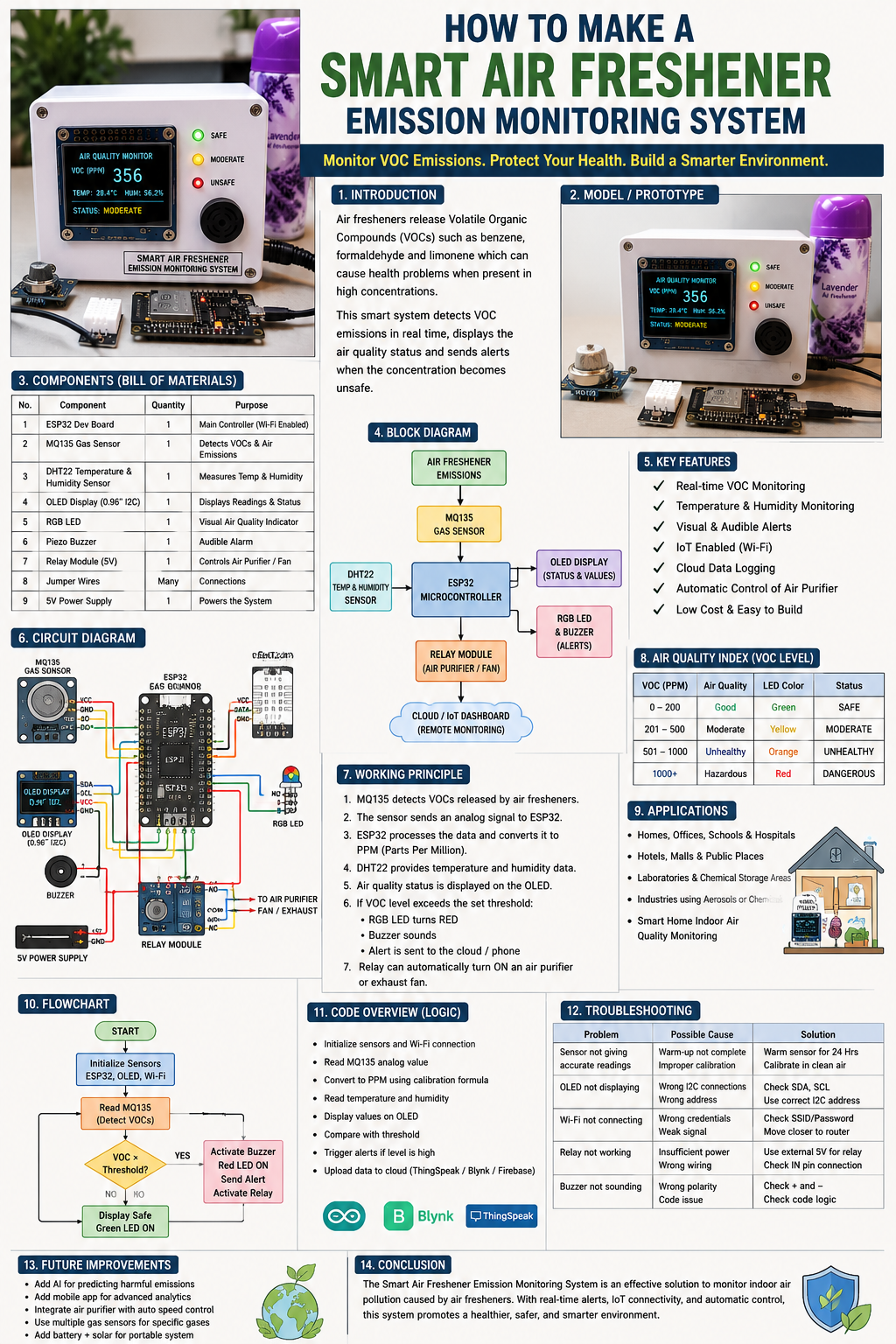
.
Meta Title: How to Make a Smart Air Freshener Emission Monitoring System Using ESP32 and Gas Sensors
Meta Description: Learn how to build a Smart Air Freshener Emission Monitoring System using ESP32, MQ135 gas sensor, OLED display, and IoT technology. Includes wiring diagrams, bill of materials, working principle, flowcharts, troubleshooting tips, and real project applications.
Indoor air pollution is becoming a major health concern due to excessive use of air fresheners, perfumes, aerosols, and cleaning chemicals. Most commercial air fresheners release Volatile Organic Compounds (VOCs) that may contribute to respiratory problems, allergies, headaches, and long-term health risks.
This project demonstrates how to make a Smart Air Freshener Emission Monitoring System capable of continuously monitoring VOC emissions, displaying indoor air quality conditions, and sending alerts when emission levels exceed safe limits.
Quick Answer: Smart Air Freshener Monitoring Wiring Diagram
If you want to build the project immediately, use the following connection table.
| Component | Pin | ESP32 Pin |
|---|---|---|
| MQ135 Gas Sensor | AO | GPIO34 |
| DHT22 Temperature Sensor | DATA | GPIO4 |
| OLED Display | SDA | GPIO21 |
| OLED Display | SCL | GPIO22 |
| RGB LED | Signal | GPIO19 |
| Buzzer | Positive | GPIO18 |
| Relay Module (Optional Air Purifier) | IN | GPIO23 |
Important: The MQ135 sensor requires a warm-up period of approximately 24 hours for accurate measurements.
System Workflow
Air Freshener → VOC Emissions → MQ135 Sensor → ESP32 Processing → Display & Alerts → Cloud Dashboard
Today 3:57 PM
Pasted markdown.md
File
use this format”
I have followed the same format from your uploaded blog structure.
How to Make a Smart Air Freshener Emission Monitoring System
Meta Title: How to Make a Smart Air Freshener Emission Monitoring System Using ESP32 and IoT
Meta Description: Learn how to build a Smart Air Freshener Emission Monitoring System using ESP32, MQ135 gas sensors, OLED displays, and IoT technologies. Includes wiring diagrams, BOM tables, working principle, flowcharts, troubleshooting tips, and real project applications.
Focus Keyword: How to Make a Smart Air Freshener Emission Monitoring System
Secondary Keywords: Smart VOC monitoring system, ESP32 air quality monitor, Arduino environmental monitoring project, indoor air pollution detector.
Air fresheners are commonly used in homes, schools, offices, and hotels to improve indoor environments. However, many commercial air fresheners release Volatile Organic Compounds (VOCs) such as benzene, formaldehyde, limonene, and ethanol that may cause headaches, respiratory problems, allergies, and long-term health risks.
A Smart Air Freshener Emission Monitoring System continuously measures these emissions and alerts users whenever air quality becomes unsafe.
This project combines Chemistry, Environmental Science, ICT, Engineering, and IoT technologies, making it an excellent STEM and KSEF project.
Quick Answer: Smart Air Freshener Monitoring Wiring Diagram
If you want to build the project immediately, use the following wiring configuration.
| Component | Pin | ESP32 Pin |
|---|---|---|
| MQ135 Gas Sensor | AO | GPIO34 |
| DHT22 Temperature Sensor | DATA | GPIO4 |
| OLED Display | SDA | GPIO21 |
| OLED Display | SCL | GPIO22 |
| RGB LED | Signal | GPIO19 |
| Piezo Buzzer | Positive | GPIO18 |
| Relay Module (Optional Air Purifier) | IN | GPIO23 |
| Wi-Fi Module | Built into ESP32 | — |
Important: The MQ135 sensor should warm up for several hours before obtaining accurate VOC readings.
System Workflow
Air Freshener → VOC Emissions → MQ135 Sensor → ESP32 Processing → Display & Alerts → Cloud Dashboard


4
Why Build a Smart Air Freshener Emission Monitoring System?
Although air fresheners improve smell, they may introduce harmful pollutants into indoor environments.
This system helps users:
Benefits
- Monitor indoor VOC concentrations
- Reduce exposure to harmful chemicals
- Improve respiratory health
- Automatically activate ventilation systems
- Record long-term air quality trends
- Support environmental research
This project is ideal for smart homes and environmental health monitoring.
How Does the Smart Air Freshener Monitoring System Work?
The system consists of four major sections.
1. VOC Detection
The MQ135 sensor detects gases released from air fresheners.
2. Environmental Monitoring
The DHT22 measures temperature and humidity, which influence VOC concentrations.
3. ESP32 Processing
The ESP32 continuously analyzes sensor data and compares it with safety thresholds.
4. Alert System
When VOC levels become excessive:
- OLED displays warning messages.
- RGB LEDs change colour.
- Buzzer activates.
- Mobile notifications can be sent.


4
Bill of Materials (BOM)
| Component | Quantity | Purpose |
|---|---|---|
| ESP32 Development Board | 1 | Main controller |
| MQ135 Gas Sensor | 1 | Detect VOC emissions |
| DHT22 Sensor | 1 | Measure temperature and humidity |
| OLED Display | 1 | Display readings |
| RGB LED | 1 | Visual alerts |
| Piezo Buzzer | 1 | Audible alarms |
| Relay Module | 1 | Controls ventilation system |
| Breadboard | 1 | Circuit assembly |
| Jumper Wires | Several | Electrical connections |
| USB Cable | 1 | Power supply |
Estimated Project Cost
| Item | Approximate Cost |
|---|---|
| ESP32 | $8 |
| MQ135 Sensor | $4 |
| OLED Display | $5 |
| DHT22 | $4 |
| Miscellaneous | $10 |
Estimated Total Cost: $30–40
Circuit Connections Explained
MQ135 Sensor
- VCC → 5V
- GND → GND
- AO → GPIO34
DHT22 Sensor
- DATA → GPIO4
OLED Display
- SDA → GPIO21
- SCL → GPIO22
Alert Components
RGB LED → GPIO19
Buzzer → GPIO18
Relay Module → GPIO23

6
Step-by-Step Guide: How to Make a Smart Air Freshener Emission Monitoring System
Step 1: Assemble the ESP32 Circuit
Connect the MQ135 sensor, OLED display, DHT22, LEDs, and buzzer according to the connection table.
Double-check all wiring before powering the system.
Step 2: Install the Sensor
Place the MQ135 sensor near the air freshener source.
Avoid placing it directly in front of fans or windows.
Step 3: Upload the ESP32 Program
The program should:
- Continuously monitor VOC levels.
- Display readings on OLED.
- Activate alarms when thresholds are exceeded.
- Send cloud updates via Wi-Fi.
Example logic:
IF VOC Level > Safe Threshold

Display Warning

Activate Buzzer

Turn LED Red

Send Notification

ELSE

Display Safe Status

Turn LED Green
Step 4: Test the System
Spray different air fresheners and verify:
- Sensor response
- OLED updates
- Alarm activation
- Mobile notifications


5
ESP32 Program Logic
The ESP32 continuously repeats the following process:
- Read VOC concentration.
- Measure temperature and humidity.
- Compare readings with safety thresholds.
- Display status.
- Activate alarms if necessary.
- Upload data to cloud dashboards.
This feedback loop provides continuous indoor air quality monitoring.
Chemistry Behind the Project
Air fresheners release compounds such as:
- Ethanol
- Limonene
- Formaldehyde
- Benzene derivatives
These compounds may react with ozone and produce secondary pollutants.
This project therefore supports:
- Environmental Chemistry
- Indoor Air Pollution Research
- Human Health Protection
Applications
This monitoring system can be used in:
- Homes
- Hospitals
- Schools
- Hotels
- Laboratories
- Offices
- Shopping malls
- Manufacturing industries
Advantages and Limitations
Advantages
- Real-time monitoring
- Low cost
- Easy to build
- Improves indoor health
- Expandable to smart homes
Limitations
- MQ135 cannot identify individual gases.
- Requires periodic calibration.
- Sensor readings are affected by humidity.
Safety Tips
- Avoid placing sensors directly in concentrated sprays.
- Use stable power supplies.
- Keep electronics away from moisture.
- Calibrate sensors regularly.
Frequently Asked Questions
Can I Identify Specific Air Fresheners?
Yes. Machine learning models can be trained using sensor patterns.
Can I Monitor Data Remotely?
Yes. ESP32 supports cloud dashboards such as:
- Blynk
- ThingSpeak
- MQTT
Can the System Automatically Improve Air Quality?
Yes. A relay can automatically activate:
- Exhaust fans
- Air purifiers
- Ventilation systems
How to Fix Common ESP32 Upload Errors
Error: Failed Connecting to ESP32
Solutions
- Hold the BOOT button during upload.
- Install USB drivers.
- Verify COM port.
Error: MQ135 Gives Incorrect Readings
Solutions
- Allow warm-up time.
- Calibrate the sensor.
- Avoid strong airflow.
Error: OLED Not Displaying
Solutions
- Verify SDA and SCL wiring.
- Check I2C address.
Error: Wi-Fi Connection Failure
Solutions
- Verify SSID and password.
- Restart the ESP32.
- Ensure good signal strength.


5
Final Thoughts
Learning how to make a Smart Air Freshener Emission Monitoring System is one of the most practical environmental monitoring projects using ESP32 and IoT technology.
By combining VOC sensors, environmental monitoring, wireless communication, and smart alerts, you can develop a powerful system that protects human health while promoting safer indoor environments.