mbeva
mbeva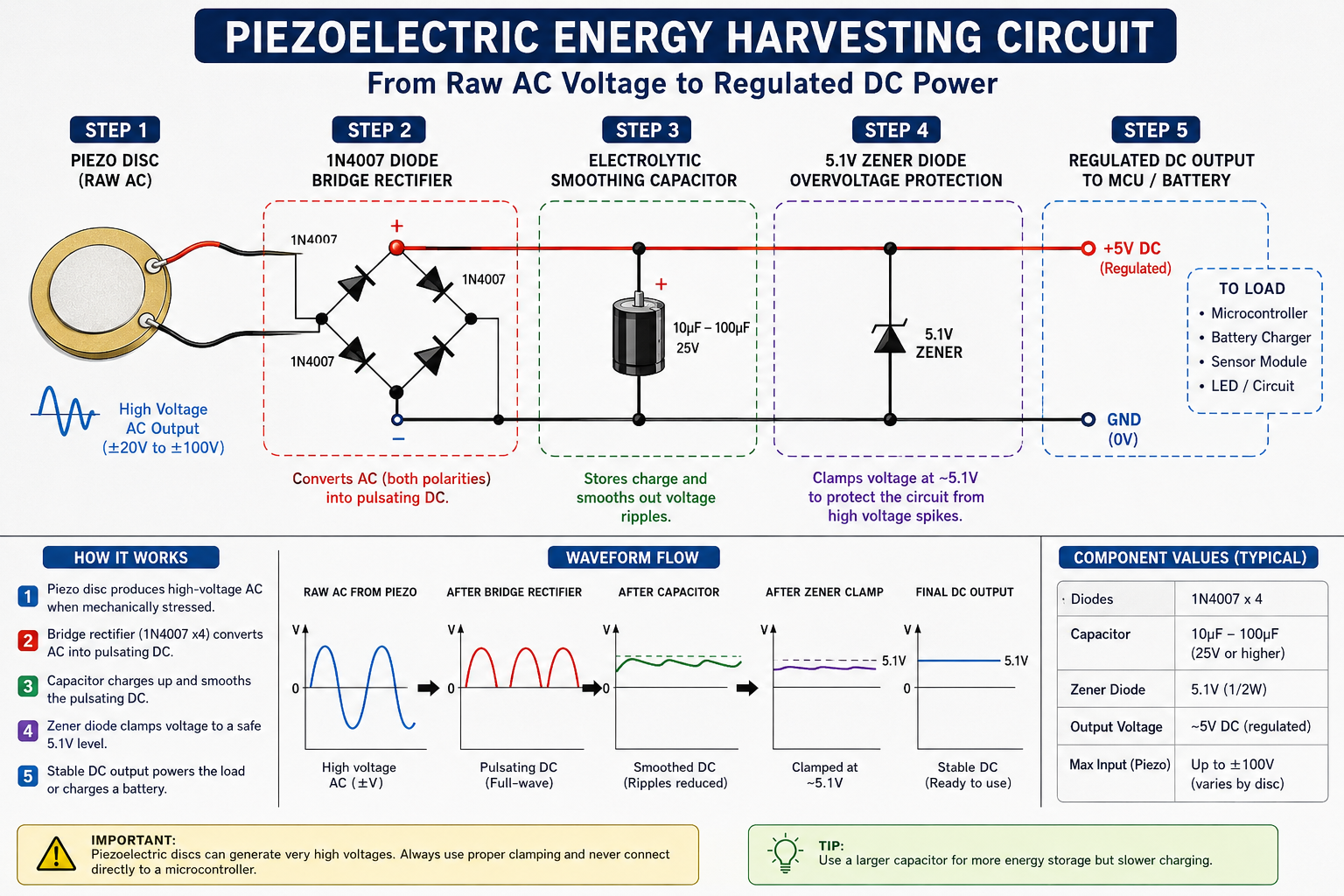
Top 5 Piezoelectric Projects for Engineering Students (With Circuit Diagrams)
As the global demand for sustainable, decentralized green energy alternatives grows, ambient kinetic energy harvesting has quickly become one of the most exciting sub-fields in mechatronics, embedded systems, and electrical engineering. At the heart of this technological movement is the piezoelectric transducer—a smart material capable of converting mechanical stress, structural vibrations, or physical impact directly into usable electrical voltage.
For engineering students looking for a high-impact capstone project, a standout final-year design, or a robust addition to a professional robotics and hardware portfolio, building an application around piezoelectricity is the ultimate choice. It offers the perfect multidisciplinary blend of material science, analog circuit design, power management, and firmware programming.
This comprehensive guide breaks down the top 5 piezoelectric projects for engineering students, complete with real-world target applications, component checklists, structural design logic, and the core circuit architectures needed to build them from scratch.
The Universal Foundation: The Energy Harvesting Circuit
Before diving into specific project builds, every kinetic energy harvesting application requires a way to capture, clean, and store the electricity generated by a piezoelectric element.
Piezo discs generate Alternating Current (AC) in highly erratic, jagged, high-voltage spikes whenever they are compressed, bent, or vibrated. Because microcontrollers (like Arduino or ESP32) and batteries require stable, low-voltage Direct Current (DC), you must route your piezo output through a standardized power-conditioning circuit.
[ STEP 1: Piezo Disc (Raw AC) ]
               │
               ▼
[ STEP 2: 1N4007 Diode Bridge Rectifier ]
               │ (Flips negative pulses to positive DC)
               ▼
[ STEP 3: Electrolytic Smoothing Capacitor ]
               │ (Fills up and levels out voltage ripples)
               ▼
[ STEP 4: 5.1V Zener Diode Overvoltage Protection ]
               │ (Clamps dangerous spikes to save your MCU)
               ▼
[ STEP 5: Regulated DC Output to Microcontroller / Battery ]
Core Hardware Components Checklist:
- Piezoelectric Transducers (PZT Ceramic Elements): Generates the raw AC spikes under mechanical stress.
- 1N4007 Rectifier Diodes (x4): Wired together to form a full-wave bridge rectifier to convert dual-polarity AC into single-polarity DC.
- Electrolytic Capacitor (10µF to 100µF): Acts as a temporary energy reservoir to smooth out transient voltage drops.
- Zener Diode (5.1V): Serves as an essential voltage regulator clamp, protecting sensitive microcontroller GPIO pins from high-voltage transients that could instantly fry the chip.
1. Smart Power-Generating Footwear (The Energy Shoe)
Project Overview
The “Smart Shoe” project integrates flat, low-profile piezoelectric elements directly into the insole of a sneaker. Every time the user takes a step, their body weight applies massive compressive forces to the shoe’s heel and ball, harvesting the kinetic energy of human locomotion. This harvested energy can be routed to a lithium-polymer (LiPo) battery mounted neatly on the shoelaces to charge small USB devices or power wearable biomedical health sensors.
System Architecture & Wiring Logic
To maximize total power output, multiple piezo discs are embedded across the highest-impact pressure points of the foot. These individual elements must be wired in a parallel configuration to increase the total current output (mA) flowing to the battery charging module, rather than boosting the voltage to dangerous levels.
[Piezo Disc Array in Parallel] ──> [Bridge Rectifier] ──> [Capacitor] ──> [TP4056 Lithium Charging Module] ──> [LiPo Battery]
Key Engineering Focus
Students tackling this build must prioritize ergonomics and material science. Because raw PZT ceramics are incredibly brittle, repeated impacts from a human body will crack the elements within minutes. You must design a custom encapsulation method—housing the sensor array inside a flexible resin matrix, 3D-printed TPU (Thermoplastic Polyurethane), or a layer of shock-absorbing EVA foam to distribute the load safely.
2. Kinetic Energy-Harvesting Floor Mats for Smart Buildings
Project Overview
Designed for high-density public infrastructure like school corridors, subway turnstiles, or mall entrances, this project scales up the footwear concept into a modular, interactive floor tile. When pedestrians walk across the tile, the downward mechanical compression depresses a spring-loaded housing mechanism that systematically strikes an underlying grid of piezoelectric transducers, generating localized power for sustainable building infrastructure.
[ Pedestrian Footstep Impact ]
              │
              ▼
[ Spring-Loaded Mechanical Top Plate ]
              │ (Distributes downward linear force evenly)
              ▼
[ Hybrid Series-Parallel Piezo Matrix ] ──> [ Rectifier Circuit ] ──> [ Low-Voltage LED Lighting Grid ]
Circuit Logic & Array Design
Unlike the footwear project, a floor mat covers a much larger surface area and experiences vastly different force distribution profiles. To optimize power transfer, the tile relies on a hybrid Series-Parallel matrix design:
- Small clusters of 4 piezo discs are wired in series to multiply the voltage output under lighter footfalls.
- These individual series clusters are then wired to one another in parallel to guarantee the system delivers adequate current to a central storage unit.
Key Engineering Focus
This project introduces students to mechanical leverage and civil design. Designing a robust spring-loaded mechanical plate that moves strictly vertically and distributes weight evenly across the entire sensor grid prevents point-failures and ensures that even light footsteps trigger the piezoelectric effect efficiently.
3. IoT Structural Health Monitoring (Vibration-Powered Sensor Node)
Project Overview
Bridges, overpasses, and heavy industrial machinery experience constant micro-vibrations that indicate structural fatigue, micro-fractures, or mechanical misalignment over time. This project functions as an entirely self-powered Internet of Things (IoT) sensor node. A tuned cantilever piezoelectric sensor detects ambient mechanical vibrations in a structure and uses those exact vibrations to self-power an ultra-low-power microcontroller (such as an MSP430) to periodically transmit structural health telemetry via Bluetooth Low Energy (BLE) or LoRaWAN.
[ Ambient Bridge Vibration ] ──> [ Tuned Cantilever Piezo ] ──> [ Power Management IC (LTC3588) ] ──> [ Ultra-Low-Power MCU ] ──> [ LoRaWAN Transmitter ]
Key Engineering Focus
Students will dive deep into the concepts of resonance tuning. A piezoelectric cantilever beam must be calibrated with a specific tip mass so that its natural resonant frequency matches the exact operational vibration frequency of the bridge or machinery it is monitoring. When resonance is successfully achieved, power generation spikes exponentially, allowing the system to sleep, harvest energy, wake up, transmit data, and return to sleep indefinitely without a battery swap.
4. Acoustic Emission Overload Detector for Industrial Machinery
Project Overview
Industrial gearboxes and high-speed bearings emit unique, high-frequency acoustic signatures immediately prior to catastrophic structural failure. This project utilizes a highly sensitive piezoelectric transducer not as a power source, but as an active, high-impedance contact microphone to listen for structural acoustic emissions. When internal friction noise crosses a safe, pre-calibrated threshold, the circuit triggers an automated emergency shutdown relay to prevent factory accidents.
Circuit Topology Breakdown
Because this application treats the piezo element as an active data sensor, the raw signal conditioning circuit requires highly sensitive, specialized components to amplify tiny acoustic pulses:
[ High-Frequency Acoustic Shockwave ]
                  │
                  ▼
[ Piezo Sensor Element ]
                  │ (Generates tiny microvolt fluctuations)
                  ▼
[ High-Impedance Operational Amplifier (LM358 Charge Amp) ]
                  │ (Amplifies weak signal while preventing signal loading)
                  ▼
[ Hardware High-Pass Filter Circuit ]
                  │ (Strips away low-frequency ambient factory floor hum)
                  ▼
[ Hardware Analog Comparator with Adjustable Potentiometer ]
                  │ (Compares live signal against safety threshold voltage)
                  ▼
[ Microcontroller GPIO Interrupt Pin ] ──> [ Solid-State Emergency Stop Relay ]
Key Engineering Focus
Signal conditioning and filtering are paramount here. Students must design and implement precise active high-pass and low-pass filter networks to isolate the target high-frequency structural fault signals while maintaining high noise immunity against low-frequency background machinery noise.
5. Piezoelectric Raindrop Energy Harvester (Smart Roof Prototype)
Project Overview
While traditional solar panels struggle to generate electricity during heavy, dark, overcast rainstorms, a piezoelectric smart roof thrives. This project utilizes flexible PVDF (Polyvinylidene Fluoride) polymer piezo strips mounted as an array of overlapping roof shingles. When heavy raindrops impact the panels, the sudden physical deflection of the flexible polymer film generates sharp electrical pulses, creating an alternative, weather-resistant green energy source during poor solar conditions.
System Architecture
Because raindrop impacts are characterized as high-velocity, short-duration impulses, standard chemical batteries cannot absorb the energy quickly enough without degrading.
[ PVDF Rain Shingle Deflection ] ──> [ Fast-Switching Schottky Diodes ] ──> [ Central Supercapacitor Bank ] ──> [ Step-Down Buck Regulator ]
Instead of a battery, the system directs the conditioned current into a high-capacity Supercapacitor bank, which can absorb high-speed, erratic electrical surges with near-perfect efficiency.
Key Engineering Focus
This project tests your material selection skills. Students must document and analyze why flexible PVDF polymers are vastly superior to rigid PZT ceramics for outdoor, high-flex weather applications where complete waterproofing, UV resistance, and wide-angle deflection are required.
Summary: Tips for Project Presentation & Grading Success
When demonstrating a piezoelectric project for engineering students to an examination panel or grading committee, success comes down to real-time data visualization.
Do not just show an LED blinking. Instead, integrate a small 16×2 I2C LCD screen or a live serial plot interface to display live metrics of your device under testing:
| Measured System Metric | Testing Tool / Method |
|---|---|
| Open Circuit Voltage (Voc) | Multimeter / Oscilloscope Probe |
| Peak Charging Current (mA) | Inline Ammeter Circuit |
| Cumulative Energy Harvested (Joules) | Software Integration (J = V × I × t) |
Demonstrating a clear, mathematical understanding of impedance matching—proving how your circuit’s input impedance matches the naturally high internal impedance of the piezoelectric elements—will guarantee your project scores top marks for both technical execution and innovative engineering design.