mbeva
Category: Education, STEM and Innovation
Introduction
Mathematics is increasingly becoming an important driver of innovation, technological advancement and practical problem-solving in modern education. At the 2026 Kenya Science and Engineering Fair (KSEF) Nationals, Senior School students demonstrated how mathematical concepts can be transformed into practical innovations that address real-life challenges.
The Mathematical Science category featured 32 projects from different schools across Kenya, covering geometry, probability, computational mathematics, measurement, mathematical modelling, accessibility technology and interactive learning systems.
The projects demonstrated that mathematics is not simply a subject involving calculations, equations and formulas. It can also provide solutions to challenges affecting people with visual impairments, improve measurement accuracy, support financial planning and introduce innovative teaching approaches.
One of the outstanding projects was Volume of Frustum from Kibutha Girls, which emerged as the national winner with 48.500 marks.
As schools begin preparing for the 2027 Kenya Science and Engineering Fair, the 2026 projects provide important lessons for learners, mathematics teachers and STEM project supervisors looking for innovative ideas.
This article examines the leading projects, their potential applications and promising mathematical science innovations students can develop for KSEF 2027.
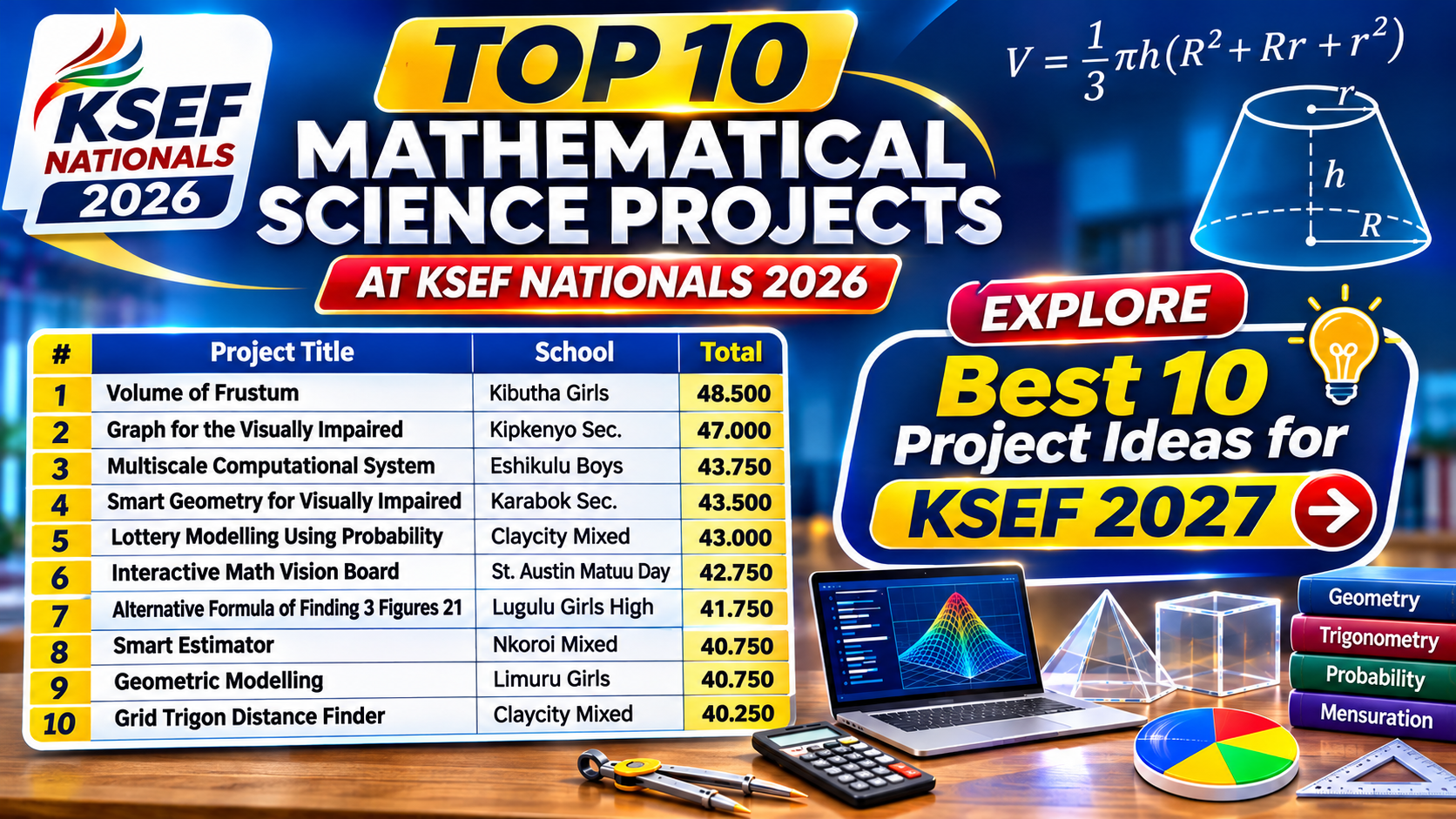
Top 10 Mathematical Science Projects at KSEF Nationals 2026
According to the 2026 national ranking report, the following projects occupied the leading positions in the Senior School Mathematical Science category.
1. Volume of Frustum – Kibutha Girls
Position: 1st
Score: 48.500 marks
Students: Joy Kuria and Trizah Kamaru
Region: Central
The project emerged as the best Mathematical Science innovation at the 2026 KSEF Nationals.
The volume of a frustum is an important mathematical concept applied in engineering, architecture, construction and manufacturing.
A frustum is formed when a cone or pyramid is cut by a plane parallel to its base.
The project provides an opportunity to demonstrate mathematical calculations using physical models, practical measurements and geometric relationships.
Potential applications include:
- Calculating the capacity of water tanks.
- Designing storage containers.
- Estimating the volume of construction materials.
- Supporting engineering measurements.
- Improving understanding of three-dimensional geometry.
2. Graph for the Visually Impaired – Kipkenyo Secondary School
Position: 2nd
Score: 47.000 marks
Students: Tuwei Milton and Raymond Kipchirchir
Region: Rift Valley
This project demonstrated the potential of mathematical innovation in promoting inclusive education.
Graphs are important mathematical tools used to represent relationships between variables. However, conventional graphs depend heavily on visual interpretation.
A graph designed for visually impaired learners could incorporate tactile surfaces, raised lines, audio explanations and other accessible features.
Possible applications include:
- Inclusive mathematics education.
- Supporting learners with visual impairments.
- Improving accessibility of mathematical information.
- Developing assistive learning technologies.
This is an important direction for future STEM innovations because technology should make education accessible to everyone.
3. Multiscale Computational System – Eshikulu Boys
Position: 3rd
Score: 43.750 marks
Students: Adrian Lucky and Elton Aseri
Region: Western
Computational mathematics involves using mathematical principles and computer-based techniques to solve complex problems.
A multiscale computational system provides an interesting opportunity to explore how mathematical problems can be represented and analysed at different scales.
Potential applications include scientific modelling, engineering simulations, numerical analysis and computer-based problem-solving.
4. Smart Geometry for Visually Impaired – Karabok Secondary School
Position: 4th
Score: 43.500 marks
Students: Tonny Blaire and Joel Orege
Region: Nyanza
The project focused on making geometry more accessible to learners with visual impairments.
A smart geometry model could incorporate tactile shapes, electronic sensors, audio feedback and interactive components.
It offers opportunities for developing inclusive learning resources for geometry.
5. Lottery Modelling Using Probability – Claycity Mixed
Position: 5th
Score: 43.000 marks
Student: Sean Kinyua
Region: Nairobi
Probability is widely applied in statistics, risk assessment, forecasting and decision-making.
This project explored the use of probability principles in lottery modelling.
Students can investigate theoretical probability, experimental probability, random events and mathematical predictions.
The mathematical principles also have applications in insurance, financial risk analysis and statistical modelling.
6. Interactive Math Vision Board – St. Austin Matuu Day
Position: 6th
Score: 42.750 marks
Students: Musembi Nthenya and Peter Mutua
Region: Eastern
Interactive mathematical learning systems can make abstract concepts easier to understand.
A mathematical vision board can provide opportunities for visual representation, interactive learning and practical demonstrations.
7. Alternative Formula of Finding 3 Figures 21 – Lugulu Girls High School
Position: 7th
Score: 41.750 marks
Students: Trina Mulati and Shalvine Dondo
Region: Western
This project explored an alternative mathematical approach to solving a numerical problem.
It demonstrates the importance of mathematical creativity, formula development and the investigation of alternative problem-solving methods.
8. Smart Estimator – Nkoroi Mixed
Position: 8th
Score: 40.750 marks
Students: Ezekiel Masese and Catherine Njeri
Region: Rift Valley
Estimation is an important mathematical skill used in everyday activities.
A smart estimator can explore how mathematical calculations and measurement techniques can improve the accuracy of estimates.
Potential applications include construction, budgeting, resource planning and measurements.
9. Geometric Modelling – Limuru Girls
Position: 8th
Score: 40.750 marks
Students: Faith Nduta and Patricia Wangu
Region: Central
Geometric modelling uses mathematical representations to explain shapes, dimensions and spatial relationships.
It has applications in architecture, engineering, computer graphics and product design.
10. Grid Trigon Distance Finder – Claycity Mixed
Position: 10th
Score: 40.250 marks
Students: Joyline Akinyi and Josphine Anyango
Region: Nairobi
Trigonometry is widely used in surveying, navigation, construction and engineering.
A grid-based trigonometric distance finder can demonstrate how angles and mathematical relationships can be applied to calculate distances.
Other Outstanding Mathematical Science Projects at KSEF 2026
Beyond the top ten, other schools presented innovative mathematical models and practical learning systems.
The remaining projects included:
- The Geometry of Multiplication – Enomatasianni Girls.
- Smart Area and Perimeter Finder – Ng’iya Girls.
- The Crosslink Angle Formula Model – Makueni Boys Senior School.
- The General Representation Matrix Formula – Wajir Girls.
- Transformation Geometry – Akithii Girls.
- LED Circle Model – Kibirichia Girls.
- Tiltmeter – Taru Boys.
- Tactile Trigonometry – Mary Hill.
- Digital Clinometer Using Laser Technology – Kabare Girls.
- Digital Globe – Ribe Girls.
- Measurement Tool for the Visually Impaired – Mama Ngina Girls.
- Design and Validation of Geometry – Rangala Girls.
- Digital Bi-Purpose Pair of Compass – Nakuru Girls.
- Arc Length, Area, Volume Constants Table – Friends School Kitale.
- Multi-Angle 3D – Mazeras Girls.
- Hotel Meal Planning Using Probability – Claycity Mixed.
- Tri Model – Chebuyusi Secondary School.
- Home Chama Saving Algorithm – Kahawa Garrison.
- Algebraic Method in Divisibility (Test for 71, 13 and 91) – County High School.
- Finding Volume of a Conical Frustum – Mandera Boys.
- Effect of Visual Error-Coding on Accuracy – Wajir School for the Deaf.
- Duplex Method of Finding Squares – Nyambaria High School.
These projects demonstrate the diversity of mathematical applications in Senior School education.
What Made the 2026 Mathematical Science Projects Outstanding?
The projects provide several important lessons for schools preparing for future science fairs.
1. Solving Real-Life Problems
Projects addressing accessibility, measurement, construction and financial planning demonstrate how mathematics can solve practical problems.
2. Integration of Technology
The use of digital systems, LEDs, laser technology and computational approaches creates opportunities to improve traditional mathematical models.
3. Inclusive Education
Projects designed for visually impaired learners demonstrate how mathematical innovation can promote equal learning opportunities.
4. Practical Demonstration
A mathematical project becomes more meaningful when learners can demonstrate its operation through a physical model, interactive system or practical application.
5. Originality and Creativity
Students should investigate existing mathematical principles and identify opportunities to develop improved models, alternative approaches or practical applications.
20 Promising Mathematical Science Project Ideas for KSEF 2027
Students and teachers preparing for the 2027 Kenya Science and Engineering Fair can explore the following ideas.
| No. | Project Idea | Main Mathematical Concept |
|---|---|---|
| 1 | AI-Powered Mathematical Problem Solver | Algorithms and algebra |
| 2 | Smart Digital Theodolite | Trigonometry |
| 3 | Automated Land Area Measurement System | Geometry |
| 4 | Interactive 3D Geometry Learning Model | Spatial geometry |
| 5 | Mathematical Model for Predicting Crop Yields | Statistics |
| 6 | Smart School Timetable Optimization System | Optimization |
| 7 | Digital Probability Experiment Simulator | Probability |
| 8 | Mathematical Model for Traffic Flow Prediction | Statistics |
| 9 | Tactile Mathematics Learning System | Inclusive mathematics |
| 10 | Smart Construction Material Estimator | Geometry and measurement |
| 11 | AI-Based Error Detection in Mathematical Calculations | Computational mathematics |
| 12 | Digital Trigonometric Height Finder | Trigonometry |
| 13 | Mathematical Model for Water Distribution | Ratios and optimization |
| 14 | Interactive Coordinate Geometry Board | Coordinate geometry |
| 15 | Smart Financial Savings Calculator | Financial mathematics |
| 16 | Mathematical Model for Predicting School Performance | Statistics |
| 17 | Automated Solar Panel Angle Optimizer | Trigonometry |
| 18 | Digital Volume and Surface Area Calculator | Mensuration |
| 19 | Mathematical Model for Reducing Food Wastage | Statistics and optimization |
| 20 | Computer-Based Mathematical Pattern Recognition | Algebra and algorithms |
How Schools Can Prepare Winning Mathematics Projects for KSEF 2027
Preparation for KSEF 2027 should begin early.
Teachers and project supervisors should encourage learners to identify problems within their communities and investigate how mathematical principles can provide practical solutions.
The following approaches can help strengthen project development.
Identify a problem: Begin with a clearly defined challenge that requires mathematical investigation.
Develop a mathematical model: Identify the relevant formulas, mathematical relationships and principles.
Construct a prototype: Where possible, develop a working model that demonstrates the mathematical concept.
Collect experimental data: Conduct repeated measurements and record observations.
Test accuracy: Compare the results obtained from the model with established mathematical calculations or accepted measurement methods.
Evaluate performance: Identify limitations, errors and opportunities for improvement.
Prepare documentation: Maintain project records, calculations, photographs, tables and experimental results.
Demonstrate originality: Explain what makes the project different from existing solutions.
Why Mathematics Projects Matter in Competency-Based Education
The transition to Competency-Based Education has increased the importance of practical learning, creativity, critical thinking and problem-solving.
Mathematical science projects provide opportunities for learners to apply classroom knowledge beyond conventional examinations.
Through project-based learning, students can demonstrate:
- Critical thinking.
- Creativity and innovation.
- Communication and collaboration.
- Digital literacy.
- Mathematical reasoning.
- Problem-solving.
- Research and investigation.
Senior School learners following the STEM pathway can particularly benefit from practical mathematical investigations that connect mathematics with engineering, technology and scientific applications.
Final Thoughts: Preparing for KSEF 2027
The KSEF Nationals 2026 Mathematical Science category demonstrated that Kenyan students have significant potential to develop innovative mathematical solutions.
From the Volume of Frustum project by Kibutha Girls to the Graph for the Visually Impaired by Kipkenyo Secondary School, the innovations demonstrated how mathematical knowledge can address practical challenges.
As schools prepare for KSEF 2027, teachers should encourage learners to move beyond ordinary mathematical demonstrations and develop original, testable and practical innovations.
The future of mathematical science education will increasingly depend on the ability of learners to combine mathematical reasoning, technology and creativity to solve real-world problems.
Download 2026 National KSEF mathematics project results