mbeva
mbeva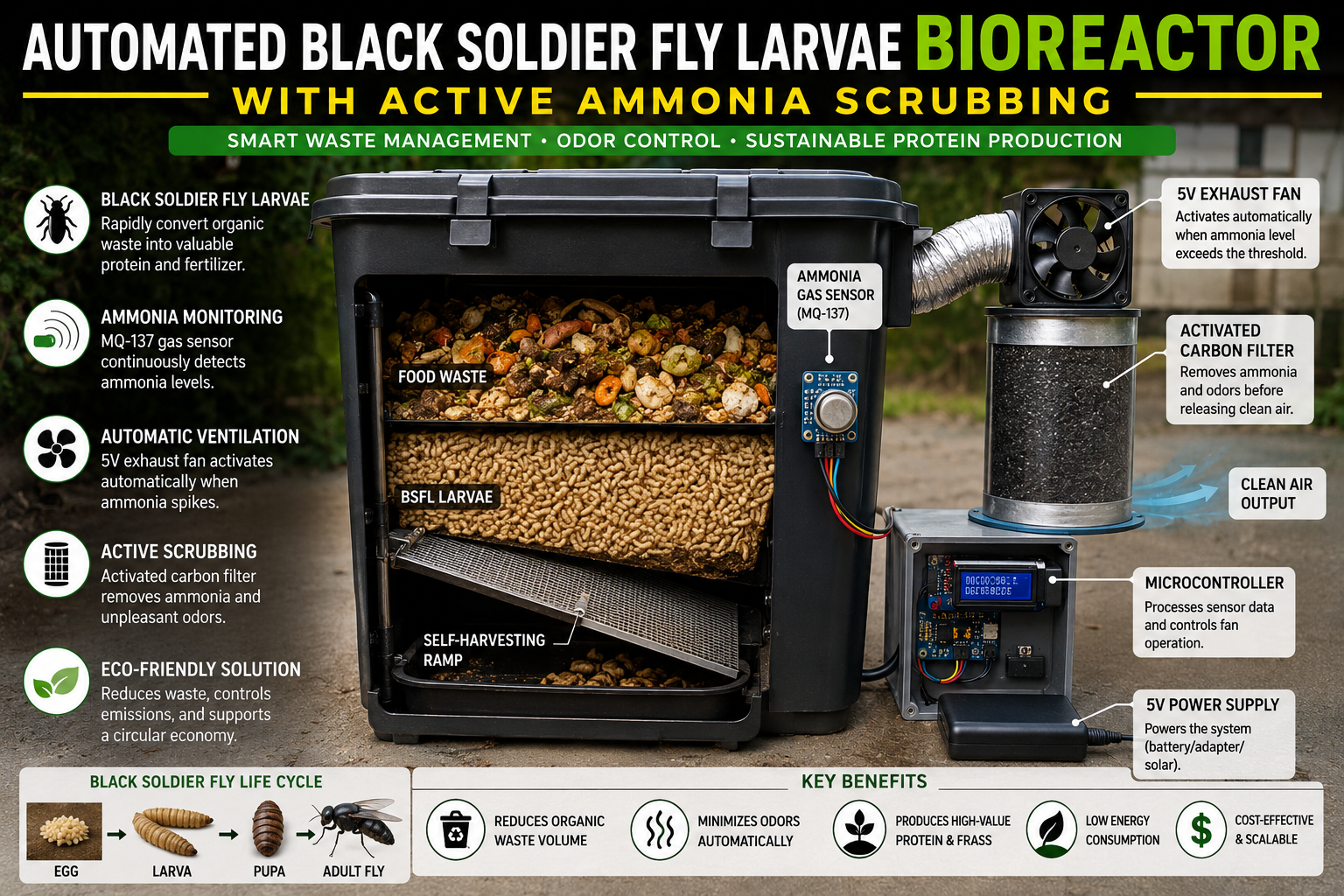
Introduction
Rapid urbanization and population growth have led to increased generation of organic waste from households, markets, schools, and food processing facilities. Improper disposal of biodegradable waste contributes to greenhouse gas emissions, unpleasant odors, pest infestations, and environmental pollution.
Black Soldier Fly Larvae (BSFL) offer an innovative solution by converting organic waste into valuable products such as high-protein animal feed and nutrient-rich frass fertilizer.
However, conventional BSFL systems can produce unpleasant odors and harmful gases, especially ammonia, when waste is overfed or poorly managed.
This project investigates the design of an automated BSFL bioreactor equipped with an active ammonia scrubbing system that detects elevated ammonia levels and automatically activates an exhaust fan connected to an activated carbon filter.


4
Statement of the Problem
Traditional organic waste disposal methods, including open dumping and landfilling, create environmental challenges such as:
- Methane emissions
- Bad odors
- Attraction of pests
- Soil and water contamination
Although BSFL technology effectively reduces organic waste volume, excessive ammonia production can:
- Lower larval growth rates
- Create unpleasant working conditions
- Reduce community acceptance
- Indicate poor bioreactor performance
There is a need for an intelligent BSFL system that automatically monitors and controls ammonia levels.
Objectives
General Objective
To design and construct an automated Black Soldier Fly Larvae bioreactor with active ammonia scrubbing for efficient organic waste processing.
Specific Objectives
- To construct a BSFL bioreactor using locally available materials.
- To integrate ammonia gas sensors for real-time monitoring.
- To automate ventilation using a 5V exhaust fan.
- To reduce ammonia concentrations using an activated carbon filter.
- To evaluate waste reduction efficiency and larval growth performance.
How the System Works
Organic waste is added to the bioreactor, where BSFL consume and decompose it.
An ammonia gas sensor continuously monitors air quality inside the chamber.
When ammonia concentrations exceed a predefined threshold, a microcontroller automatically activates a 5V exhaust fan.
The fan pulls contaminated air through an activated carbon filter, which adsorbs ammonia and reduces odor emissions.
Once gas levels return to acceptable values, the fan switches off automatically.
System Flow Diagram
Organic Waste + BSFL
          ↓
     Bioreactor Chamber
          ↓
   Ammonia Gas Sensor
          ↓
      Microcontroller
          ↓
   5V Exhaust Fan ON/OFF
          ↓
 Activated Carbon Filter
          ↓
      Clean Air Output


4
Materials and Equipment
| Component | Quantity |
|---|---|
| Plastic bioreactor container (50–100 L) | 1 |
| Black Soldier Fly larvae | 500–1,000 |
| Organic waste | As required |
| Ammonia gas sensor (MQ-137 or equivalent) | 1 |
| Microcontroller (Arduino Uno or ESP32) | 1 |
| 5V exhaust fan | 1 |
| Activated carbon filter | 1 |
| Relay module or transistor switch | 1 |
| Temperature and humidity sensor | 1 |
| Power supply or battery pack | 1 |
| Ventilation tubing | As required |
| Mesh screen | 1 |
Bioreactor Design
The bioreactor should include:
- Waste feeding chamber
- Larvae processing zone
- Leachate collection area
- Gas monitoring compartment
- Ventilation outlet
- Self-harvesting ramp for mature larvae
Ensure adequate drainage and airflow while preventing pest entry.
Bioreactor Layout
 ┌─────────────────────────┐
 │ Organic Waste Input     │
 ├─────────────────────────┤
 │ BSFL Processing Zone    │
 │                         │
 │  Gas Sensor             │
 │                         │
 ├─────────────────────────┤
 │ Leachate Collection     │
 └─────────────────────────┘
             │
             ▼
       Exhaust Fan
             │
             ▼
   Activated Carbon Filter
             │
             ▼
         Clean Air


4
Construction Procedure
Step 1: Prepare the Bioreactor Container
Select a plastic container with a secure lid.
Drill ventilation openings and install mesh screens to prevent pest entry.
Step 2: Install the Self-Harvesting Ramp
Create an inclined ramp that allows mature larvae to migrate into a collection container.
Step 3: Install the Gas Monitoring System
Mount the ammonia sensor near the top of the chamber where gases accumulate.
Connect the sensor to the microcontroller.
Step 4: Install the Ventilation System
Attach the 5V exhaust fan to an outlet port.
Connect the outlet to an activated carbon filter using flexible tubing.
Step 5: Program the Controller
Configure the microcontroller to:
- Continuously monitor ammonia concentration
- Activate the fan above a threshold value
- Deactivate the fan when levels normalize
Step 6: Introduce BSFL and Organic Waste
Add larvae and feedstock to the chamber.
Begin monitoring system performance.
Experimental Procedure
- Record the initial weight of organic waste.
- Add a fixed number of larvae.
- Monitor ammonia levels every hour.
- Record fan activation frequency.
- Measure internal temperature and humidity.
- Weigh residual waste after processing.
- Measure harvested larvae biomass.
Data Collection
Gas Monitoring Table
| Time | Ammonia Level (ppm) | Fan Status | Temperature (°C) | Humidity (%) |
|---|---|---|---|---|
| 08:00 | ||||
| 12:00 | ||||
| 16:00 |
Waste Reduction Table
| Day | Initial Waste (kg) | Remaining Waste (kg) | Waste Reduction (%) |
|---|---|---|---|
| 1 | |||
| 3 | |||
| 5 |
Expected Results
The system is expected to:
- Reduce organic waste volume by 50–80%
- Lower ammonia emissions
- Eliminate unpleasant odors
- Improve larval growth rates
- Produce high-quality frass fertilizer
Expected performance indicators:
| Parameter | Target Value |
|---|---|
| Waste reduction | 50–80% |
| Ammonia concentration | <25 ppm |
| Fan response time | <10 seconds |
| Larval survival rate | >90% |


4
Advantages of the System
- Reduces landfill waste
- Produces valuable animal feed
- Minimizes odors automatically
- Improves environmental hygiene
- Operates with low energy consumption
- Supports circular economy practices
Limitations
- Sensors require calibration
- Activated carbon filters need replacement
- BSFL performance depends on feedstock quality
- Extreme temperatures may affect larval growth
Conclusion
The automated BSFL bioreactor demonstrates how biological waste conversion can be combined with smart environmental monitoring to create an efficient and sustainable waste management system.
By integrating ammonia detection, automated ventilation, and activated carbon scrubbing, the system improves odor control, enhances larval productivity, and increases community acceptance of BSFL technology.