mbeva
mbeva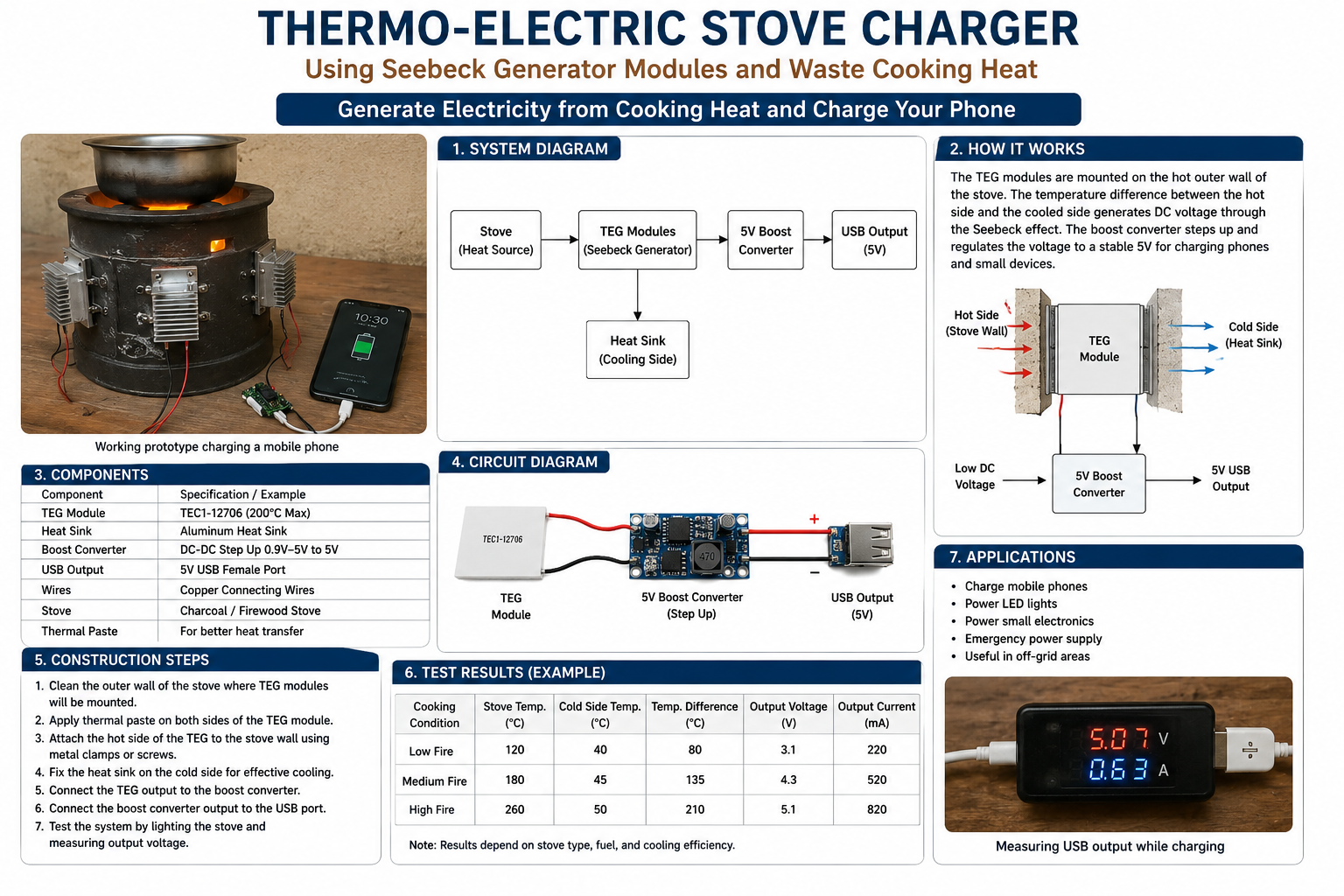
Introduction
Access to reliable electricity remains a challenge for many households that rely on charcoal and firewood stoves for daily cooking. Mobile phones have become essential tools for communication, mobile banking, education, and emergency response, yet charging services are often expensive or unavailable in remote areas.
At the same time, traditional cooking stoves release significant amounts of thermal energy into the environment. Most of this heat is wasted.
This project investigates how thermoelectric generator (TEG) modules can convert waste cooking heat into usable electrical energy capable of charging mobile phones and powering small electronic devices.
The system uses the Seebeck effect, where a temperature difference across a thermoelectric material generates an electrical voltage.

4
Statement of the Problem
Millions of households cook using biomass fuels but lack affordable access to electricity.
Common charging methods often require:
- Travelling long distances to charging stations
- Purchasing expensive solar systems
- Depending on unreliable grid electricity
Meanwhile, substantial heat generated during cooking is wasted.
There is a need for a low-cost, sustainable technology that converts this waste heat into useful electrical energy.
Objectives
General Objective
To design and construct a thermo-electric stove charger that converts waste cooking heat into electricity for charging mobile phones.
Specific Objectives
- To mount thermoelectric generator modules onto a charcoal or firewood stove.
- To generate electricity using the Seebeck effect.
- To regulate the output voltage using a 5V boost converter.
- To evaluate charging performance under different cooking conditions.
- To assess the feasibility of waste heat recovery for off-grid applications.
How the System Works
A thermoelectric generator produces electrical energy when a temperature difference exists between its two sides.
The hot side of the TEG module is attached directly to the stove wall, while the cold side is connected to an aluminum heat sink.
The temperature difference creates a direct current (DC) voltage, which is boosted and regulated to a stable 5V USB output.
System Flow Diagram
Heat from Stove
       ↓
TEG Modules
       ↓
5V Boost Converter
       ↓
USB Charging Port
       ↓
Mobile Phone


4
Materials and Equipment
| Component | Quantity |
|---|---|
| High-temperature TEG modules | 2–4 |
| Charcoal or firewood stove | 1 |
| Aluminum heat sinks | 2–4 |
| Thermal paste | 1 tube |
| 5V DC boost converter module | 1 |
| USB charging port | 1 |
| Connecting wires | Several |
| Metal brackets and screws | As required |
| Digital multimeter | 1 |
| Temperature sensors | 2 |
Construction Procedure
Step 1: Prepare the Stove
Select a charcoal or firewood stove with a metal outer wall that experiences consistent heating during cooking.
Step 2: Install the TEG Modules
Apply thermal paste to both sides of each TEG module to improve heat transfer.
Secure the hot side of each module against the stove wall using metal brackets.
Step 3: Attach the Heat Sinks
Mount aluminum heat sinks to the cold side of the modules.
Ensure sufficient airflow around the heat sinks to maximize the temperature difference.
Step 4: Connect the Circuit
Connect the TEG modules in series or parallel depending on the desired voltage and current output.
Wire the output to a 5V boost converter module and connect the converter to a USB charging port.
Step 5: Test the System
Light the stove and allow it to reach normal cooking temperature.
Measure:
- Hot-side temperature
- Cold-side temperature
- Output voltage
- Output current
Verify that the USB output remains close to 5V during operation.


4
Circuit Diagram
[Stove Wall]
      │
      ▼
┌────────────┐
│ TEG Module │
└────────────┘
      │
      ▼
┌────────────┐
│ Heat Sink  │
└────────────┘

TEG Output ──► 5V Boost Converter ──► USB Port ──► Phone
Experimental Procedure
- Record the ambient temperature.
- Measure the hot-side temperature every five minutes.
- Measure the cold-side temperature.
- Calculate the temperature difference.
- Measure output voltage and current.
- Connect a mobile phone and monitor charging performance.
- Repeat the test under different cooking conditions.
Data Collection
Temperature and Voltage Table
| Time (min) | Hot Side (°C) | Cold Side (°C) | Temperature Difference (°C) | Output Voltage (V) | Output Current (A) |
|---|---|---|---|---|---|
| 0 | |||||
| 5 | |||||
| 10 | |||||
| 15 |
Charging Performance Table
| Cooking Condition | Output Voltage (V) | Output Current (A) | Phone Charging Status |
|---|---|---|---|
| Low Heat | |||
| Medium Heat | |||
| High Heat |
Expected Results
The system is expected to achieve:
- Temperature difference: 50–150°C
- Raw TEG output: 1–4V
- Regulated USB output: 5V
- Charging current: 0.3–1.0A
Actual performance will depend on:
- Stove temperature
- Heat sink efficiency
- TEG module quality
- Ambient conditions


4
Advantages of the System
- Uses waste heat without additional fuel consumption
- Requires no moving parts
- Low maintenance costs
- Environmentally friendly
- Suitable for off-grid communities
- Provides emergency charging capability
Limitations
- Output varies with cooking intensity
- Excessive heat can damage TEG modules
- Cooling efficiency affects performance
- Charging speed is lower than conventional chargers
Conclusion
The thermo-electric stove charger demonstrates how waste cooking heat can be converted into useful electrical energy using the Seebeck effect.
By integrating thermoelectric modules with traditional cooking stoves, households can access a reliable, low-cost charging solution without additional fuel consumption or grid electricity.
This technology has the potential to improve energy access, reduce charging costs, and promote efficient use of existing resources in off-grid communities