mbeva
Introduction
The Kenya Science and Engineering Fair (KSEF) continues to provide an important platform for learners to demonstrate creativity, scientific thinking and practical problem-solving through research and innovation.
The 2026 KSEF Nationals Microbiology and Health Science (Senior School) category showcased several interesting innovations addressing challenges in healthcare, disease prevention, medical monitoring, environmental health and biotechnology.
The official 2026 project ranking report identifies 31 competing projects, with final scores ranging from 71.500 to 36.000.
The leading projects demonstrate how students are increasingly exploring the relationship between microbiology, medical technology, artificial intelligence, natural products and public health.
This article examines the top 10 projects, highlights the innovation trends reflected in their titles and rankings, and presents promising project ideas that students and science teachers can consider when preparing for KSEF 2027.
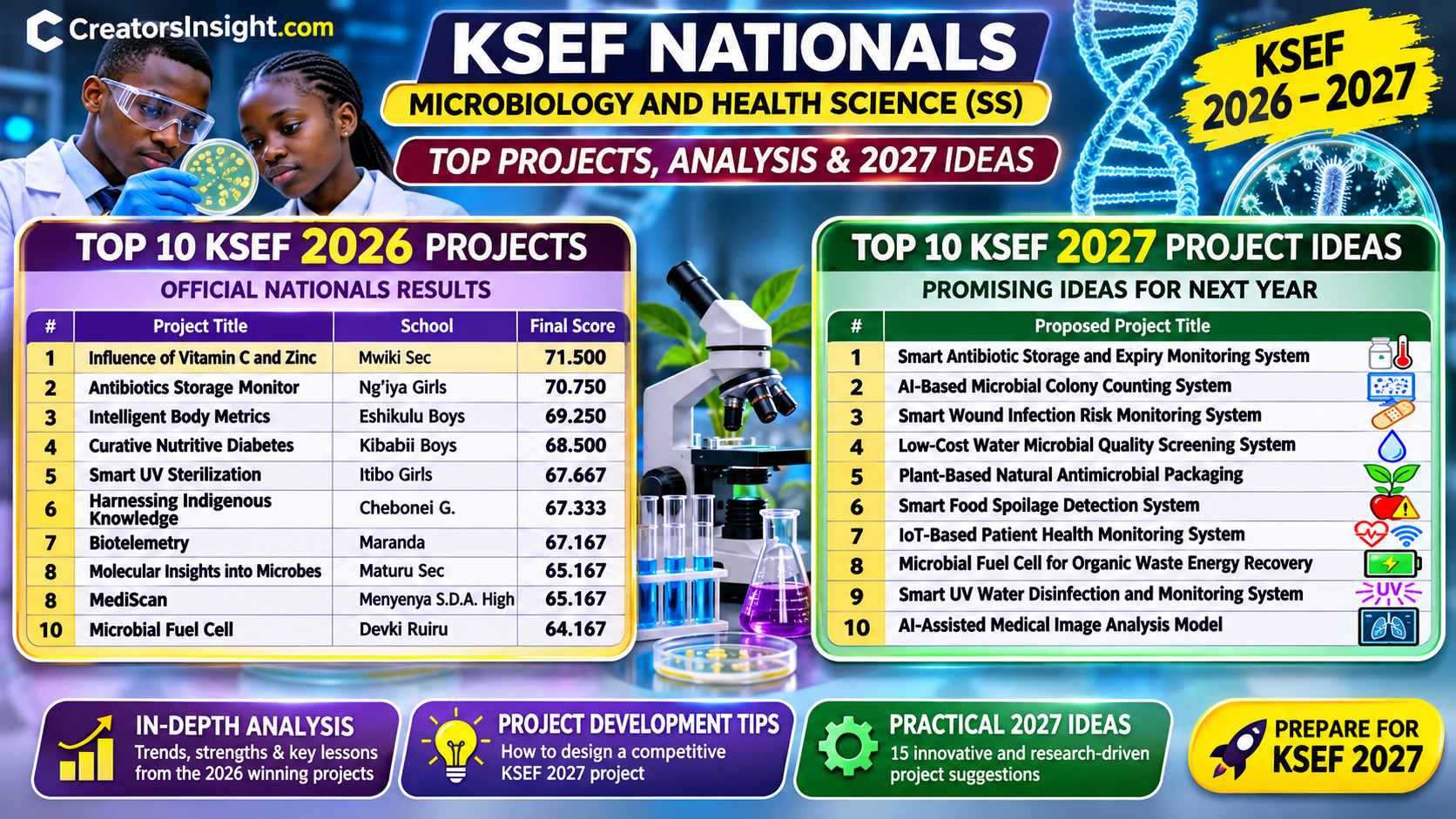
Top 10 KSEF 2026 Microbiology and Health Science Projects
According to the official KSEF Nationals 2026 ranking report, the following projects occupied the first ten positions in the Senior School Microbiology and Health Science category.
| Position | Project Title | School | Final Score |
|---|---|---|---|
| 1 | Influence of Vitamin C and Zinc | Mwiki Secondary | 71.500 |
| 2 | Antibiotics Storage Monitor | Ng’iya Girls | 70.750 |
| 3 | Intelligent Body Metrics | Eshikulu Boys | 69.250 |
| 4 | Curative Nutritive Diabetes | Kibabii Boys | 68.500 |
| 5 | Smart UV Sterilization | Itibo Girls | 67.667 |
| 6 | Harnessing Indigenous Knowledge | Chebonei G. | 67.333 |
| 7 | Biotelemetry | Maranda | 67.167 |
| 8 | Molecular Insights into Microbes | Maturu Secondary | 65.167 |
| 8 | MediScan | Menyenya S.D.A. High | 65.167 |
| 10 | Microbial Fuel Cell | Devki Ruiru | 64.167 |
Note: Molecular Insights into Microbes and MediScan shared position 8. The next listed project occupied position 10.
1. Influence of Vitamin C and Zinc – Mwiki Secondary
Position: 1
Final Score: 71.500
The top-ranked project investigated the influence of Vitamin C and Zinc, two important micronutrients associated with human health and immune function.
The project demonstrates the potential of nutrition-focused research in addressing health challenges.
For future development, similar research could investigate the effects of different nutrient combinations on measurable biological indicators, using appropriate controls, reliable measurements and scientifically approved procedures.
Its first-place ranking makes it an interesting example for learners preparing nutrition and health science investigations.
2. Antibiotics Storage Monitor – Ng’iya Girls
Position: 2
Final Score: 70.750
Antibiotics require appropriate storage conditions to maintain their quality and effectiveness.
The Antibiotics Storage Monitor explored a practical healthcare challenge: monitoring the conditions under which antibiotics are stored.
This is particularly relevant in healthcare facilities, pharmacies and areas where temperature fluctuations may affect medicine storage.
A future version could incorporate:
- Temperature sensors.
- Humidity monitoring.
- Digital display systems.
- Automatic alerts when storage conditions exceed selected limits.
- Data logging for reviewing storage conditions.
This project provides an excellent opportunity to combine microbiology, electronics and Internet of Things (IoT) technology.
3. Intelligent Body Metrics – Eshikulu Boys
Position: 3
Final Score: 69.250
The Intelligent Body Metrics project highlights the growing importance of technology in monitoring human health.
Body measurements can provide useful information for assessing certain aspects of physical health and identifying potential health risks.
A more advanced version could integrate digital sensors, automated calculations and data visualization.
Possible features include:
- Body mass index calculation.
- Body temperature monitoring.
- Heart rate measurement.
- Digital health reports.
- Automated interpretation of selected measurements.
Students developing similar projects should clearly distinguish between health screening and medical diagnosis.
4. Curative Nutritive Diabetes – Kibabii Boys
Position: 4
Final Score: 68.500
Diabetes remains an important public health challenge, making nutrition-based research particularly relevant.
The Curative Nutritive Diabetes project explored the relationship between nutrition and diabetes.
Future investigations could examine the nutritional composition of selected local foods and their potential relationship with blood glucose regulation.
Possible research directions include:
- Comparing the carbohydrate content of different local food products.
- Investigating dietary fiber in selected foods.
- Developing low-sugar food alternatives.
- Evaluating food labeling and nutritional awareness.
- Investigating appropriate food formulation strategies.
Scientific claims about treating or curing diabetes must be supported by rigorous evidence. A school project should not present a food product as a proven diabetes treatment.
5. Smart UV Sterilization – Itibo Girls
Position: 5
Final Score: 67.667
The Smart UV Sterilization project explored the application of ultraviolet technology in sterilization.
UV-C radiation is used in specialized disinfection systems to inactivate microorganisms under controlled conditions.
A smart sterilization system could combine UV technology with electronic control mechanisms.
Potential features include:
- Automatic operation.
- Timed sterilization cycles.
- Safety interlocks.
- Motion detection.
- Digital monitoring.
An important improvement for future projects would be demonstrating microbial reduction through appropriate laboratory testing rather than relying on the operation of the UV device alone.
UV-C radiation can damage human eyes and skin. Any prototype should include suitable shielding and safety mechanisms.
6. Harnessing Indigenous Knowledge – Chebonei G.
Position: 6
Final Score: 67.333
Indigenous knowledge provides opportunities for scientific investigation, especially in traditional plant uses, food preservation and community health practices.
This project highlights the potential relationship between traditional knowledge and modern scientific research.
Possible future investigations include:
- Laboratory screening of selected plant extracts for antimicrobial activity.
- Comparing traditional and modern food preservation methods.
- Investigating locally available natural materials.
- Evaluating traditional knowledge through controlled experiments.
Researchers should document the original knowledge appropriately, respect community ownership and avoid making unsupported medicinal claims.
7. Biotelemetry – Maranda
Position: 7
Final Score: 67.167
Biotelemetry involves collecting and transmitting biological information from a distance.
The project represents an interesting intersection between biology, electronics and communication technology.
Future developments could explore remote monitoring of selected physiological parameters.
Possible components include:
- Microcontrollers.
- Heart rate sensors.
- Temperature sensors.
- Wireless communication modules.
- Mobile monitoring interfaces.
This project area has potential applications in remote healthcare monitoring and patient observation.
8. Molecular Insights into Microbes – Maturu Secondary
Position: 8
Final Score: 65.167
Microorganisms play important roles in human health, agriculture, food production and environmental processes.
The Molecular Insights into Microbes project highlights the importance of understanding microorganisms at the molecular level.
Future investigations could explore microbial identification, microbial diversity and the relationship between microorganisms and their environments.
Possible research areas include:
- Comparing microbial diversity in different environments.
- Investigating microbial roles in decomposition.
- Exploring fermentation processes.
- Studying microbial contamination indicators.
- Investigating the relationship between microorganisms and food preservation.
9. MediScan – Menyenya S.D.A. High
Position: 8
Final Score: 65.167
MediScan shared position 8 with Molecular Insights into Microbes.
The project title suggests an interest in medical scanning and health assessment.
Future development opportunities could involve combining sensors, image processing and digital technology to support selected healthcare screening applications.
For example, students could investigate how computer vision can be used to analyze medical images or how digital systems can improve the collection and interpretation of health information.
The specific technical design and methodology of the original MediScan project are not provided in the ranking report.
10. Microbial Fuel Cell – Devki Ruiru
Position: 10
Final Score: 64.167
A microbial fuel cell is a bioelectrochemical system that uses microorganisms to facilitate the conversion of chemical energy into electrical energy.
This technology offers opportunities to investigate renewable energy, waste management and environmental biotechnology.
Future research could explore:
- Electricity generation from organic waste.
- Different electrode materials.
- Effects of operating conditions on voltage production.
- Performance comparisons between different substrates.
- Potential applications in low-power energy systems.
The project demonstrates the potential of integrating microbiology with sustainable energy technology.
What Made the Leading KSEF 2026 Projects Stand Out?
The ranking report provides final scores and project titles rather than detailed judging comments or experimental methodologies. Therefore, the following analysis identifies innovation trends from the project titles; it does not claim to establish the exact reasons why judges awarded particular scores.
1. Addressing Real-World Health Challenges
Several projects focused on challenges that affect individuals and communities.
Examples include:
- Antibiotics Storage Monitor.
- Curative Nutritive Diabetes.
- Smart UV Sterilization.
- Intelligent Body Metrics.
This demonstrates the relevance of research that connects scientific knowledge with practical healthcare problems.
2. Integration of Science and Technology
Projects such as Biotelemetry, Smart UV Sterilization and Antibiotics Storage Monitor illustrate opportunities to integrate biological concepts with electronic systems.
Combining sensors, microcontrollers and digital monitoring can make scientific innovations more practical.
3. Application of Microbiology in Sustainable Development
Microbial Fuel Cell demonstrates how microorganisms can be explored beyond their traditional association with disease.
Microbiology also has applications in renewable energy, environmental management, agriculture and waste treatment.
4. Nutrition and Preventive Healthcare
The first- and fourth-ranked projects explored nutrition-related health themes.
These areas offer opportunities for research into food composition, nutritional quality, dietary awareness and preventive healthcare.
5. Indigenous Knowledge and Scientific Research
Harnessing Indigenous Knowledge demonstrates the potential of using community knowledge as a starting point for scientific investigation.
The strongest future approach is to translate such knowledge into measurable research questions and scientifically controlled experiments.
Project Development Lessons for KSEF 2027
Students and science teachers preparing for the next competition can draw several lessons from the 2026 ranking report.
First, identify a genuine community problem. A project should address an identifiable challenge in healthcare, agriculture, environmental management or everyday life.
Second, move beyond making a model. A working prototype should be supported by experimental evidence.
Third, collect measurable data. Use appropriate measurements, repeated trials, control groups and well-organized data tables.
Fourth, demonstrate improvement. Compare the proposed innovation with an existing method or product.
Fifth, establish scientific validity. Explain the scientific principles behind the innovation and support conclusions with reliable evidence.
Finally, demonstrate practical application. Show how the innovation could benefit a school, household, healthcare facility or community.
Top 15 Promising Microbiology and Health Science Project Ideas for KSEF 2027
Based on the innovation themes reflected in the 2026 rankings, the following are proposed project ideas for learners preparing for KSEF 2027.
These are new suggestions, not official KSEF 2027 entries or predictions of competition results.
| No. | Proposed Project Title | Main Innovation |
|---|---|---|
| 1 | Smart Antibiotic Storage and Expiry Monitoring System | Temperature, humidity and expiry monitoring |
| 2 | AI-Based Microbial Colony Counting System | Image processing for counting microbial colonies |
| 3 | Smart Wound Infection Risk Monitoring System | Sensor-based monitoring of selected wound conditions |
| 4 | Low-Cost Water Microbial Quality Screening System | Rapid screening indicators for water quality |
| 5 | Plant-Based Natural Antimicrobial Packaging | Investigating plant-derived antimicrobial materials |
| 6 | Smart Food Spoilage Detection System | Monitoring environmental indicators of food spoilage |
| 7 | IoT-Based Patient Health Monitoring System | Remote monitoring of selected vital signs |
| 8 | Microbial Fuel Cell for Organic Waste Energy Recovery | Generating electricity using microbial processes |
| 9 | Smart UV Water Disinfection and Monitoring System | Controlled UV disinfection with safety monitoring |
| 10 | AI-Assisted Medical Image Analysis Model | Computer vision for selected medical imaging tasks |
| 11 | Natural Plant Extracts for Antimicrobial Applications | Laboratory investigation of selected plant extracts |
| 12 | Smart Handwashing Effectiveness Monitoring System | Evaluating handwashing performance |
| 13 | Biodegradable Antimicrobial Food Packaging | Developing and testing alternative packaging materials |
| 14 | Microalgae-Based Wastewater Treatment and Biomass Recovery | Combining wastewater treatment with biomass production |
| 15 | Smart Cold-Chain Monitoring System for Medical Products | Monitoring temperature during medicine transportation |
Five Particularly Promising Project Directions for 2027
1. AI-Based Microbial Colony Counting System
This project could combine microbiology with artificial intelligence.
Students could develop a digital imaging system that captures photographs of microbial colonies on prepared laboratory plates and uses image-processing techniques to estimate colony numbers.
Possible components:
- Smartphone camera or digital camera.
- Computer or microcontroller-supported processing system.
- Image-processing software.
- Controlled lighting enclosure.
- Digital results display.
Research question: How accurately can an image-processing system count visible microbial colonies compared with manual counting?
The project could be evaluated using prepared, safe teaching materials and appropriate laboratory supervision.
2. Smart Antibiotic Storage and Expiry Monitoring System
Building on the second-ranked 2026 project, students could develop a more comprehensive medicine storage monitoring system.
The system could monitor temperature and humidity, record storage conditions and provide alerts when preset limits are exceeded.
Possible components:
- ESP32 microcontroller.
- DHT22 or suitable temperature and humidity sensor.
- LCD display.
- Buzzer.
- Real-time clock module.
- Data logging system.
Research question: How effectively can an automated monitoring system identify storage-condition deviations compared with manual monitoring?
3. Plant-Based Natural Antimicrobial Packaging
This project could investigate biodegradable packaging materials incorporating selected plant-derived extracts.
Students could compare different formulations and evaluate their physical properties, biodegradability and antimicrobial performance using approved laboratory procedures.
Research question: Can selected plant-derived materials improve the antimicrobial performance of biodegradable food packaging?
This project connects microbiology, chemistry, environmental science and food technology.
4. Microalgae-Based Wastewater Treatment and Biomass Recovery
Microalgae can contribute to nutrient removal from wastewater under suitable controlled conditions.
Students could investigate how selected microalgae cultures influence measurable water-quality parameters.
Possible research measurements:
- pH.
- Turbidity.
- Nitrate concentration.
- Phosphate concentration.
- Biomass production.
Research question: How does microalgae cultivation affect selected water-quality parameters under controlled conditions?
5. Smart Food Spoilage Detection System
Food spoilage presents challenges in households, schools and food distribution systems.
Students could investigate whether selected sensors can detect environmental changes associated with food deterioration.
Possible components:
- ESP32.
- Temperature sensor.
- Humidity sensor.
- Gas sensor suitable for the intended application.
- LCD display.
- Data logging system.
Research question: Can a sensor-based system identify changes associated with food spoilage earlier than conventional visual inspection?
The system should be validated against appropriate food-quality measurements rather than assuming that a gas sensor alone can establish food safety.
How to Prepare a Competitive KSEF 2027 Microbiology and Health Science Project
A promising project should demonstrate more than an attractive display or a functioning electronic model.
Learners should prepare a complete scientific investigation.
Recommended Project Structure
- Project title.
- Abstract.
- Introduction and background.
- Statement of the problem.
- Research objectives.
- Research questions or hypothesis.
- Literature review.
- Materials and methodology.
- Experimental design.
- Results and data presentation.
- Data analysis and interpretation.
- Discussion.
- Conclusion.
- Recommendations.
- References.
Important Factors to Consider
Originality: Explain what makes the proposed innovation different from existing approaches.
Scientific accuracy: Demonstrate a clear understanding of the relevant biological, chemical or technological principles.
Experimental evidence: Present results from actual investigations, not assumed or invented data.
Innovation: Show how the project improves an existing process or addresses an unmet need.
Practical application: Explain the potential benefits to the community.
Reproducibility: Provide sufficient methodological details for another learner to understand and repeat the investigation.
Safety and ethics: Follow appropriate laboratory biosafety procedures, obtain necessary permissions and protect human participants.
Microbiology projects should use approved, low-risk teaching materials and supervised procedures. Culturing unknown microorganisms from potentially contaminated sources can create avoidable health risks.
Conclusion: The Future of Microbiology and Health Science Innovation in Kenya
The KSEF Nationals 2026 Microbiology and Health Science rankings demonstrate the diversity of scientific interests among Kenyan Senior School learners.
From nutrition and antibiotic storage to smart sterilization, biotelemetry, microbial research and microbial fuel cells, the 31 projects provide a useful picture of the different directions learners are exploring.
The first-place project, Influence of Vitamin C and Zinc, scored 71.500, while Antibiotics Storage Monitor followed closely with 70.750.
For KSEF 2027, students and teachers should consider moving toward research-driven innovations that combine scientific investigation, measurable results and practical applications.
Artificial intelligence, biotechnology, environmental microbiology, smart healthcare systems and sustainable materials offer promising directions for future student research.
Ultimately, the strongest science projects should not simply demonstrate that something works. They should provide credible evidence explaining how well it works, why it works and how it can solve a real problem.
Kenya’s next generation of scientists and innovators has an opportunity to transform classroom knowledge into solutions that make a meaningful difference in society.
Are you preparing a project for KSEF 2027? Start with a real community challenge, develop a testable research question and turn your scientific idea into an evidence-based innovation.
Download