mbeva
mbevaA Climate-Smart Water Solution for Rural Communities


Access to safe drinking water remains one of the greatest challenges in many rural and arid regions. Water sources are often contaminated by salts, sediments, microorganisms, and agricultural pollutants. Conventional treatment systems require expensive infrastructure and grid electricity.
This project presents a Hybrid Solar Desalination and Smart Water Purification Plant powered entirely by solar energy. The system integrates solar desalination, multi-stage filtration, UV sterilization, Artificial Intelligence (AI), GSM communication, and Internet of Things (IoT) technologies to produce clean drinking water while providing real-time monitoring and automated operation.
The system can be deployed in schools, villages, hospitals, refugee camps, and drought-prone regions to improve access to safe water while reducing environmental impact.
SYSTEM FLOW DIAGRAM
               SUNLIGHT
                   │
                   ▼
        ┌──────────────────┐
        │ SOLAR PANEL      │
        └────────┬─────────┘
                 │
                 ▼
        ┌──────────────────┐
        │ BATTERY SYSTEM   │
        └────────┬─────────┘
                 │
                 ▼
     ┌──────────────────────────┐
     │ ARDUINO + AI CONTROLLER  │
     └───────────┬──────────────┘
                 │
     ┌───────────┼───────────┐
     ▼           ▼           ▼
 GSM Module   Sensors     Water Pump
     │           │            │
     ▼           ▼            ▼

      CONTAMINATED WATER
                │
                ▼
      ┌───────────────────┐
      │ EVAPORATION BASIN │
      └─────────┬─────────┘
                │
                ▼
         WATER VAPOUR
                │
                ▼
      ┌───────────────────┐
      │ CONDENSER GLASS   │
      └─────────┬─────────┘
                ▼
      ┌───────────────────┐
      │ CARBON FILTER     │
      └─────────┬─────────┘
                ▼
      ┌───────────────────┐
      │ UV STERILIZATION  │
      └─────────┬─────────┘
                ▼
      ┌───────────────────┐
      │ CLEAN WATER TANK  │
      └───────────────────┘
PROBLEM STATEMENT
Many communities rely on unsafe water sources containing:
• Excess salts
• Disease-causing microorganisms
• Suspended particles
• Chemical contaminants
Most purification systems require electricity and skilled operators.
There is therefore a need for a low-cost, intelligent, renewable-energy-powered purification system capable of producing safe drinking water in remote locations.
OBJECTIVES
Main Objective
To develop a smart solar-powered desalination and purification plant capable of producing safe drinking water from saline and contaminated water sources.
Specific Objectives
- Remove dissolved salts from water.
- Eliminate harmful microorganisms.
- Remove sediments and suspended particles.
- Utilize renewable solar energy.
- Monitor water quality automatically.
- Send GSM alerts to operators.
- Apply AI to predict maintenance needs and optimize water production.
PHYSICS PRINCIPLES INVOLVED
Thermodynamics
Solar radiation heats water causing evaporation.
Heat Transfer
Solar energy transfers heat into the evaporation chamber.
Phase Change
Water changes from liquid to vapor.
Condensation
Water vapor cools and becomes pure liquid water.
Optics
Reflective mirrors increase solar heating efficiency.
Electricity
Solar panels convert sunlight into electrical energy.
Electromagnetism
Sensors and GSM modules communicate system data.
MATERIALS REQUIRED
Structural Components
• Plywood sheets
• Aluminum sheets
• Transparent tempered glass
• PVC pipes
• Silicone sealant
• Water collection channels
Filtration Components
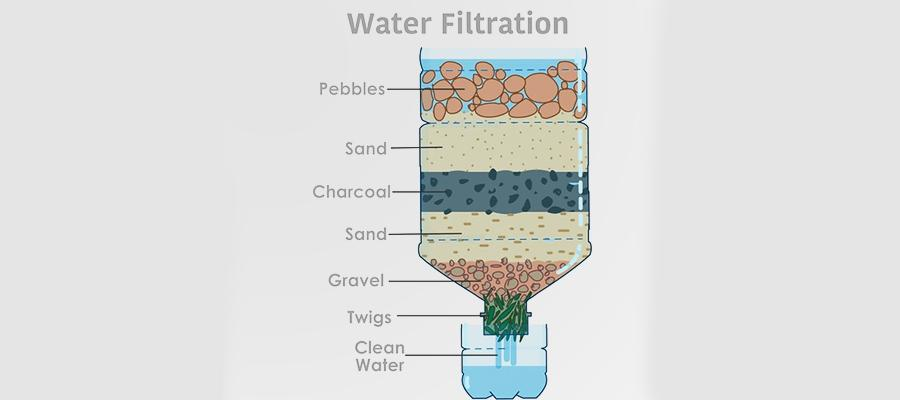
• Gravel
• Fine sand
• Activated carbon
• Cotton filter
• UV sterilizer
Solar Components
• 100W solar panel
• Charge controller
• 12V battery
Electronics
• Arduino Mega
• ESP32 WiFi Module
• GSM SIM800L Module
• TDS Water Quality Sensor
• pH Sensor
• Temperature Sensor
• Ultrasonic Water Level Sensor
• LCD Display
• Water Pump
• Solenoid Valves
CONSTRUCTION PROCEDURE
Stage 1: Solar Desalination Chamber
Construct a shallow black-painted basin.
Install transparent glass cover at a 15–20° angle.
Add aluminum reflectors to increase sunlight concentration.
Stage 2: Water Filtration Unit
Construct three filtration chambers:
Layer 1:
Gravel
Layer 2:
Fine Sand
Layer 3:
Activated Carbon
Stage 3: UV Sterilization Chamber
Install UV-C LEDs to destroy microorganisms before storage.
Stage 4: Solar Power System
Connect:
Solar Panel → Charge Controller → Battery → Arduino System
Stage 5: AI and GSM Integration
Install:
• Water quality sensors
• GSM module
• ESP32 WiFi module
• AI monitoring software
HOW THE SYSTEM WORKS
- Contaminated water enters the evaporation basin.
- Solar energy heats the water.
- Pure water evaporates.
- Salts and contaminants remain behind.
- Vapor condenses on the glass cover.
- Distilled water flows into the collection channel.
- Water passes through activated carbon filtration.
- UV sterilization destroys microorganisms.
- Sensors analyze water quality.
- AI evaluates system efficiency.
- GSM sends SMS alerts.
- Safe water is stored for use.
ARTIFICIAL INTELLIGENCE FEATURES
The AI system can:
• Predict filter replacement dates.
• Predict water production rates.
• Detect abnormal temperature changes.
• Identify poor water quality.
• Recommend maintenance actions.
• Optimize solar energy utilization.
GSM FEATURES
The GSM Module sends SMS notifications such as:
“Water Tank Full”
“Filter Replacement Needed”
“Water Quality Unsafe”
“Low Battery Warning”
“Pump Failure Detected”
IoT FEATURES
Users can monitor remotely using a mobile phone.
Displayed information includes:
• Water level
• Temperature
• pH
• TDS
• Solar output
• Water production rate
EXPECTED RESULTS
• 95–99% salt removal.
• Significant reduction of bacteria.
• Continuous water production.
• Remote monitoring capability.
• Low operating cost.
• Improved access to safe drinking water.
ENVIRONMENTAL BENEFITS
• Uses renewable energy.
• Reduces carbon emissions.
• Improves water security.
• Supports climate adaptation.
• Reduces dependence on fossil fuels.
APPLICATIONS
• Schools
• Rural villages
• Hospitals
• Coastal communities
• Refugee camps
• Disaster relief operations
• Drought-prone regions
CONCLUSION
The AI-GSM Hybrid Solar Desalination and Smart Water Purification Plant combines physics, renewable energy, electronics, automation, artificial intelligence, and telecommunications into one integrated system. The project provides a sustainable, affordable, and scalable solution to water scarcity while demonstrating innovative applications of modern technology for community development.