mbeva
Introduction
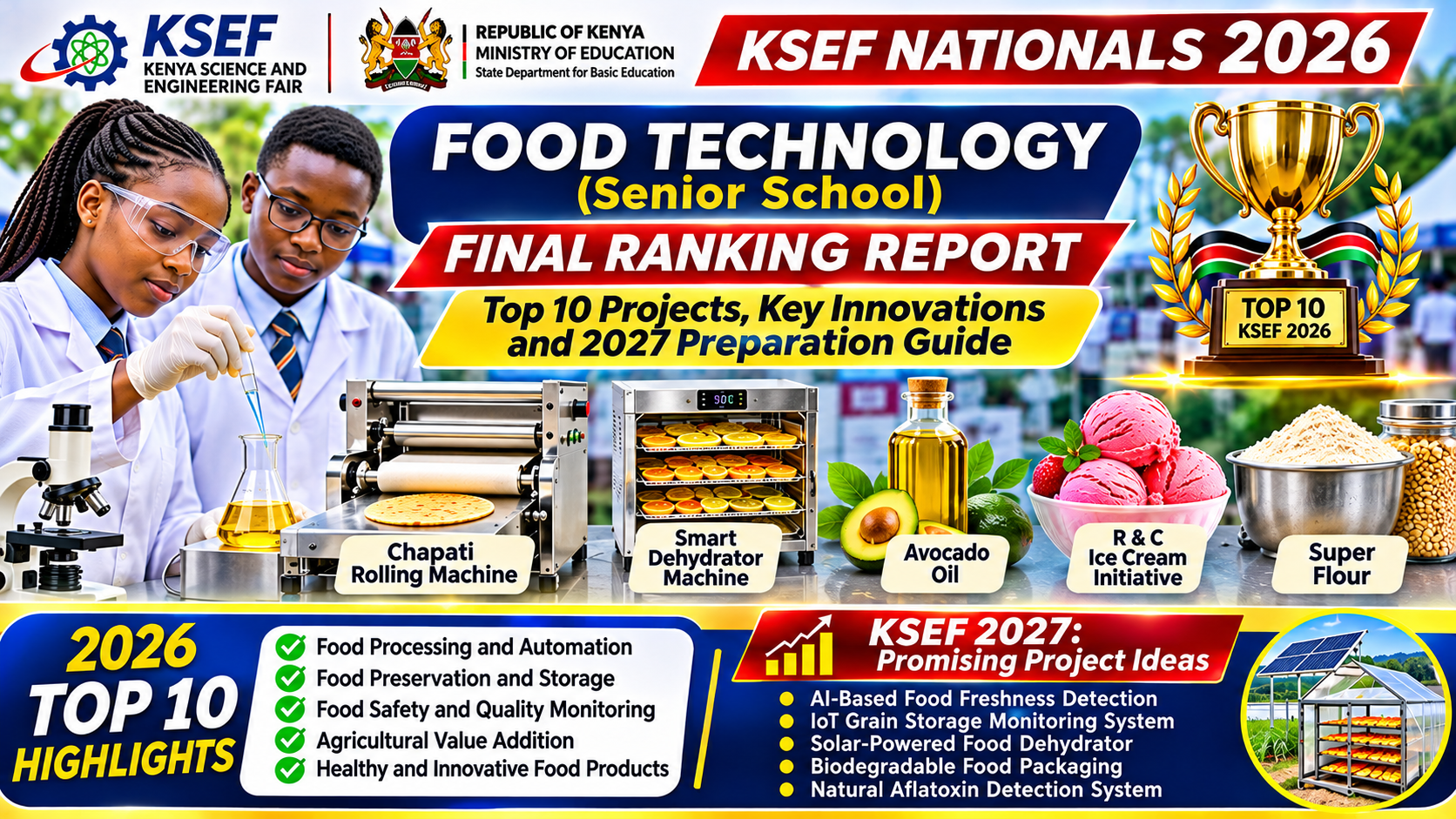
The Kenya Science and Engineering Fair (KSEF) Nationals 2026 showcased impressive creativity and scientific innovation among Senior School learners participating in the Food Technology category.
The final ranking report features 32 projects addressing different challenges in food processing, preservation, hygiene, nutrition, agricultural value addition and food safety.
Two projects emerged joint first-place winners, each scoring 61.333 marks. These were the Chapati Rolling Machine from Olkejuado High School and Safe Home from Orando School.
The competition also demonstrated how learners are increasingly applying science, engineering and technology to develop practical solutions to everyday challenges affecting households, farmers and food industries.
For students and teachers preparing for KSEF 2027, the 2026 results offer valuable insights into the types of innovations that can attract attention at national level.
This article presents the top 10 ranking entries, highlights outstanding innovations and explores promising project ideas for the next competition.
KSEF Nationals 2026 Food Technology Top 10 Projects
According to the official final totals report, the following projects occupied the first ten ranking positions. The list includes tied positions.
| Position | Project title | School | Final score |
|---|---|---|---|
| 1 | Chapati Rolling Machine | Olkejuado High | 61.333 |
| 1 | Safe Home | Orando | 61.333 |
| 3 | Smart Dehydrator Machine | St. Antony Nyandiwa | 60.333 |
| 4 | R & C Ice Cream Initiative | Kisumu Girls | 59.667 |
| 5 | Super Flour | Moi Mbiruri | 59.500 |
| 6 | The Golden Shield | Bunyore Girls | 58.333 |
| 6 | AFLESH: Aflatoxin Risk Monitoring for Grain Farmers | Silungai Girls | 58.333 |
| 8 | Avocado Oil | Hon. John Njoroge | 58.083 |
| 9 | Mango Biokerosene | Ngara Girls | 57.500 |
| 9 | Food Calorimeter | Cardinal Otunga Girls High School | 57.500 |
Source: KSEF Nationals 2026 Food Technology (SS), Final Totals Report, pages 1–3.
Important ranking observation: There are ten projects in the first ten ranking entries, but only eight distinct ranking positions because of joint positions at 1, 6 and 9.
Analysis of the Outstanding Food Technology Projects
The 2026 competition featured projects that addressed several important challenges in food production, processing, preservation and safety.
Here are some of the most interesting innovations from the top-ranking entries.
1. Chapati Rolling Machine – Olkejuado High School
Joint position 1

Scoring 61.333 marks, the Chapati Rolling Machine emerged as one of the two national champions.
The project focused on mechanising an everyday food preparation activity. Chapati production involves repeated manual rolling, which can be time-consuming, particularly when preparing large quantities.
A mechanical rolling system offers an opportunity to improve consistency, reduce repetitive labour and increase production efficiency.
For future participants, this project demonstrates the potential of combining mechanical engineering with food processing.
2. Safe Home – Orando School
Joint position 1
The Safe Home project also scored 61.333 marks, sharing the national top position.
Its title suggests a household-oriented innovation. However, the official ranking document does not provide a technical description of the prototype, so its exact operating principle and application cannot be established from the results sheet alone.
Its joint first-place finish makes it one of the most notable entries in the category.
3. Smart Dehydrator Machine – St. Antony Nyandiwa
Position 3

The Smart Dehydrator Machine scored 60.333 marks.
Food dehydration is an important preservation technique that reduces moisture content, helping to extend the storage life of suitable agricultural products.
A smart dehydrator can be developed around:
- Temperature monitoring.
- Humidity measurement.
- Automatic ventilation.
- Controlled heating.
- Solar energy integration.
This is a particularly promising area for learners interested in agricultural technology and food preservation.
4. R & C Ice Cream Initiative – Kisumu Girls
The project scored 59.667 marks, securing fourth position.
Ice cream production presents opportunities for food science investigations involving formulation, texture, flavour, temperature control and product quality.
Students preparing similar projects for 2027 could investigate locally available fruits and other ingredients to develop innovative ice cream products.
5. Super Flour – Moi Mbiruri
Scoring 59.500 marks, Super Flour occupied fifth position.
Value addition to locally available agricultural products is an important area of food technology.
Future projects in this area could investigate:
- Nutritional enrichment.
- Alternative flour formulations.
- Shelf-life improvement.
- Affordable food products.
- Use of locally available crops.
6. The Golden Shield – Bunyore Girls
The Golden Shield achieved 58.333 marks and joint sixth position.
The ranking report identifies the project title and school but does not explain its formulation or technical application. Further details would be necessary before describing its actual innovation.
7. AFLESH – Aflatoxin Risk Monitoring for Grain Farmers
Joint position 6

AFLESH, developed by learners from Silungai Girls, scored 58.333 marks.
Its stated focus is aflatoxin risk monitoring for grain farmers.
Aflatoxins are toxic substances associated with certain moulds that can contaminate food crops, particularly grains and nuts under unsuitable storage conditions.
This project addresses an important agricultural and public health concern.
Potential future improvements could include:
- Grain moisture monitoring.
- Early warning systems.
- Portable testing technologies.
- Digital reporting of grain quality.
- Improved grain storage monitoring.
8. Avocado Oil – Hon. John Njoroge
The Avocado Oil project achieved 58.083 marks, securing eighth position.
Avocado processing presents an opportunity for agricultural value addition, particularly in areas where avocado production is common.
Possible investigations for future learners include oil extraction efficiency, processing methods, product quality and storage stability.
9. Mango Biokerosene – Ngara Girls

Mango Biokerosene scored 57.500 marks, sharing ninth position.
The project explores an interesting connection between fruit waste utilisation and alternative energy development.
Future research could investigate extraction methods, fuel properties, production efficiency and environmental considerations.
10. Food Calorimeter – Cardinal Otunga Girls High School
The Food Calorimeter also scored 57.500 marks, securing joint ninth position.
Calorimetry provides a scientific approach to investigating the energy content of food.
A food calorimeter can be used to demonstrate how the energy released during combustion relates to the nutritional energy content of food samples.
This project connects practical experimentation with chemistry, physics and nutrition.
Other Notable Projects in the KSEF 2026 Food Technology Category
The competition included several additional innovations beyond the first ten entries.
| Position | Project | School | Score |
|---|---|---|---|
| 11 | Micro-organism and Food Spoilage | Ngara Girls | 57.333 |
| 12 | Hand’s Off Germs Off | Sabaki Sec | 56.500 |
| 13 | Casein Plastics | Turkana Girls | 55.500 |
| 13 | Tamarind Mango and Apple Candy | Holy Trinity Girls | 55.500 |
| 15 | IoT Autonomous Food Preservation | Kabaa Boys | 55.333 |
| 16 | Shell | Gitugi Girls | 55.167 |
| 17 | Small Food Freshness Indicator Using Natural Dye | Muthambi Girls | 54.000 |
| 18 | Artificial Air Sanitizer | Kenyatta Mahiga | 53.667 |
| 19 | Smart Eco Hygiene Tian | Enomatasiani Girls | 51.833 |
| 20 | Solar Drying System | OLC Mugoiri | 51.500 |
The remaining projects included Smart Cool Box, Nutri Candy, Simple DIY Autostirrer Machine, Zero Contact Water and Liquid Food Server, Dehydrating Machine, Pwani Afia, Kefir Milk, Smart Dairy, Making Organic Lipstick, Use of Food Ash to Treat and Reduce Pain, and Making Air Treatment.
What Do the 2026 Results Tell Us About Food Technology Innovation?
Several important innovation themes emerge from the national rankings.
1. Food preservation remains an important research area.
Smart Dehydrator Machine, IoT Autonomous Food Preservation, Solar Drying System and Smart Cool Box demonstrate the range of opportunities available in food preservation.
2. Food safety offers opportunities for technological innovation.
AFLESH and Micro-organism and Food Spoilage highlight the importance of contamination monitoring, food hygiene and consumer safety.
3. Agricultural value addition can produce competitive projects.
Avocado Oil, Mango Biokerosene, Super Flour and Tamarind Mango and Apple Candy demonstrate the potential of transforming agricultural materials into useful products.
4. Automation can improve food production.
Chapati Rolling Machine, Smart Dehydrator Machine and Simple DIY Autostirrer Machine illustrate how engineering can be applied to food processing activities.
Best KSEF Food Technology Project Ideas for 2027
The 2026 competition provides useful inspiration for learners planning their next innovations. However, students should aim to identify a new problem, develop an original prototype and collect reliable experimental data rather than simply reproduce previous winning projects.
Here are 15 promising ideas for KSEF 2027.
| No. | Proposed project | Main innovation |
|---|---|---|
| 1 | AI-Based Food Freshness Detection System | Uses sensors and machine learning to identify food spoilage indicators. |
| 2 | Smart IoT Grain Storage Monitoring System | Monitors temperature, humidity and grain storage conditions. |
| 3 | Solar-Powered Smart Fruit Dehydrator | Automates fruit drying using temperature and humidity sensors. |
| 4 | Natural Aflatoxin Risk Detection System | Investigates low-cost grain contamination screening. |
| 5 | Smart Milk Quality Monitoring System | Monitors selected milk quality indicators using sensors. |
| 6 | Biodegradable Food Packaging from Banana Fibres | Develops environmentally friendly packaging materials. |
| 7 | Automated Nutritional Food Mixing Machine | Combines ingredients according to programmed formulations. |
| 8 | Waste-to-Value Fruit Peel Food Preservative | Investigates suitable natural extracts for food preservation. |
| 9 | Smart Refrigerator Food Spoilage Alert System | Provides alerts based on monitored storage conditions. |
| 10 | Portable Solar-Powered Food Pasteuriser | Investigates controlled heating for food safety. |
| 11 | Edible Packaging from Cassava Starch | Develops biodegradable edible films and evaluates their properties. |
| 12 | Smart Egg Freshness Testing Device | Investigates non-destructive methods of assessing egg freshness. |
| 13 | Natural Food Colourant Extraction and Stability Testing | Evaluates pigments from locally available plants. |
| 14 | Automated Honey Quality Monitoring System | Investigates selected physical and chemical quality indicators. |
| 15 | Smart Food Waste Conversion System | Converts suitable food waste into useful agricultural products. |
Five Particularly Promising Areas for 2027
For students targeting strong national-level performance, I would prioritise:
- AI-based food freshness detection.
- Smart IoT grain storage monitoring.
- Natural aflatoxin risk detection.
- Biodegradable food packaging.
- Solar-powered smart food preservation.
These are project-development recommendations, not predictions of the official KSEF 2027 judging criteria.
How to Prepare a Competitive KSEF Food Technology Project in 2027
A strong project should demonstrate more than an attractive prototype. Learners should show that they understand the problem, have investigated existing solutions and can demonstrate measurable improvements.
1. Identify a real community problem
Investigate challenges affecting farmers, households, food vendors and food-processing businesses.
2. Conduct preliminary research
Review existing technologies and identify limitations that your proposed innovation can address.
3. Develop a working prototype
Use locally available materials where appropriate. Integrate electronics, sensors or automation when they provide a genuine improvement.
4. Collect experimental data
Record measurements before and after introducing the innovation.
For example, a smart dehydrator project could investigate:
- Initial mass of food samples.
- Final mass after drying.
- Drying duration.
- Temperature variations.
- Moisture reduction.
- Energy consumption.
5. Compare your innovation with existing methods
A project becomes more convincing when learners can demonstrate measurable advantages over a conventional approach.
6. Document the entire research process
Maintain a project journal containing observations, experimental procedures, photographs, results, challenges and improvements.
Frequently Asked Questions About KSEF 2026 Food Technology Results
1. Which schools jointly won first position in Food Technology at KSEF Nationals 2026?
Olkejuado High School and Orando School jointly secured first position with 61.333 marks each.
2. Which project came third in Food Technology?
Smart Dehydrator Machine from St. Antony Nyandiwa, scoring 60.333 marks.
3. Which project from Eastern Region ranked highest among the listed top five?
Super Flour from Moi Mbiruri, which scored 59.500 marks and secured fifth position.
4. Which project focused on aflatoxin risk monitoring?
AFLESH: Aflatoxin Risk Monitoring for Grain Farmers, developed by learners from Silungai Girls.
5. How many projects appeared in the final Food Technology ranking report?
The report contains 32 projects.
6. What should students consider when preparing for KSEF 2027?
Students should prioritise original innovations, working prototypes, scientific investigations, measurable results and solutions to real community problems.
Conclusion
The KSEF Nationals 2026 Food Technology category demonstrated the growing potential of Senior School learners to apply science and engineering to practical challenges.
From mechanised chapati production and smart dehydration to aflatoxin risk monitoring and agricultural value addition, the projects showcased the diversity of innovation taking place in Kenyan schools.
As preparations for KSEF 2027 begin, students and teachers should build on these achievements by developing original, research-driven innovations that address real problems in food production, preservation, processing and safety.
The next generation of food technology innovators could be developing solutions that eventually benefit households, farmers and the wider food industry.
CreatorsInsight will continue highlighting student innovations, national science fair results and promising STEM project ideas for future competitions.