mbeva
Introduction: KSEF Nationals 2026 Showcases Outstanding Student Innovations
The Kenya Science and Engineering Fair (KSEF) Nationals 2026 brought together talented learners from different parts of the country to showcase creativity, scientific investigation, technological innovation and practical problem-solving.
Among the participating categories was Clothing, Textiles and Decor (Senior School), which featured innovative projects focusing on textile production, fashion design, footwear manufacturing, recycling, interior decoration and sustainable materials.
The competition demonstrated how learners are transforming locally available resources, agricultural waste and discarded materials into useful products with potential environmental and commercial benefits.
Some of the outstanding innovations included Poly Shoe, Banana Fibre Weaving, 3D Eco Interior Floral Décor from T-Cartons, Smart Curtains, biodegradable fabrics and decorative products made from recycled materials.
According to the official KSEF Nationals 2026 Project Ranking Report, 33 projects were listed in the Clothing, Textiles and Decor category.
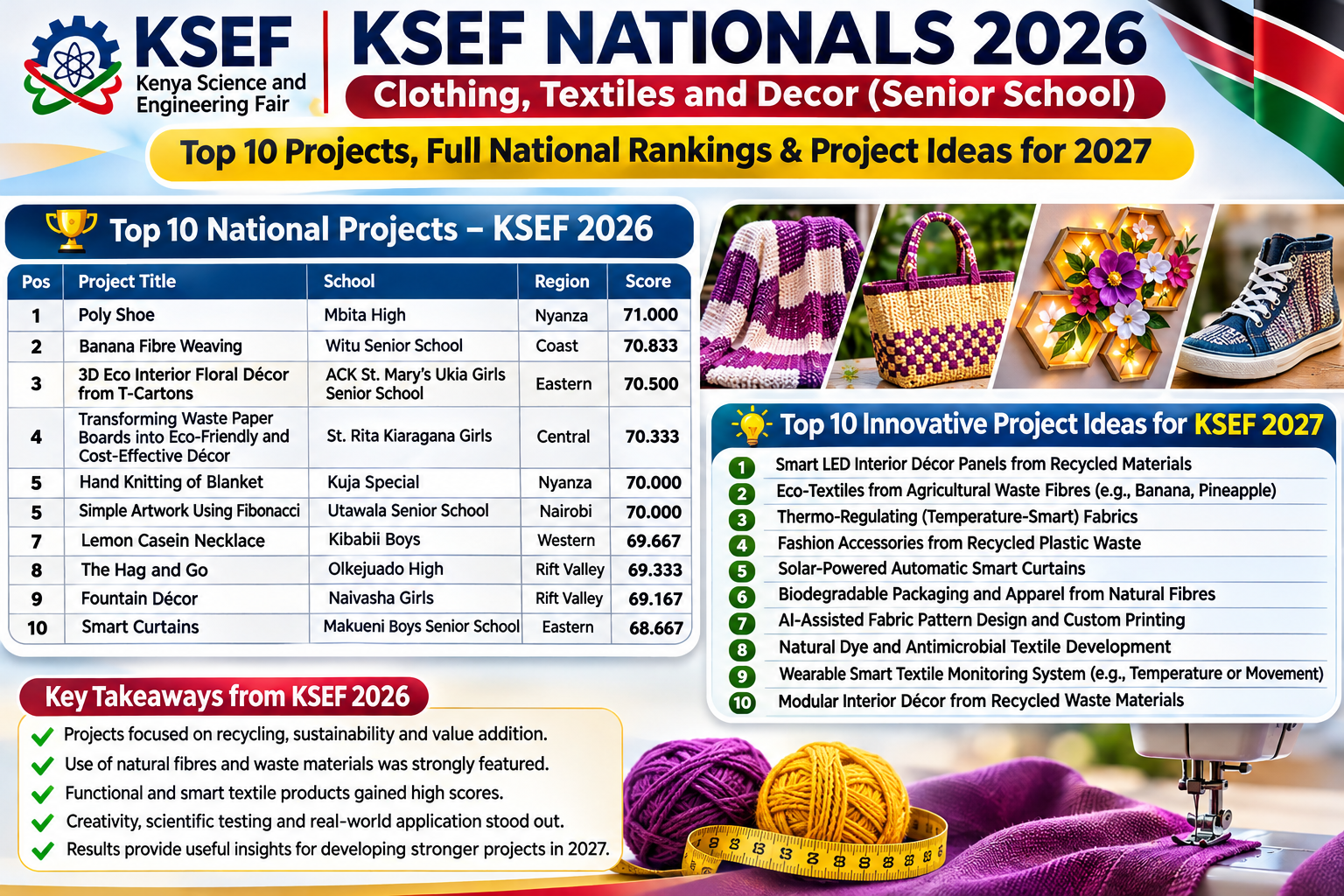
Poly Shoe from Mbita High secured the first position nationally with 71.000 marks, followed by Banana Fibre Weaving from Witu Senior School with 70.833 marks. The third position was attained by 3D Eco Interior Floral Décor from T-Cartons, which scored 70.500 marks.
Other schools also demonstrated impressive innovation in textile technology, artistic design and sustainable product development.
As preparations for KSEF 2027 begin, the 2026 results provide useful insights into emerging innovation trends and opportunities for learners and teachers seeking to develop competitive science fair projects.
This article presents the leading projects, the full national ranking, an analysis of the innovations and ten promising project ideas for KSEF 2027.
KSEF Nationals 2026: Top 10 Clothing, Textiles and Decor Projects
The official national ranking report identifies the following leading projects in the Senior School Clothing, Textiles and Decor category.
| Position | Project Title | School | Region | Marks |
|---|---|---|---|---|
| 1 | Poly Shoe | Mbita High | Nyanza | 71.000 |
| 2 | Banana Fibre Weaving | Witu Senior School | Coast | 70.833 |
| 3 | 3D Eco Interior Floral Décor from T-Cartons | ACK St. Mary’s Ukia Girls Senior School | Eastern | 70.500 |
| 4 | Transforming Waste Paper Boards into Eco-Friendly and Cost-Effective Décor | St. Rita Kiaragana Girls | Central | 70.333 |
| 5 | Hand Knitting of Blanket | Kuja Special | Nyanza | 70.000 |
| 5 | Simple Artwork Using Fibonacci | Utawala Senior School | Nairobi | 70.000 |
| 7 | Lemon Casein Necklace | Kibabii Boys | Western | 69.667 |
| 8 | The Hag and Go | Olkejuado High | Rift Valley | 69.333 |
| 9 | Fountain Décor | Naivasha Girls | Rift Valley | 69.167 |
| 10 | Smart Curtains | Makueni Boys Senior School | Eastern | 68.667 |
| 10 | Glittering Décor | St. Antony Nyandiwa | Nyanza | 68.667 |
Note: The category has eleven projects in the first ten ranking positions because two projects tied at position 5 and two projects tied at position 10.
Analysis of the Leading Projects at KSEF Nationals 2026
The national results demonstrate the diversity of innovation in clothing, textiles and decorative product development.
1. Poly Shoe – Mbita High
Scoring 71.000 marks, Poly Shoe secured first position nationally.
The project represents innovation in footwear development and product design.
Footwear manufacturing provides opportunities for investigating alternative materials, durability, flexibility, comfort and affordable production methods.
Future innovations could explore recycled materials and improved footwear manufacturing techniques.
2. Banana Fibre Weaving – Witu Senior School
Banana Fibre Weaving secured second position with 70.833 marks.
Banana plants produce considerable amounts of pseudostem waste after harvesting. This material can be investigated as a source of natural fibres for weaving and textile production.
Possible applications include mats, baskets, bags, decorative products and alternative textile materials.
3. 3D Eco Interior Floral Décor from T-Cartons – ACK St. Mary’s Ukia Girls Senior School
The project attained third position nationally with 70.500 marks.
It explored the use of discarded T-cartons in developing three-dimensional interior floral decorations.
The project represents an opportunity to combine recycling, artistic design and interior decoration while investigating the value of materials that would otherwise be discarded.
Further research could investigate material durability, moisture resistance, production costs and alternative decorative designs.
4. Transforming Waste Paper Boards into Eco-Friendly and Cost-Effective Décor – St. Rita Kiaragana Girls
The project scored 70.333 marks.
It demonstrates the potential of converting waste paper boards into useful decorative products.
Possible applications include wall decorations, decorative panels and other interior design products.
Future investigations could compare different paperboard compositions and their resistance to moisture and physical damage.
5. Hand Knitting of Blanket – Kuja Special
Scoring 70.000 marks, the project shared position five.
Knitting is an important textile production technique with applications in clothing, household products and decorative materials.
Further innovation could involve recycled yarns, alternative natural fibres and improved knitting methods.
6. Simple Artwork Using Fibonacci – Utawala Senior School
This project also scored 70.000 marks and shared position five.
It demonstrates the relationship between mathematics and artistic design.
Fibonacci patterns can be incorporated into decorative products, textile arrangements and artistic compositions.
The project provides an opportunity to apply mathematical principles in practical design.
7. Lemon Casein Necklace – Kibabii Boys
The project scored 69.667 marks.
Casein-based materials offer an interesting area of investigation for decorative product development.
Further research could explore material strength, shaping, finishing, durability and the suitability of different production methods.
8. The Hag and Go – Olkejuado High
The project achieved 69.333 marks.
Its inclusion among the highly ranked projects demonstrates the range of ideas represented in the national competition.
9. Fountain Décor – Naivasha Girls
The project scored 69.167 marks.
Decorative fountain products provide opportunities to combine artistic design with functional applications.
Future development could investigate water circulation, material durability, energy efficiency and improved decorative features.
10. Smart Curtains – Makueni Boys Senior School
The project scored 68.667 marks and shared position ten.
Smart curtains demonstrate the potential of integrating technology into traditional textile products.
Possible improvements include automatic opening and closing systems, light sensors, remote controls and solar-powered operation.
11. Glittering Décor – St. Antony Nyandiwa
The project also scored 68.667 marks and shared position ten.
It demonstrates the diversity of decorative innovation in the category and provides opportunities for exploring material finishing, artistic techniques and sustainable product development.
Full KSEF Nationals 2026 Ranking: Clothing, Textiles and Decor
The following is the complete national ranking as presented in the official KSEF Nationals 2026 report.
| No. | Project Title | School | Region | Marks | Position |
|---|---|---|---|---|---|
| 1 | Poly Shoe | Mbita High | Nyanza | 71.000 | 1 |
| 2 | Banana Fibre Weaving | Witu Senior School | Coast | 70.833 | 2 |
| 3 | 3D Eco Interior Floral Décor from T-Cartons | ACK St. Mary’s Ukia Girls Senior School | Eastern | 70.500 | 3 |
| 4 | Transforming Waste Paper Boards into Eco-Friendly and Cost-Effective Décor | St. Rita Kiaragana Girls | Central | 70.333 | 4 |
| 5 | Hand Knitting of Blanket | Kuja Special | Nyanza | 70.000 | 5 |
| 6 | Simple Artwork Using Fibonacci | Utawala Senior School | Nairobi | 70.000 | 5 |
| 7 | Lemon Casein Necklace | Kibabii Boys | Western | 69.667 | 7 |
| 8 | The Hag and Go | Olkejuado High | Rift Valley | 69.333 | 8 |
| 9 | Fountain Décor | Naivasha Girls | Rift Valley | 69.167 | 9 |
| 10 | Smart Curtains | Makueni Boys Senior School | Eastern | 68.667 | 10 |
| 11 | Glittering Décor | St. Antony Nyandiwa | Nyanza | 68.667 | 10 |
| 12 | Linda Mama | Lukhokho Secondary | Western | 66.667 | 12 |
| 13 | Waste to Worth | St. Christopher Mixed | Central | 65.667 | 13 |
| 14 | Artificial Blossoming Flower | Gitugi Girls | Central | 65.500 | 14 |
| 15 | Waste to Worth | Edmund Rice | Rift Valley | 65.500 | 14 |
| 16 | Linmax All-Round Garment | Lelwak | Rift Valley | 65.333 | 16 |
| 17 | Homemade Lava Lamp | Mwambonu | Coast | 63.833 | 17 |
| 18 | Bio Hair Fibres | Kerugoya Girls | Central | 63.500 | 18 |
| 19 | Biodegradable Fabrics from Banana and Pineapple Fibres | Mwiki Secondary | Nairobi | 63.333 | 19 |
| 20 | Smart Fabric Moisture | Msambweni | Coast | 63.167 | 20 |
| 21 | Decorations Using Tissue Paper Rolls | Ikuu Boys | Eastern | 62.667 | 21 |
| 22 | Eco-Friendly Shoe Rack | NEP Girls | North Eastern | 62.500 | 22 |
| 23 | Temperature Regulating Floor Mat | Mandera Boys | North Eastern | 61.833 | 23 |
| 24 | Pendulum Painting | Ng’iya Girls | Nyanza | 61.833 | 23 |
| 25 | Eco Dryline | Silungai Girls | Western | 61.667 | 25 |
| 26 | Biodegradable Packets | Mwiki Secondary | Nairobi | 61.000 | 26 |
| 27 | Colour AI Touch | Mwiki Secondary | Nairobi | 59.500 | 27 |
| 28 | Fire-Resistant Clothing | Ribe Girls | Coast | 59.333 | 28 |
| 29 | Smart Baby Backpack | Bungoma High School | Western | 59.000 | 29 |
| 30 | Onion Skin Dye in Coloring Clothes | Sheikh Ali | North Eastern | 56.000 | 30 |
| 31 | Quilt Making | St. Mary’s Igoji SS | Eastern | 54.333 | 31 |
| 32 | Recycling Plastic Bottle Tops to Design Decorative Curtains | Garissa High School | North Eastern | 53.333 | 32 |
| 33 | Banana Pseudostem Mat | Iftin Girls | North Eastern | 52.750 | 33 |
Source: KSEF Nationals 2026 Project Ranking Report, Clothing, Textiles and Decor (SS), pages 1–3.
The report records 33 entries. The original ranking positions have been retained, including ties at positions 5, 10, 14 and 23.
What Do the KSEF 2026 Results Reveal About Innovation Trends?
The national results reveal several important areas of innovation that schools can explore when developing future science fair projects.
1. Recycling and waste utilisation
Projects involving waste paper boards, T-cartons, tissue paper rolls and plastic bottle tops demonstrate opportunities for transforming discarded materials into useful products.
2. Natural fibre technology
Banana fibre weaving and biodegradable fabric production demonstrate the potential of agricultural resources in textile manufacturing.
3. Smart textile applications
Smart curtains and smart fabric-related projects demonstrate opportunities for integrating technology into traditional textile products.
4. Sustainable fashion and product design
Footwear, garments, blankets and decorative accessories provide opportunities for investigating affordable and sustainable manufacturing methods.
5. Artistic and mathematical innovation
Projects involving Fibonacci patterns, decorative flowers and artistic designs demonstrate how mathematics and creativity can be incorporated into product development.
These observations are based on the project themes represented in the ranking report. They do not constitute official explanations of the judges’ assessment criteria.
KSEF 2027: Top 10 Innovative Clothing, Textiles and Decor Project Ideas
Schools preparing for KSEF 2027 should consider developing projects that combine creativity, scientific investigation, sustainability and practical applications.
The following ten ideas provide possible directions for learners and teachers.
1. Smart LED Eco-Interior Wall Decoration
Develop decorative wall panels using recycled cartons and paper materials, incorporating LED lighting and automatic illumination.
Suggested materials:
- Recycled cartons.
- LED strips.
- Arduino Uno or ESP32.
- Light-dependent resistor.
- Resistors.
- Connecting wires.
- Power supply.
- Decorative finishing materials.
Research opportunity: Investigate the relationship between panel design, illumination, power consumption and structural durability.
2. Eco-Textile Production from Agricultural Waste Fibres
Investigate the production of textile materials using banana pseudostems, pineapple leaves and other locally available agricultural waste.
Research opportunity: Compare fibre strength, flexibility, water absorption and production costs.
3. Thermo-Regulating Smart Fabric
Develop a textile material designed to reduce temperature fluctuations when used in clothing or other textile products.
Research opportunity: Investigate the temperature-regulating performance of different fabric combinations and suitable phase-change materials.
4. Fashion Accessories from Recycled Plastic Waste
Convert suitable plastic waste into fashionable and durable products such as handbags, belts, jewellery and decorative accessories.
Research opportunity: Evaluate flexibility, tensile strength, durability and production costs.
5. Solar-Powered Automatic Smart Curtains
Design a curtain system that automatically opens or closes according to environmental light intensity.
Suggested materials:
- Arduino Uno or ESP32.
- LDR sensor.
- Servo motor or geared motor.
- Solar panel.
- Rechargeable battery.
- Curtain fabric.
- Motor driver where required.
Research opportunity: Investigate response time, energy consumption and performance under different lighting conditions.
6. Biodegradable Packaging and Apparel from Natural Fibres
Explore the development of biodegradable materials using locally available plant fibres.
Research opportunity: Investigate tensile strength, flexibility, water absorption and degradation under controlled conditions.
7. AI-Assisted Fabric Pattern Design and Custom Printing
Develop a digital design system that generates customised textile patterns using artificial intelligence.
Research opportunity: Evaluate pattern quality, design accuracy, material utilisation and production costs.
8. Natural Dye and Antimicrobial Textile Development
Investigate natural dyes extracted from plant materials and their suitability for colouring different fabrics.
Possible materials include onion skins, selected leaves, flower extracts and other locally available plant materials.
Research opportunity: Investigate colour retention, wash resistance and dyeing efficiency. Any antimicrobial claims should be supported by appropriate laboratory testing.
9. Wearable Smart Textile Monitoring System
Develop a wearable textile prototype incorporating electronic sensors.
Possible features include:
- Movement detection.
- Temperature monitoring.
- Wireless data transmission.
- Activity monitoring.
- Smartphone connectivity.
Research opportunity: Evaluate sensor accuracy, reliability and the performance of electronic components integrated into fabric.
10. Modular Interior Decoration from Recycled Waste
Develop reusable three-dimensional decorative panels using waste cartons, paper boards, bottle tops and other suitable materials.
Research opportunity: Investigate structural strength, moisture resistance, ease of installation, appearance and production costs.
How to Develop a Competitive KSEF Project for 2027
Developing a competitive science fair project requires more than producing an attractive prototype. Learners should demonstrate a clear problem, a scientific approach and evidence that their innovation works.
The following steps can help schools prepare.
Step 1: Identify a real community problem
Start by identifying an issue affecting households, schools, businesses or the environment.
Examples include:
- High costs of textile products.
- Accumulation of plastic waste.
- Poor utilisation of agricultural waste.
- High costs of interior decoration.
- Limited access to affordable clothing materials.
Step 2: Develop a research question
A research question should identify exactly what the learner intends to investigate.
For example:
How does the percentage of banana fibre incorporated into a composite textile material affect its tensile strength and water absorption?
Step 3: Formulate objectives and hypotheses
Develop measurable objectives and a testable hypothesis to guide the investigation.
Step 4: Design and construct a prototype
Use locally available materials to develop a functional prototype that demonstrates the proposed innovation.
Step 5: Conduct controlled experiments
Collect measurable data using appropriate experimental procedures.
| Parameter | Possible measurement |
|---|---|
| Tensile strength | Force required to break a sample |
| Water absorption | Percentage increase in mass |
| Flexibility | Bending or folding performance |
| Durability | Performance after repeated use |
| Temperature regulation | Temperature changes over time |
| Energy consumption | Electrical energy used |
| Production cost | Cost per finished product |
Step 6: Analyse experimental results
Present findings using tables, graphs and appropriate calculations.
Compare different samples and identify the factors influencing performance.
Step 7: Demonstrate the innovation
Show how the prototype addresses the original problem and compare its performance with an existing alternative.
Step 8: Document the research process
Maintain a project journal containing:
- Background information.
- Problem identification.
- Research questions.
- Objectives and hypotheses.
- Materials and methods.
- Experimental procedures.
- Results and analysis.
- Conclusions and recommendations.
Entrepreneurship Opportunities from Clothing, Textiles and Decor Projects
Science fair innovations can also provide opportunities for entrepreneurship and small-scale manufacturing.
Learners can investigate whether their prototypes can be developed into commercially useful products.
| Project area | Potential business opportunity |
|---|---|
| Natural fibre weaving | Bags, mats and decorative products |
| Footwear innovation | Affordable footwear |
| Smart curtains | Automated household solutions |
| Recycled interior décor | Wall panels and decorations |
| Natural textile dyes | Sustainable fabric colouring |
| Biodegradable fabrics | Alternative textile materials |
| Fashion accessories | Bags, jewellery and accessories |
| Modular décor | Reusable decorative products |
| Smart textiles | Functional wearable products |
| Recycled paper products | Interior design materials |
Commercial development should consider production costs, product quality, safety, customer needs and market demand.
Frequently Asked Questions About KSEF 2026 and KSEF 2027
1. What is KSEF?
The Kenya Science and Engineering Fair is a national platform for learners to showcase scientific investigations, engineering innovations and practical solutions to community challenges.
2. Which project ranked first in Clothing, Textiles and Decor at KSEF Nationals 2026?
Poly Shoe from Mbita High secured first position with 71.000 marks.
3. Which project ranked second nationally?
Banana Fibre Weaving from Witu Senior School secured second position with 70.833 marks.
4. How many projects were listed in the 2026 Clothing, Textiles and Decor ranking?
The official report lists 33 Senior School projects in the category.
5. Which project ranked third nationally?
3D Eco Interior Floral Décor from T-Cartons secured third position with 70.500 marks.
6. What types of projects are suitable for KSEF 2027?
Potential projects include smart textiles, natural fibre production, recycled fashion accessories, biodegradable materials, automated curtains and sustainable interior decorations.
7. Can learners use recycled materials in KSEF projects?
Yes. Recycled materials can provide useful raw materials for investigations involving product development, environmental conservation and sustainable manufacturing.
The project should demonstrate a clear innovation supported by appropriate experimental evidence.
8. How can schools improve their KSEF project performance?
Schools should identify genuine community problems, develop testable research questions, construct functional prototypes, conduct controlled experiments and present reliable data.
9. Why are natural fibres important in textile innovation?
Natural fibres provide opportunities for exploring alternative raw materials, agricultural waste utilisation and potentially more sustainable textile production.
10. Can technology be integrated into Clothing, Textiles and Decor projects?
Yes. Electronics, sensors, microcontrollers, automation and digital design can be incorporated into suitable textile and decorative products to develop functional innovations.
Conclusion: Preparing for a More Innovative KSEF 2027
The KSEF Nationals 2026 Clothing, Textiles and Decor category demonstrated the creativity, technical skills and innovative potential of Kenyan Senior School learners.
The national ranking featured projects involving footwear development, natural fibre weaving, recycled decorative products, artistic design, smart curtains and biodegradable materials.
The results provide valuable insights for schools preparing for the 2027 competition.
Learners should focus on developing original solutions that address genuine community problems, demonstrate measurable improvements and use reliable scientific investigations.
Smart textiles, agricultural waste utilisation, biodegradable materials, automated curtains and recycled interior decorations provide promising opportunities for future research.
Ultimately, the most valuable innovation is one that combines creativity with scientific evidence and offers a practical solution to society.