mbeva
mbeva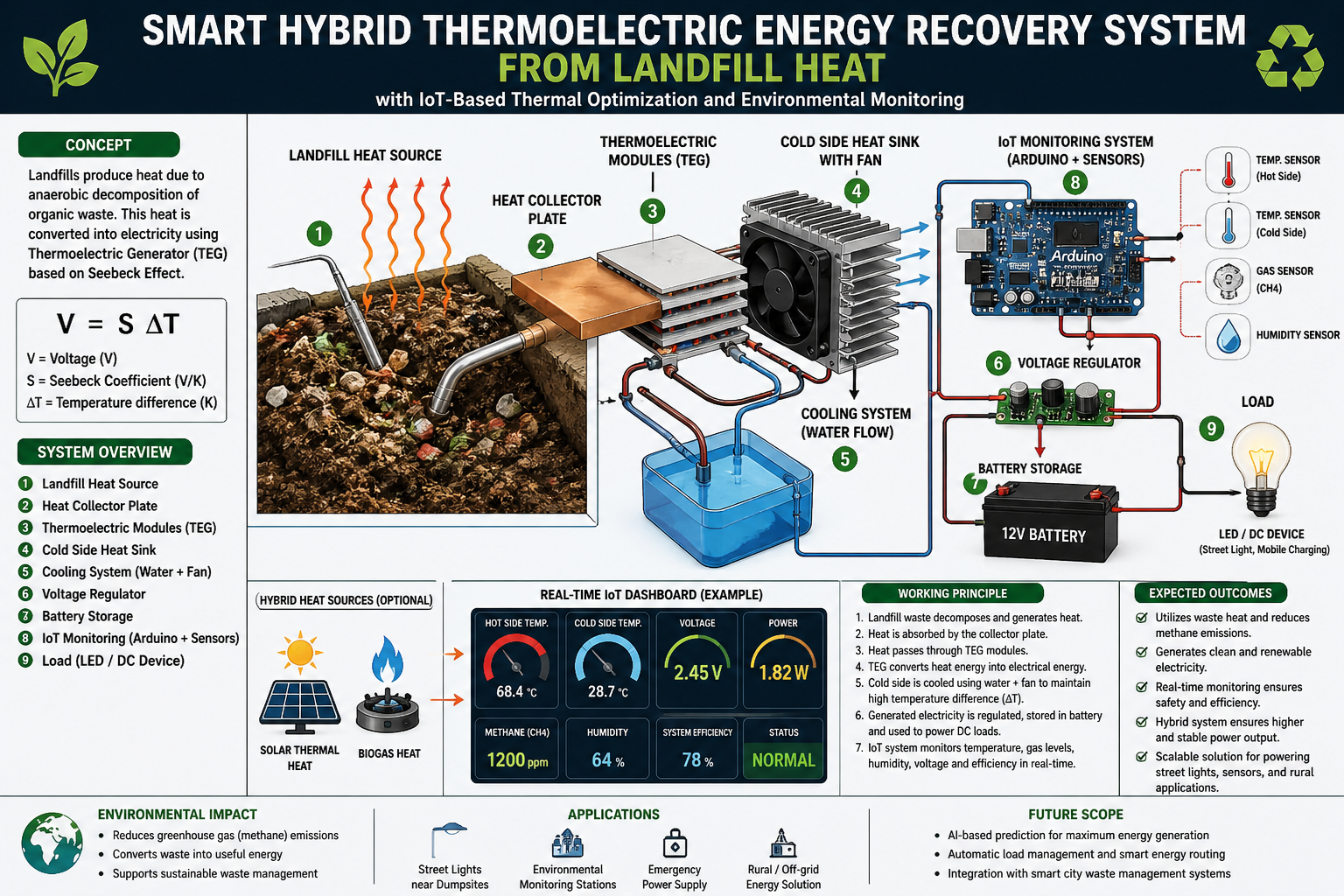
ABSTRACT
The purpose of this project was to design and develop a thermoelectric generator system capable of converting landfill heat into usable electrical energy. The study aimed to demonstrate that heat produced from decomposing waste materials in landfill environments can be harvested and converted into electricity using thermoelectric modules based on the Seebeck Effect, while promoting sustainable energy use and environmental conservation.
The technical performance of the thermoelectric system was evaluated through direct observation and repeated functional testing of voltage generation, temperature gradient efficiency, heat transfer performance, and electrical output stability. The system was tested under varying temperature conditions to determine its efficiency and reliability. A five-point performance rating scale was adopted to assess system performance.
After constructing the prototype, data collection was carried out using experimental measurements and a small community awareness survey to evaluate perceptions on waste-to-energy technologies. Respondents were asked to comment on environmental benefits, practicality, and potential application in local landfill sites.
Observations and results indicated that the system successfully generated electrical energy proportional to the temperature difference between the hot and cold junctions. Increased temperature gradients resulted in higher voltage output. Most respondents acknowledged the environmental benefits and supported the adoption of such systems for renewable energy generation. The study concluded that landfill heat is a viable and underutilized source of renewable energy.
CHAPTER ONE: INTRODUCTION
1.1 BACKGROUND INFORMATION
Rapid urbanization and population growth have significantly increased solid waste generation globally and in Kenya. Landfills, which serve as primary waste disposal sites, are characterized by continuous microbial decomposition of organic waste. This process generates heat, methane gas, and other by-products. Studies show that landfill temperatures can reach between 40°C and 70°C due to biological activity and heat retention within waste layers.
Despite the availability of this thermal energy, most landfill heat remains unutilized and contributes to environmental challenges such as greenhouse gas emissions. Meanwhile, the demand for sustainable and renewable energy sources continues to rise.
Thermoelectric technology offers a promising solution for converting waste heat into electricity. Thermoelectric generators operate based on the Seebeck Effect, where a temperature difference between two junctions produces an electrical voltage. This technology has been widely used in industrial waste heat recovery, automotive systems, and space applications.
This project explores the application of thermoelectric generators in landfill environments, positioning waste heat as a valuable renewable energy resource rather than an environmental burden.
FOCUS QUESTIONS
- Can landfill heat be effectively converted into electrical energy using thermoelectric generators?
- How does temperature difference affect voltage output in a thermoelectric system?
- Can thermoelectric systems provide a sustainable solution for waste-to-energy conversion?
1.1 STATEMENT OF THE PROBLEM
Large amounts of heat generated in landfill sites are released into the environment without being utilized. This represents a significant loss of potential energy and contributes to environmental degradation. Despite advancements in renewable energy technologies, low-grade heat recovery remains underdeveloped, especially in developing countries.
There is limited application of thermoelectric systems in converting landfill heat into electricity. This project addresses the gap by developing a low-cost thermoelectric generator capable of harnessing landfill heat for practical energy use.
1.2 STATEMENT OF ORIGINALITY
This project was inspired by observations of waste accumulation in local dumping sites, where heat could be felt emanating from decomposing materials. At the same time, many rural and peri-urban areas face challenges in accessing reliable electricity.
This inspired the idea of converting landfill heat into electrical energy using thermoelectric modules. The project combines environmental management with energy innovation, offering a sustainable and cost-effective solution to two major challenges: waste management and energy access.
1.4 OBJECTIVES OF THE PROJECT
- To design and construct a thermoelectric generator system using landfill heat as the energy source
- To evaluate the relationship between temperature difference and electrical output
- To assess the efficiency and reliability of the thermoelectric system
- To promote sustainable waste-to-energy technologies
1.5 JUSTIFICATION AND SIGNIFICANCE OF THE STUDY
This project is justified by the increasing need for sustainable energy solutions and efficient waste management systems. By converting landfill heat into electricity, the study demonstrates a practical approach to energy recovery from waste.
The project contributes to environmental conservation by reducing heat loss and promoting renewable energy use. It also supports innovation in science and engineering education while providing a potential solution for off-grid energy generation.
1.6 LIMITATIONS
Low Efficiency: Thermoelectric modules have relatively low energy conversion efficiency
Cooling Requirement: Effective cooling is required to maintain temperature difference
Material Constraints: Availability of high-performance thermoelectric materials may be limited
1.7 ASSUMPTIONS AND PRECAUTIONS
It was assumed that sufficient temperature gradients would be achieved during testing. Precautions included proper insulation, safe handling of heated components, and ensuring stable electrical connections.
CHAPTER TWO: LITERATURE REVIEW
2.1 PAST WORK PRESENTED ON THE SAME
Thermoelectric energy conversion has been widely studied as a method of recovering waste heat. Applications include industrial processes, automotive exhaust systems, and space exploration.
Recent studies indicate that waste heat recovery systems can significantly improve energy efficiency. However, most applications focus on high-temperature industrial systems, leaving low-temperature sources such as landfills largely unexplored.
2.2 RELEVANT RESEARCH AND REMAINING GAPS
While thermoelectric technology is well established, its application in landfill environments remains limited. Most research focuses on high-efficiency materials rather than practical implementation in real-world waste systems.
There is also limited research on community awareness and acceptance of waste-to-energy technologies.
2.3 SCIENTIFIC CONCEPTS
The project is based on the Seebeck Effect, where voltage is generated due to temperature difference:
V=SΔT
Where:
V = Voltage generated
S = Seebeck coefficient
ΔT = Temperature difference
2.4 IMPORTANCE OF THE STUDY
Environmental Conservation: Reduces waste heat loss
Renewable Energy: Provides alternative energy source
Innovation: Encourages scientific and engineering creativity
CHAPTER THREE: METHODOLOGY
3.1 APPARATUS / MATERIALS
| S/N | Item | Quantity | Description |
|---|---|---|---|
| i | Thermoelectric modules | 6 | Energy conversion units |
| ii | Heat sink | 3 | Cooling system |
| iii | Copper plates | 3 | Heat conduction |
| iv | Temperature sensors | 2 | Measure temperature |
| v | Multimeter | 1 | Measure voltage/current |
| vi | Battery | 1 | Energy storage |
| vii | Wires | Several | Electrical connections |
| viii | Insulation material | – | Reduce heat loss |
3.2 SYSTEM CONSTRUCTION PROCEDURE
- A heat source simulating landfill conditions was prepared using decomposing organic materials
- Thermoelectric modules were placed between the heat source and cooling system
- The hot side was exposed to heat while the cold side was attached to a heat sink
- Electrical connections were made to measure voltage output
- Data was recorded under varying temperature conditions
3.3 DATA COLLECTION
Measurements included:
- Temperature difference
- Voltage output
- Current generated
3.4 VARIABLES
Independent Variables
- Temperature difference
- Number of thermoelectric modules
Dependent Variables
- Voltage output
- Power generated
CHAPTER FOUR: DATA ANALYSIS AND INTERPRETATION
Results showed that:
- Voltage increased with temperature difference
- Multiple modules increased total power output
- Cooling efficiency improved system performance
CHAPTER FIVE: CONCLUSION AND RECOMMENDATIONS
5.1 CONCLUSION
The project successfully demonstrated that landfill heat can be converted into electrical energy using thermoelectric generators. The system proved that temperature difference directly influences voltage output, confirming the effectiveness of thermoelectric conversion.
APPLICATION IN REAL-LIFE SITUATIONS
- Powering landfill monitoring systems
- Rural electrification
- Smart waste management systems
5.2 FUTURE RECOMMENDATIONS
- Improve cooling systems for higher efficiency
- Use advanced thermoelectric materials
- Integrate with solar or methane energy systems
- Scale for real landfill applications