mbeva
mbeva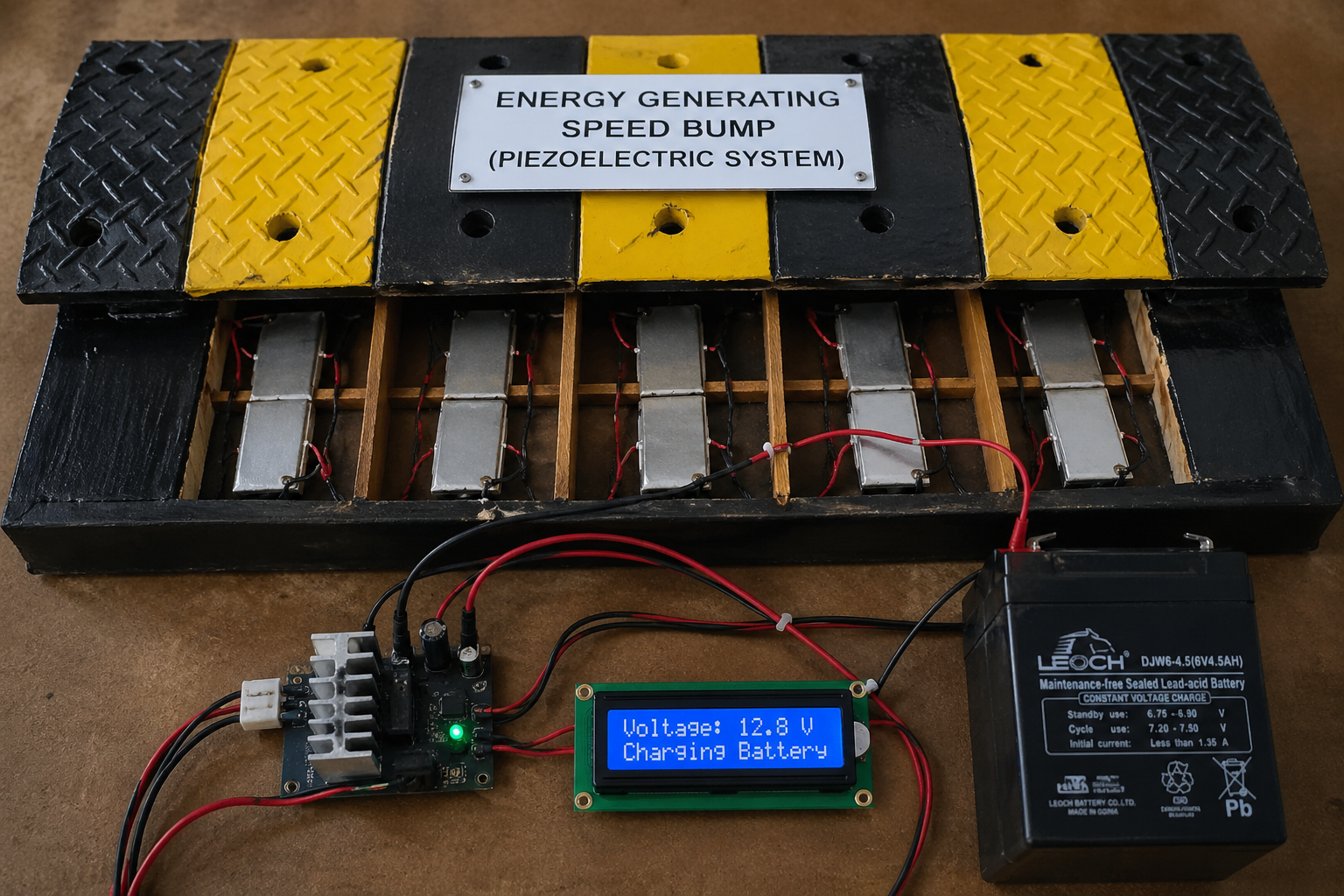
ABSTRACT
The purpose of this project was to design, construct, and evaluate an energy-generating speed bump using a piezoelectric system that converts mechanical pressure from moving vehicles into electrical energy. The study aimed to demonstrate that mechanical energy from road traffic, which is normally wasted, can be harvested and utilized as a renewable energy source for low-power applications such as street lighting and road signage.
The prototype incorporated piezoelectric sensors embedded within a reinforced speed bump structure. When vehicles passed over the bump, mechanical stress generated electrical charges through the piezoelectric effect. The generated energy was rectified and stored in rechargeable batteries. The system was evaluated through repeated loading tests to determine voltage output, efficiency, and durability.
A community survey involving 30 respondents was conducted to assess perceptions of safety, practicality, and environmental benefits. Results showed that the system successfully generated electrical energy proportional to applied pressure. The system demonstrated consistent performance, and most respondents supported the innovation due to its sustainability and potential for energy conservation.
The study concludes that piezoelectric energy harvesting from road infrastructure is feasible and offers a promising approach to renewable energy generation and smart urban development.
CHAPTER ONE: INTRODUCTION
1.1 BACKGROUND INFORMATION
Global energy demand continues to rise due to population growth, industrialization, and urbanization. In Kenya, increasing vehicle usage and infrastructure expansion have intensified the need for sustainable energy solutions (International Energy Agency, 2023). Traditional energy sources such as fossil fuels are associated with environmental pollution and are non-renewable. This has led to increased research into alternative energy sources such as solar, wind, and geothermal energy. However, energy harvesting from everyday activities, such as road traffic, remains underutilized (Priya & Inman, 2009).
Piezoelectric materials generate electrical energy when subjected to mechanical stress. This property enables them to convert pressure, vibrations, and mechanical movement into usable electrical energy (Uddin et al., 2018). Roads, particularly speed bumps, experience continuous pressure from vehicles, making them ideal for energy harvesting applications. Speed bumps are widely used for traffic control and safety, and integrating piezoelectric systems allows them to serve a dual purpose without additional infrastructure.
FOCUS QUESTIONS
How can mechanical pressure from vehicles be converted into electrical energy using piezoelectric materials?
Can a speed bump generate electricity without compromising safety?
What is the efficiency of a piezoelectric energy harvesting system?
How do users perceive the system in terms of practicality and safety?
STATEMENT OF THE PROBLEM
Mechanical energy generated by vehicles on roads is largely wasted in the form of pressure and vibrations. Speed bumps, which are subjected to repeated mechanical stress, do not utilize this energy. Despite advancements in renewable energy, there is limited application of piezoelectric systems in road infrastructure, especially in developing countries, representing a missed opportunity for sustainable energy generation (Gupta et al., 2016).
STATEMENT OF ORIGINALITY
This project was inspired by observing vehicles passing over speed bumps without any energy utilization. The originality lies in integrating piezoelectric technology into speed bumps to convert mechanical energy into electrical energy, offering a sustainable and innovative solution to energy challenges.
OBJECTIVES OF THE PROJECT
General Objective
To design and develop a piezoelectric energy-generating speed bump.
Specific Objectives
To construct a functional prototype
To measure electrical energy output under varying loads
To evaluate system efficiency and durability
To assess community perception
JUSTIFICATION AND SIGNIFICANCE
This project promotes renewable energy by utilizing wasted mechanical energy. It contributes to sustainable development and smart infrastructure while reducing reliance on fossil fuels (International Energy Agency, 2023).
LIMITATIONS
The prototype generates low power suitable for small-scale applications
Piezoelectric materials may degrade over time
Environmental conditions may affect performance
ASSUMPTIONS AND PRECAUTIONS
It was assumed that sufficient pressure would be applied to generate measurable output. Electrical insulation and structural safety were ensured during construction.
CHAPTER TWO: LITERATURE REVIEW
2.1 PAST WORK PRESENTED
Piezoelectric energy harvesting has been widely studied for applications such as flooring systems, wearable devices, and vibration-based generators. According to Priya and Inman (2009), piezoelectric materials are effective in converting mechanical energy into electrical energy in various environments. In Japan, piezoelectric flooring systems have been implemented in transport stations to generate electricity from human movement (Uddin et al., 2018). Research by Gupta et al. (2016) also demonstrated that road traffic pressure can be used to generate electrical energy using piezoelectric sensors.
2.2 RESEARCH GAPS
There is limited implementation of piezoelectric systems in road infrastructure
High costs limit large-scale adoption
Few studies evaluate community acceptance
2.3 SCIENTIFIC CONCEPTS
Piezoelectric Effect
The generation of electrical charge when mechanical stress is applied to certain materials (Priya & Inman, 2009)
Energy Conversion
Transformation of mechanical energy into electrical energy
Electrical Storage Systems
Use of rectifiers and batteries to store generated energy
2.4 IMPORTANCE OF THE STUDY
Promotes renewable energy innovation
Reduces energy wastage
Supports smart infrastructure development
Encourages sustainable practices
CHAPTER THREE: METHODOLOGY
3.1 MATERIALS
Piezoelectric sensors
Speed bump structure
Rectifier circuit
Rechargeable battery
Connecting wires
Multimeter
3.2 PROCEDURE
A speed bump structure was constructed and fitted with piezoelectric sensors. The sensors were connected to a rectifier circuit and rechargeable battery. Pressure was applied to simulate vehicle movement, and electrical output was measured using a multimeter. Observations were recorded for analysis.
3.3 TECHNICAL PERFORMANCE EVALUATION
| Parameter | Score | Performance Level |
|---|---|---|
| Energy Output Consistency | 4 | Very Satisfactory |
| Sensor Responsiveness | 5 | Excellent |
| Structural Stability | 4 | Very Satisfactory |
| Energy Storage Efficiency | 4 | Very Satisfactory |
3.4 COMMUNITY SURVEY RESULTS
| Parameter | Agree | Neutral | Disagree |
|---|---|---|---|
| Energy Efficiency | 24 | 4 | 2 |
| Safety | 22 | 5 | 3 |
| Environmental Impact | 26 | 3 | 1 |
| Practical Use | 23 | 5 | 2 |
CHAPTER FOUR: DATA ANALYSIS
Results showed that increased pressure produced higher voltage output, confirming the effectiveness of piezoelectric materials. The system demonstrated consistent performance under repeated testing. Community responses indicated strong support, especially in environmental sustainability and innovation, suggesting high potential for adoption.
CHAPTER FIVE: CONCLUSION AND RECOMMENDATIONS
5.1 CONCLUSION
The project successfully demonstrated that mechanical energy from vehicles can be converted into electrical energy using piezoelectric materials. The system is sustainable, efficient, and practical for small-scale applications.
APPLICATION IN REAL LIFE
Street lighting
Traffic signals
Smart road systems
RECOMMENDATIONS
Improve durability for real-road conditions
Increase number of sensors for higher output
Conduct large-scale testing
Integrate with other renewable energy systems
REFERENCES
International Energy Agency. (2023). World energy outlook 2023.
Gupta, R., Sharma, A., & Gupta, P. (2016). Energy harvesting using piezoelectric materials from road traffic. International Journal of Engineering Research.
Priya, S., & Inman, D. J. (2009). Energy harvesting technologies. Springer.
Uddin, M. J., Rahman, M. M., & Islam, M. R. (2018). Piezoelectric energy harvesting from road vehicles. Energy Reports