mbeva
mbeva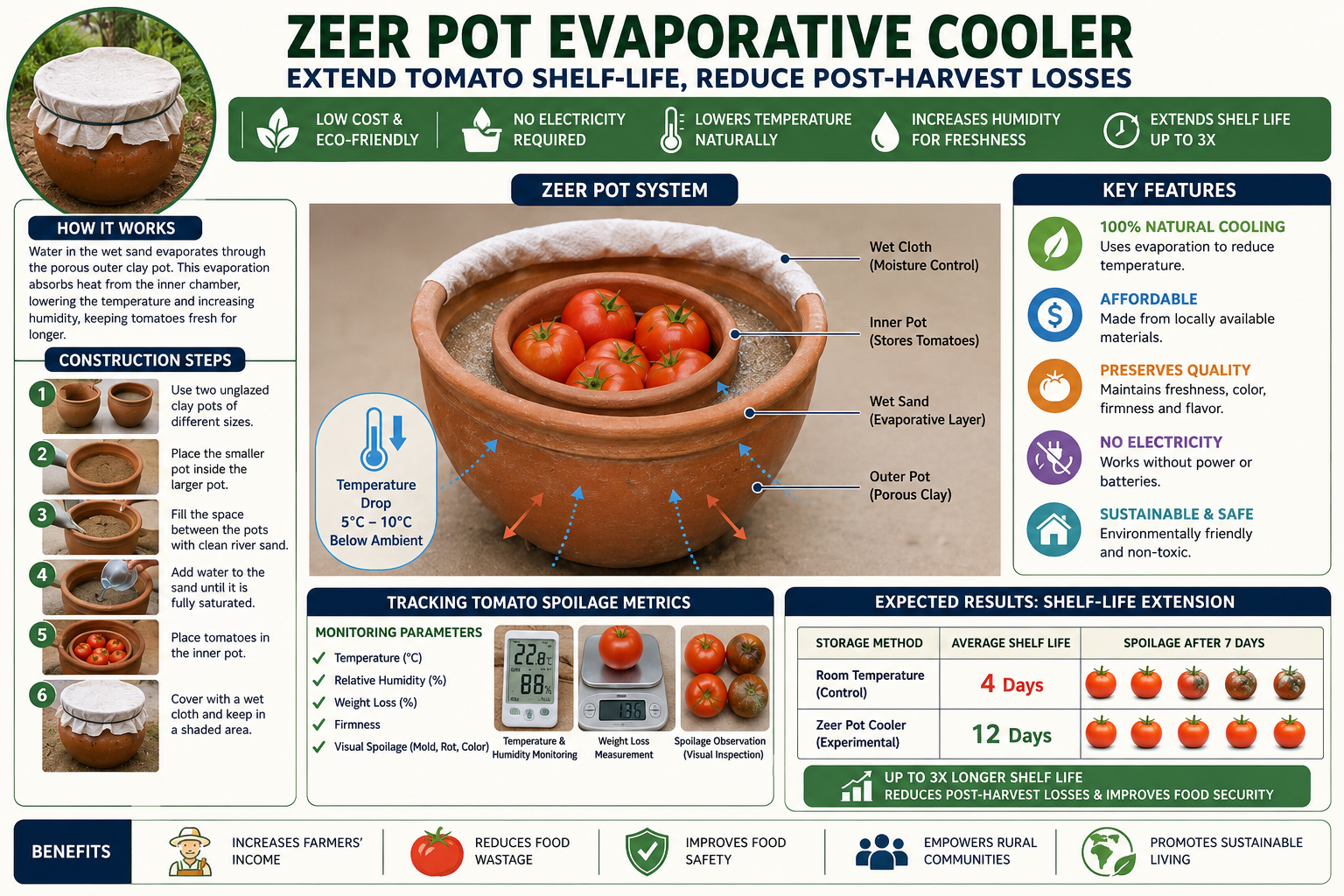
Abstract
The SmartZeer project investigates the effectiveness of a low-cost evaporative cooling system in extending the shelf life of tomatoes and leafy vegetables without electricity. The system consists of two clay pots separated by a layer of wet river sand. Water evaporation from the sand absorbs heat from the inner chamber, lowering the storage temperature and increasing relative humidity.
The study compares the spoilage rate, weight loss, temperature, and humidity of tomatoes stored inside the Zeer pot against those stored under normal room conditions. Results are expected to demonstrate a threefold increase in shelf life while reducing post-harvest losses for small-scale farmers and households.
Introduction
Post-harvest losses remain a major challenge in many developing regions due to limited access to refrigeration. Fresh produce such as tomatoes and leafy greens deteriorates rapidly under high temperatures, leading to economic losses and food insecurity.
Evaporative cooling is an affordable and environmentally friendly preservation technique that requires no electricity. The Zeer pot, also known as a pot-in-pot refrigerator, uses the natural process of water evaporation to lower internal temperatures and maintain high humidity levels.
This project aims to construct a low-cost Zeer pot using locally available materials and scientifically evaluate its ability to preserve tomatoes.


4
Statement of the Problem
Tomatoes and leafy vegetables spoil quickly after harvest due to high ambient temperatures and low humidity. Conventional refrigeration systems are often unavailable or unaffordable in rural communities because they require electricity and have high installation costs.
There is a need for an affordable, sustainable, and electricity-free cooling technology that can extend the shelf life of perishable produce.
Objectives
General Objective
To construct a low-cost Zeer pot evaporative cooler and evaluate its effectiveness in extending the shelf life of tomatoes.
Specific Objectives
- To design and construct a pot-in-pot evaporative cooling system.
- To measure the temperature and humidity inside the Zeer pot.
- To compare spoilage rates between cooled and uncooled tomatoes.
- To determine the percentage increase in shelf life.
- To assess the cost-effectiveness of the Zeer pot system.
Materials and Equipment
| Item | Quantity |
|---|---|
| Large unglazed clay pot | 1 |
| Small unglazed clay pot | 1 |
| Clean river sand | 5–10 kg |
| Water | As required |
| Cotton cloth or wet sack | 1 |
| Fresh tomatoes | 20–30 |
| Digital thermometer | 2 |
| Digital hygrometer | 1 |
| Weighing scale | 1 |
| Measuring tape | 1 |
| Data recording sheet | 1 |
Construction of the Zeer Pot
- Select two unglazed clay pots of different sizes.
- Place the smaller pot inside the larger pot.
- Fill the space between the pots with clean river sand.
- Add water to the sand until it is fully saturated.
- Place tomatoes inside the inner pot.
- Cover the top with a damp cotton cloth.
- Position the Zeer pot in a shaded, well-ventilated area.
- Rewet the sand daily to maintain cooling efficiency.


4
Construction Diagram
           Wet Cotton Cloth
        ┌───────────────────┐
        │     Tomatoes      │
        │   Inner Clay Pot  │
        └───────────────────┘
       ╔═════════════════════╗
       ║     Wet River Sand  ║
       ╚═════════════════════╝
      ┌───────────────────────┐
      │   Outer Clay Pot      │
      └───────────────────────┘
Principle of Operation
The Zeer pot works through evaporative cooling.
Water contained in the wet sand evaporates through the porous outer clay pot. As the water evaporates, it absorbs heat from the inner chamber, reducing the temperature and increasing relative humidity.
Lower temperatures and higher humidity slow down:
- Moisture loss
- Microbial growth
- Ripening rate
- Enzymatic activity


4
Methodology
Experimental Setup
Create two storage groups:
- Control Group: Tomatoes stored at room temperature.
- Experimental Group: Tomatoes stored inside the Zeer pot.
Use tomatoes of similar:
- Size
- Weight
- Ripeness
- Variety
Store both groups under the same environmental conditions.
Procedure
- Label tomatoes in each group.
- Record the initial weight of each tomato.
- Measure and record ambient temperature and humidity.
- Measure and record the Zeer pot temperature and humidity.
- Inspect tomatoes daily for spoilage indicators.
- Record changes in:
- Weight loss
- Firmness
- Color
- Mold growth
- Odor
- Continue observations until all tomatoes become unsuitable for consumption.
Data Collection
Record measurements twice daily.
Temperature and Humidity Table
| Day | Ambient Temperature (°C) | Zeer Pot Temperature (°C) | Ambient Humidity (%) | Zeer Pot Humidity (%) |
|---|---|---|---|---|
| 1 | ||||
| 2 | ||||
| 3 |
Tomato Spoilage Table
| Day | Control Group Spoiled (%) | Zeer Pot Spoiled (%) | Average Weight Loss (%) |
|---|---|---|---|
| 1 | |||
| 2 | |||
| 3 |
Expected Results
The Zeer pot is expected to:
- Reduce internal temperature by 5–10°C.
- Increase relative humidity to above 85%.
- Reduce tomato weight loss.
- Delay spoilage by at least three times compared to room storage.
Example:
| Storage Method | Average Shelf Life |
|---|---|
| Room Temperature | 4 days |
| Zeer Pot | 12 days |
Results and Discussion
Compare:
- Average temperature difference
- Relative humidity levels
- Percentage spoilage
- Weight loss
- Shelf-life duration
Discuss how evaporative cooling influenced food preservation.


4
Cost Analysis
| Material | Estimated Cost (KES) |
|---|---|
| Clay pots | |
| River sand | |
| Thermometer | |
| Hygrometer | |
| Cotton cloth | |
| Tomatoes | |
| Total Cost |
Compare the total cost with conventional refrigeration systems.
Conclusion
The Zeer pot evaporative cooler provides a simple, affordable, and sustainable solution for reducing post-harvest losses. By lowering temperature and maintaining high humidity, the system significantly extends the shelf life of tomatoes without requiring electricity.
The technology can improve food security and increase farmers’ incomes in off-grid communities.
Recommendations
Future improvements may include:
- Integrating digital temperature and humidity sensors
- Using solar-powered data logging systems
- Testing additional crops such as spinach, kale, and fruits
- Developing larger community-scale Zeer storage units
- Incorporating mobile monitoring applications


4